




18 Couple Room Decor Ideas for a Bedroom You Both Actually Love
Two people sharing one bedroom means two sets of preferences, two morning routines, and one limited amount of wall space.
Couple room decor ideas work best when they solve real friction first, things like tangled phone chargers and one person waking the other with a bright lamp, and look good second.
Most bedrooms in ordinary US, UK and Canadian homes run between 120 and 180 square feet, which is enough to do this well without a renovation.
The ideas below cover furniture placement, storage, lighting and color choices that two people can genuinely agree on.
A few cost almost nothing; others take an afternoon to install and stay useful for years.
1- Upholstered Headboard Wall
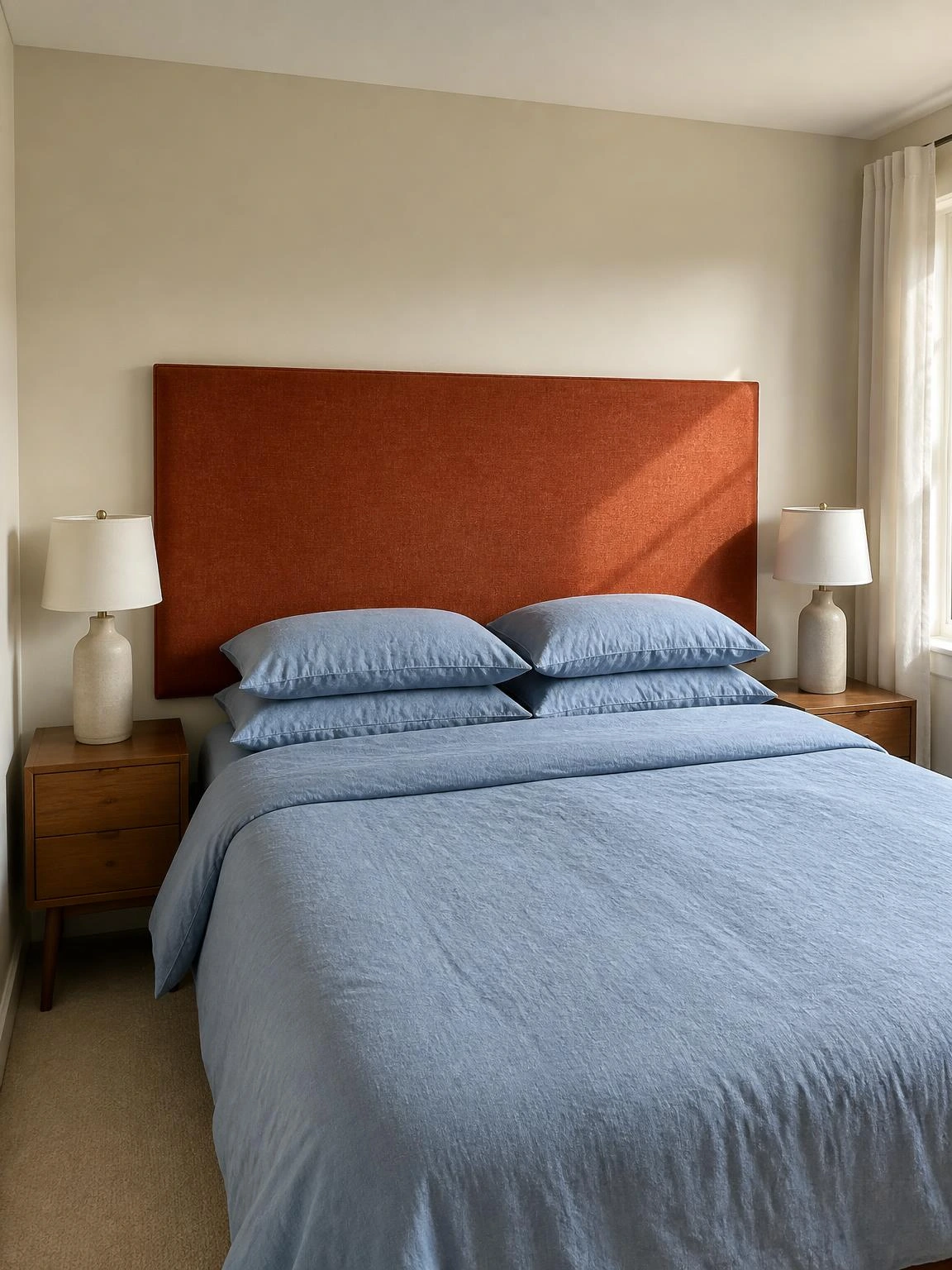
A large upholstered panel behind a queen bed does more visual work than almost any other single piece of furniture in a couple’s room.
Rust-toned upholstery against warm white walls reads warm and grounded without feeling gender-specific, which makes it an easier shared choice.
Mount the panel to wall studs, centering it on the bed, with the top sitting roughly 20 to 24 inches above the mattress surface so both partners get comfortable back support when reading in bed.
Soft blue linen bedding pairs well with rust upholstery because the colors sit across from each other on the color wheel without competing for attention.
Foam upholstered panels collect dust faster than a painted wall, so a quick pass with a vacuum brush attachment once a month keeps the texture looking fresh.
It is one of those changes that makes a plain rental bedroom feel deliberately designed rather than assembled from whatever was available.
2- Dual Nightstand Setup
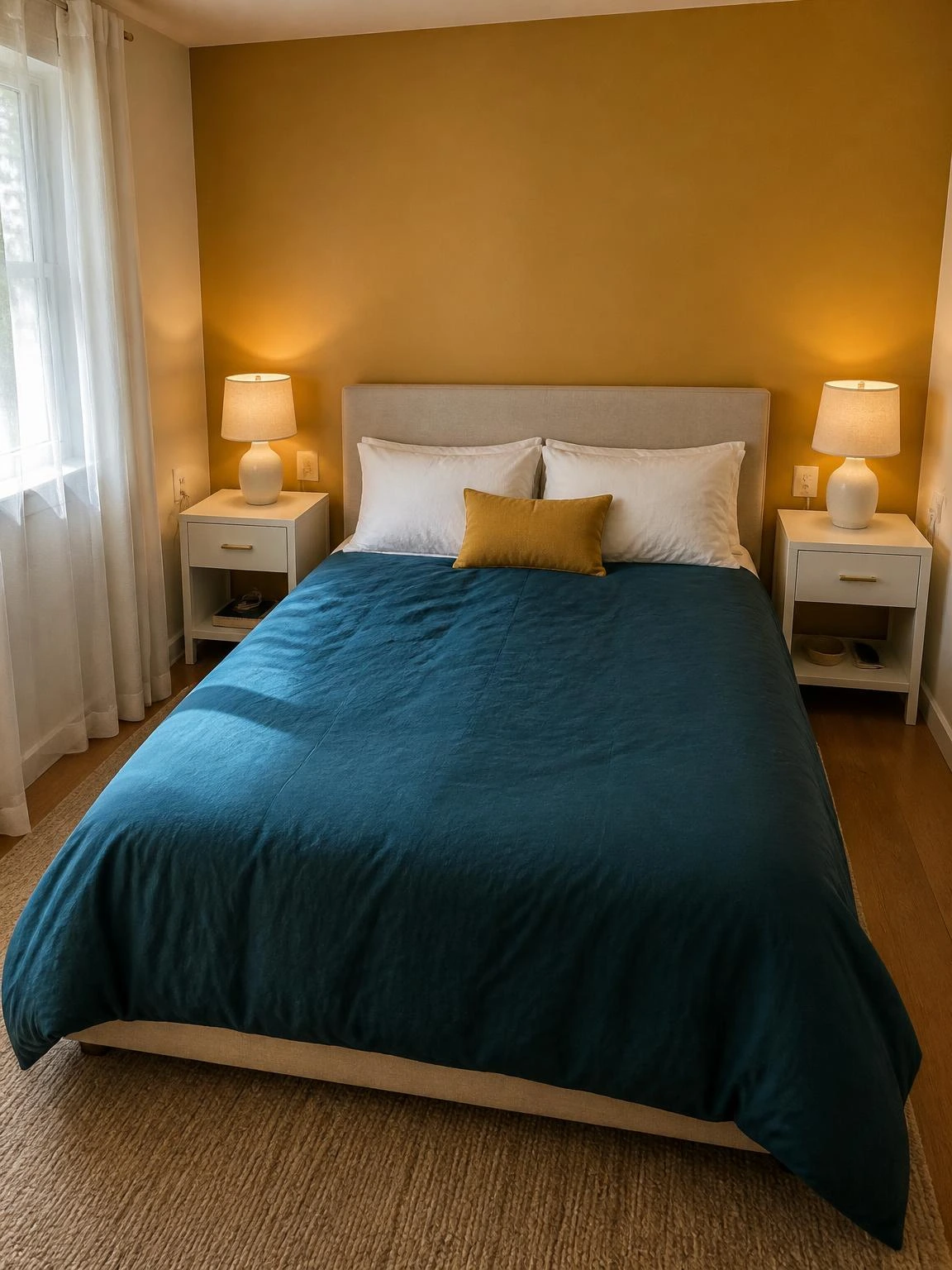
Matching nightstands on each side of the bed signal equal ownership of the room in a way that one mismatched pair never quite does.
Warm white painted MDF units with brass drawer pulls are a practical starting point because they work with most wall colors and are easy to find at most price points.
Each unit should have at least one drawer and a lower shelf so a phone, charger and current book all have a home off the surface.
A ceramic lamp base in the same finish on both sides keeps the symmetry without requiring identical shades.
Before placing furniture, check that outlets are symmetrically positioned on both sides of the bed; asymmetric outlets mean visible cord runs on one side unless routing is planned early.
A deep teal duvet pulls the whole setup together when the nightstands and lamps are kept neutral.
3- His-and-Hers Closet Zones
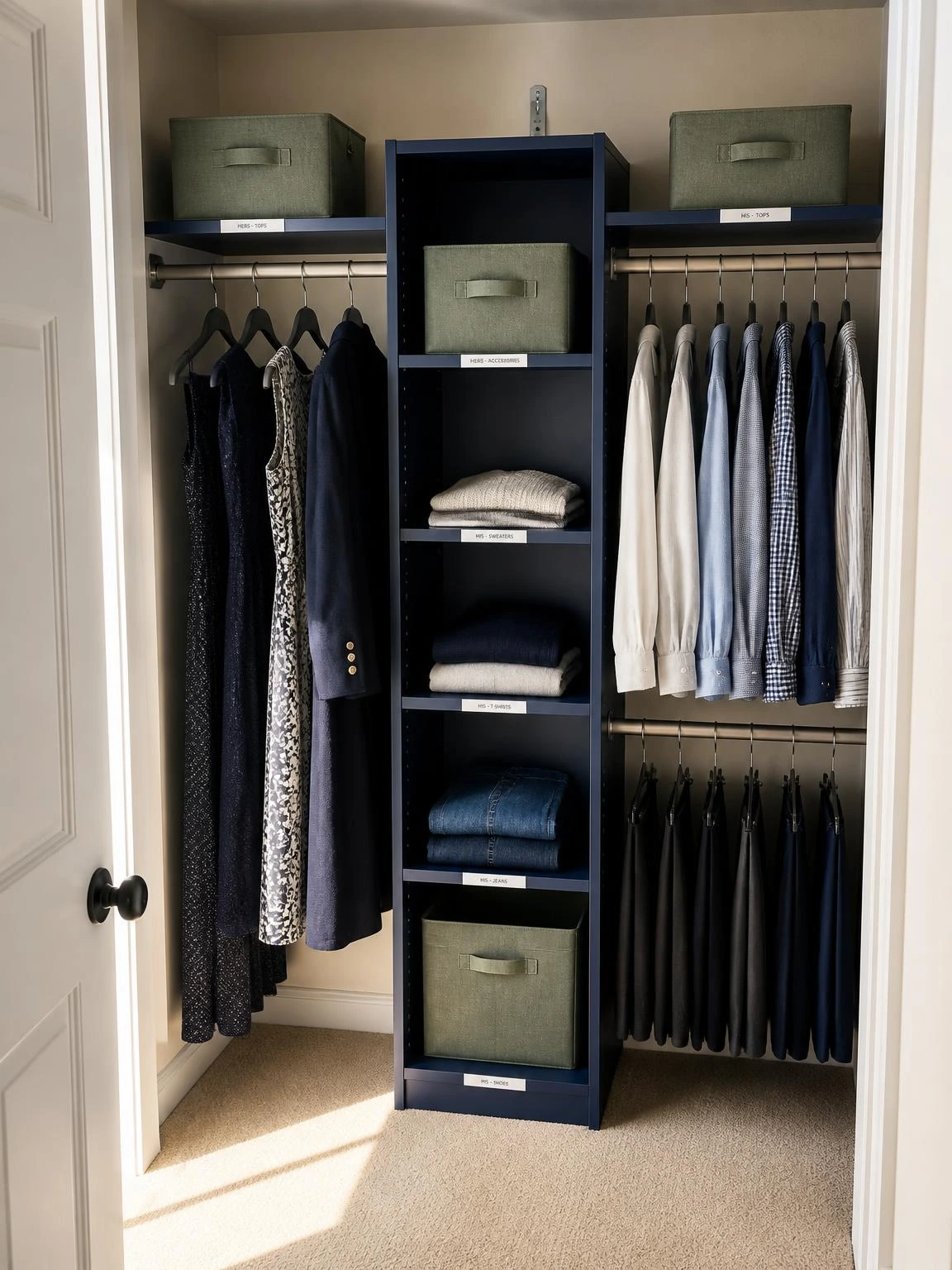
A reach-in closet shared by two people turns chaotic quickly without a defined system, and a modular laminate unit provides that system without permanent construction.
A center divider created by a freestanding modular unit gives each partner a distinct side, one with longer hanging space for dresses and jackets, the other with double-hang rods and folded shelves for shirts and trousers.
Muted green fabric bins on the upper shelves are useful for seasonal accessories and look tidier than open stacks of folded items.
Simple adhesive labels on each shelf section prevent the division from drifting over time, which it will without them.
Any modular unit deeper than about 18 inches needs a wall anchor strap at the top panel to prevent tipping when the shelves are loaded, especially in closets where the floor is uneven.
Ivory walls inside the closet keep the space feeling bright even when the door is only half open.
4- Shared Bedroom Accent Wall
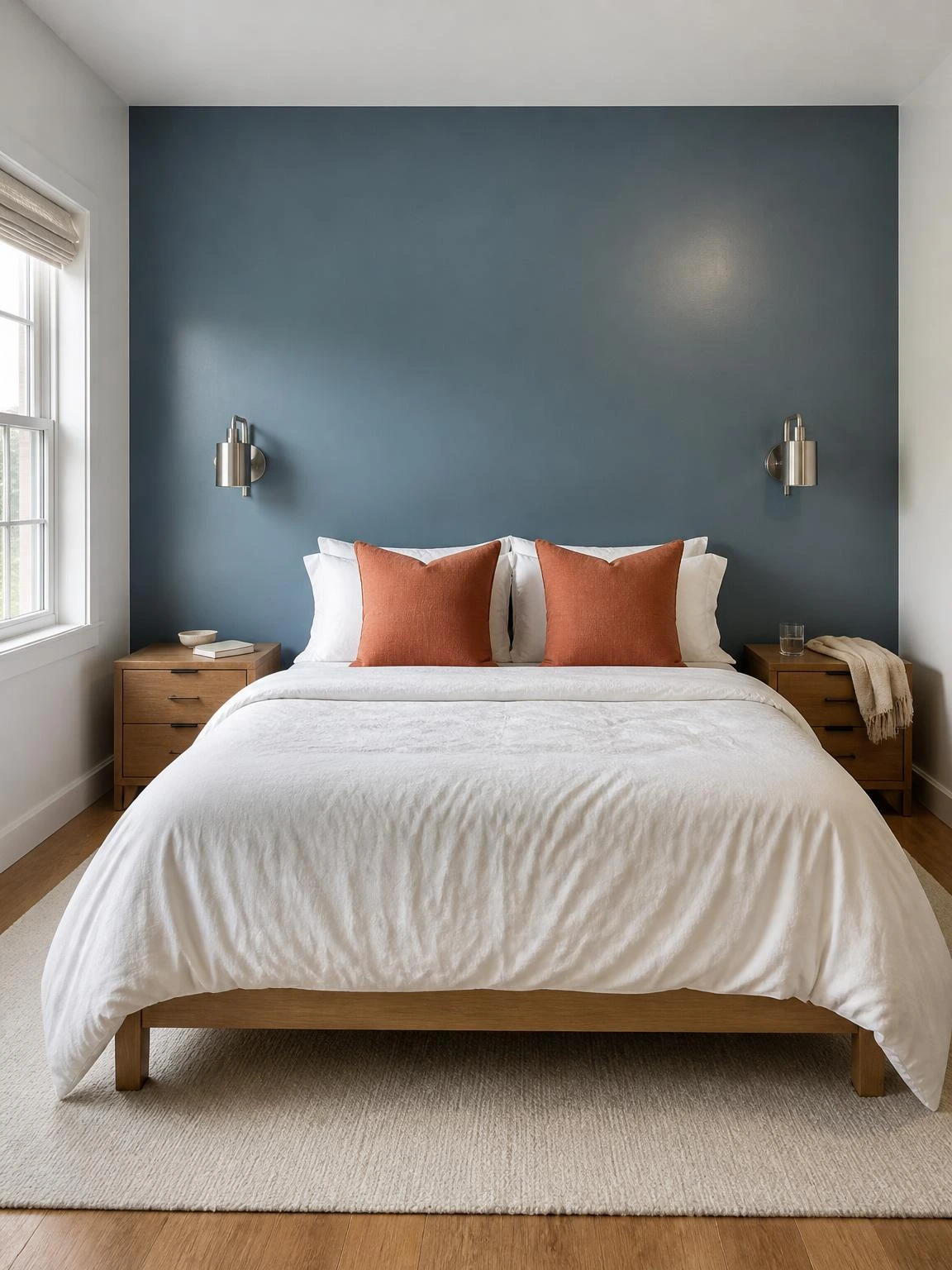
A single dusty blue wall behind the bed is one of the most agreed-upon couple room decor choices because it reads as neither too feminine nor too masculine.
Keeping the remaining three walls warm white stops the blue from making the room feel smaller than it is.
Terracotta euro shams on white bedding connect the warm tones in the room to the cooler accent wall without feeling forced.
Use a satin finish rather than matte on the accent wall so the occasional scuff from a headboard or moving a lamp wipes off cleanly.
Dusty blue looks noticeably different under a warm incandescent bulb at night than it does in morning daylight, so test a large painted swatch across at least two days before committing to the full wall.
Wall-mount reading sconces above each nightstand keep the bed wall functional as well as decorative.
5- Under-Bed Storage Drawers
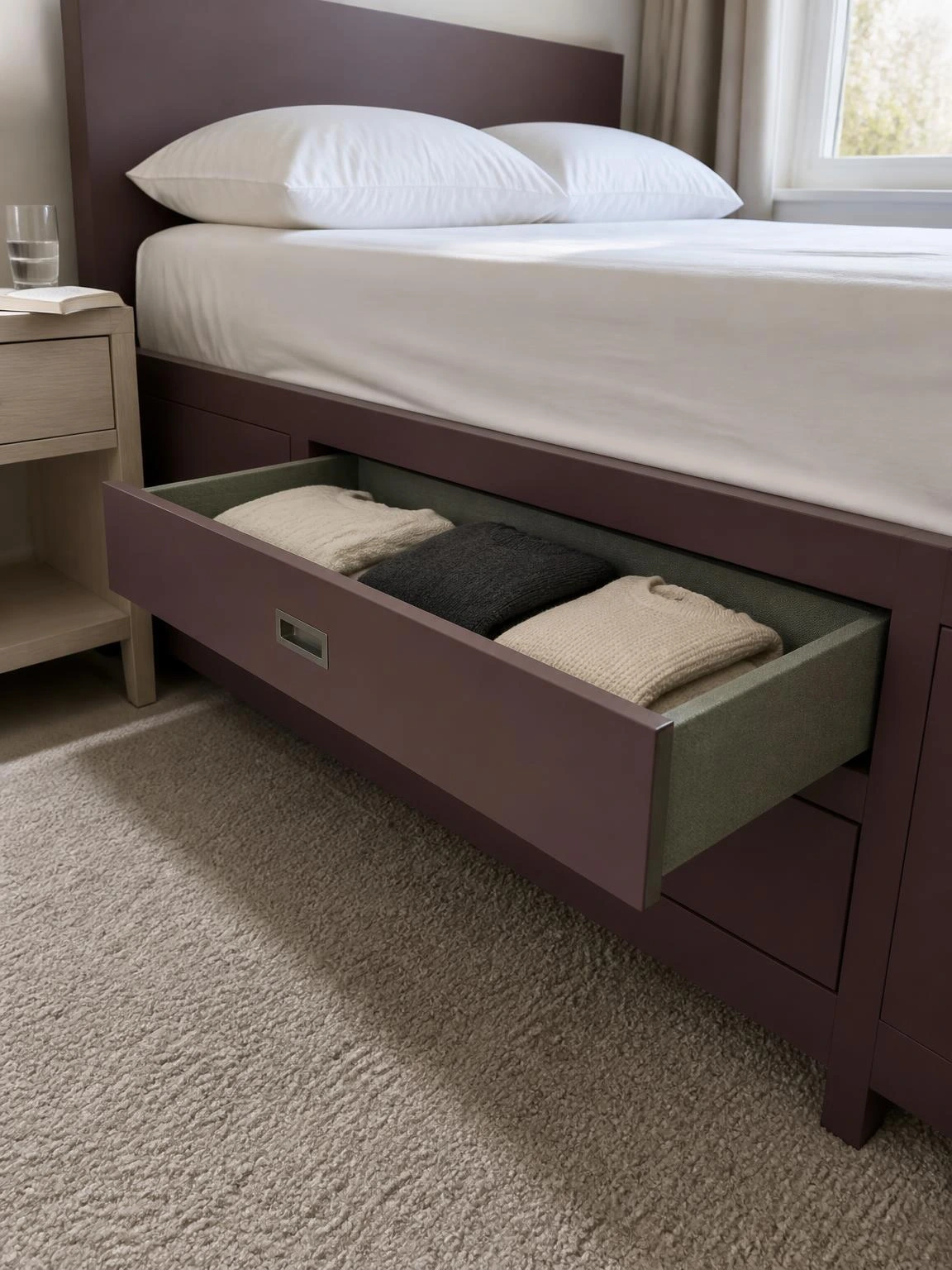
A platform bed with built-in drawers on each side solves the perennial problem of where off-season clothing actually goes in a shared bedroom with limited closet space.
Assigning one side’s drawers to each partner prevents the low-grade negotiation that happens when storage is communal and undefined.
Soft green cotton drawer liners protect folded sweaters and keep the inside of the drawers from smelling stale over a long winter season.
Recessed metal pulls on a muted plum-toned frame keep the hardware from catching on bedding when the drawers are closed.
Measure the clearance between your floor and the bottom of an existing bed frame before purchasing; under-bed drawers need at least 7 inches of height to open and close without scraping.
Stone-colored carpet at the bedside makes the drawer pull surface easy to grip when kneeling to access stored items.
6- Reading Nook Corner Chair
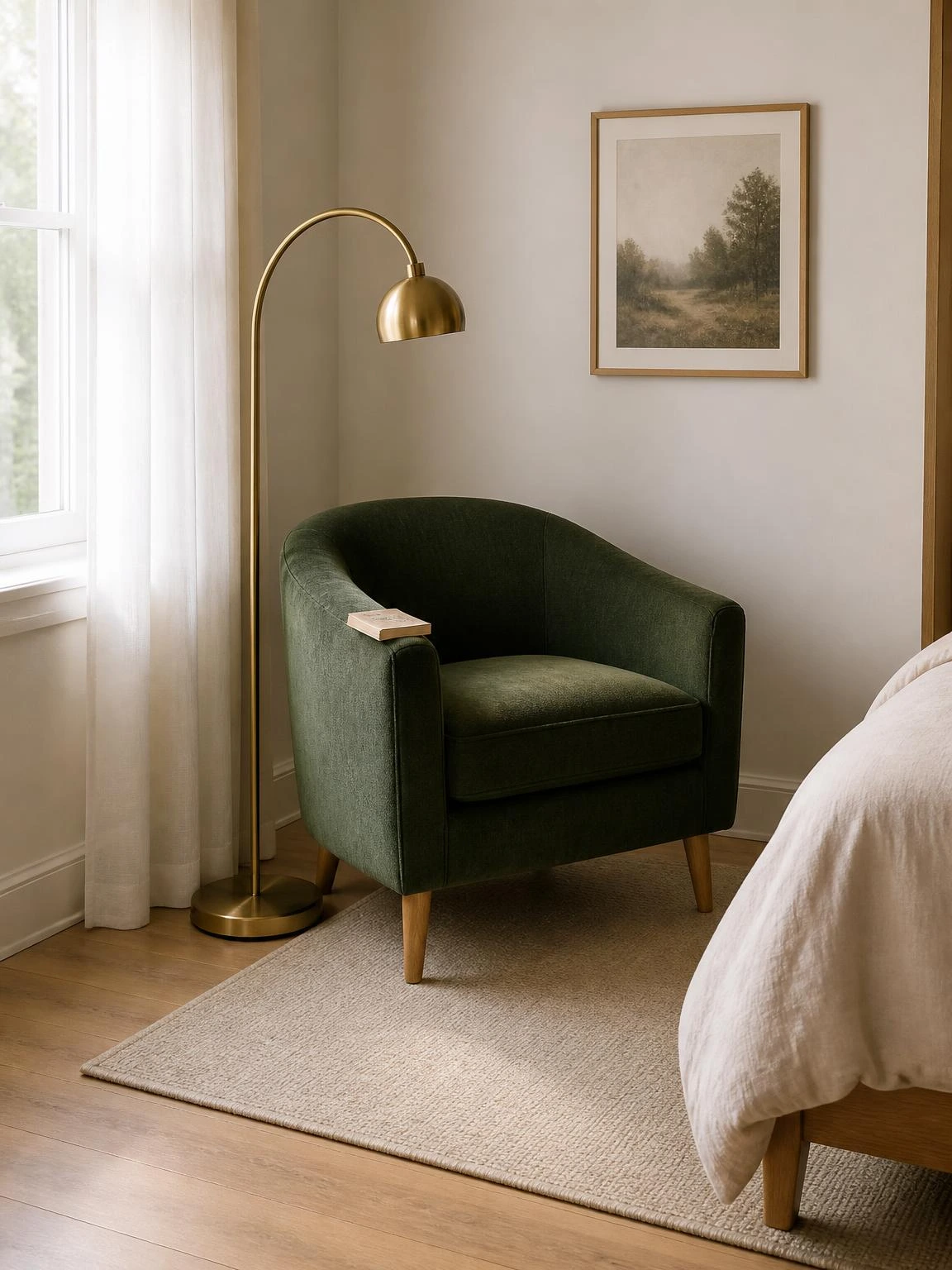
A single upholstered armchair in a bedroom corner gives both partners somewhere to land that is not the bed, which matters more at the end of a long day than most people expect.
Forest green upholstery holds up well to daily use and looks deliberate against warm neutral walls rather than like a chair that was simply placed there.
A slim arc floor lamp in a restrained brass finish takes up almost no floor space while putting light exactly where it needs to be; the center of the light should fall around 40 inches from the floor when measured at seated eye level.
A small low-pile area rug under the chair defines the corner as its own zone within the larger room.
In any bedroom under about 150 square feet, leave at least 30 inches of walking clearance around the chair before deciding the corner can fit one; a tight squeeze negates the whole point of having a calm spot.
7- Coordinated Dresser Styling
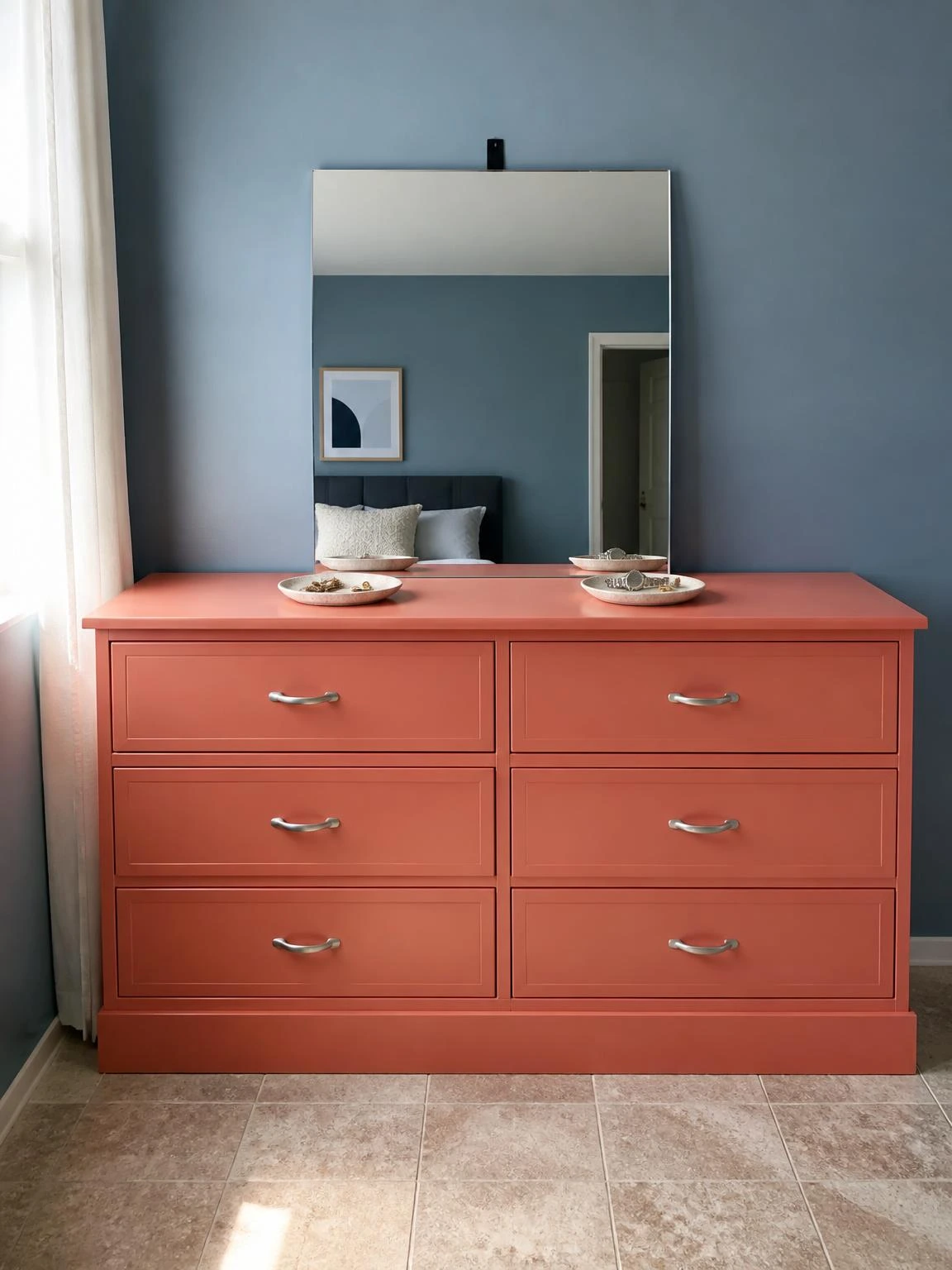
A wide six-drawer dresser used by both partners works best when the top surface is treated as shared space with a single defined purpose rather than a landing zone for whatever gets emptied from pockets.
Assigning the top three drawers to one partner and the bottom three to the other removes the need to negotiate every time laundry gets put away.
A soft coral painted dresser against a muted blue wall is one of those color pairings that sounds uncertain until it is in the room, where the warmth of the coral keeps the blue from feeling cold.
Two small ceramic trays on the surface, one per partner, contain jewelry and a watch without the surface looking cluttered.
A frameless glass mirror leaning against the wall above the dresser looks intentional and avoids the commitment of drilling into the wall, but it must be secured with a safety strap anchored to the wall to prevent tipping.
8- Blackout Curtain Layering
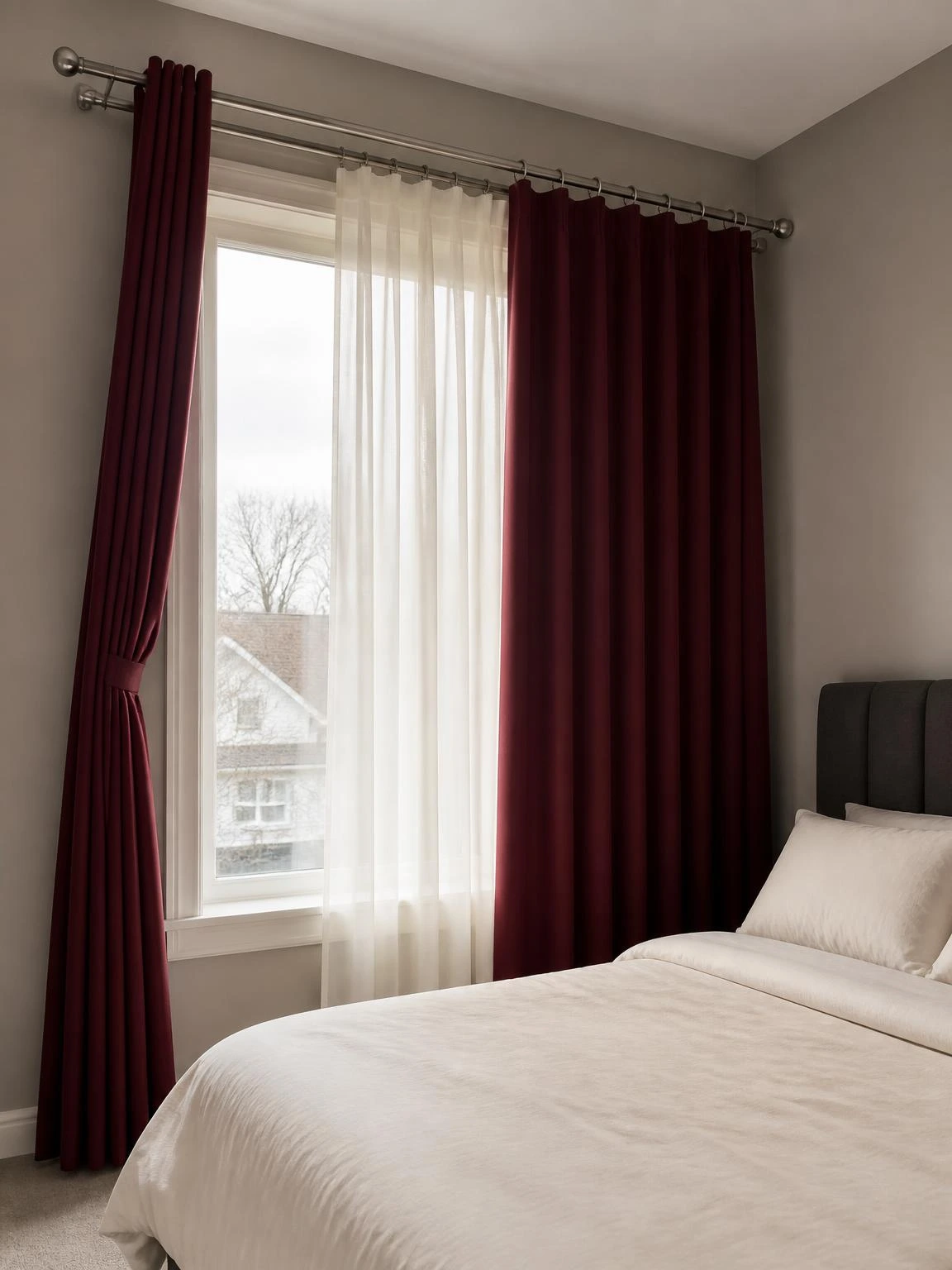
One partner who needs total darkness and one who likes morning light coming in is one of the most common bedroom conflicts in shared spaces, and layered curtains solve it without argument.
A double curtain rod holds an ivory sheer panel on the inside track and a burgundy blackout drape on the outer track, so each person can adjust their side independently.
Install the rod 4 to 6 inches above the window frame and extend it 6 inches past each side of the window so the drapes clear the glass completely when pushed open.
Burgundy blackout fabric against warm gray walls keeps the window treatment from looking purely functional, which single-layer blackout curtains often do.
Blackout liners are heavier than most people expect; use a rod rated for at least double the panel weight shown on the packaging, not the rod’s general listed capacity.
The sheer layer alone on a bright morning gives soft, diffused light that works well for both partners when neither needs full blackout conditions.
9- Bedside Charging Station
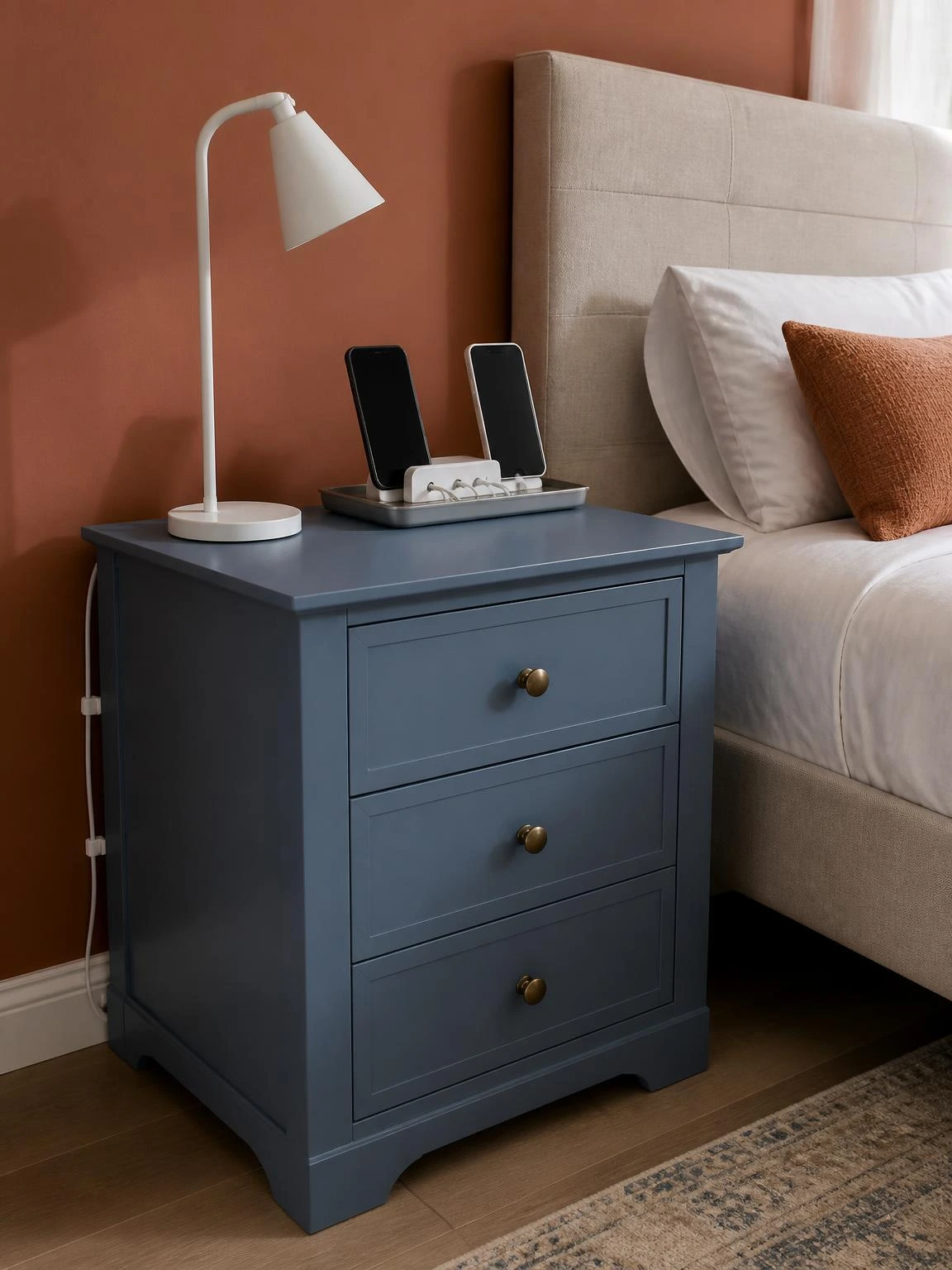
Two phones, two cables and one small nightstand surface is a combination that produces a specific kind of nightly clutter that a multi-port USB hub solves simply.
A flat charging hub sitting on a small metal tray keeps the cables contained and gives both devices a visible resting spot rather than a tangle near the lamp base.
Adhesive cord clips on the back edge of the nightstand route the hub’s single power cable cleanly down to the outlet so nothing drapes across the front of the furniture.
A rust-toned wall behind a soft blue nightstand makes the small metal tray and white cable hub disappear visually rather than draw the eye.
Position the hub away from the mattress edge where it could be knocked during the night, and check that the outlet circuit is not already running a fan, lamp and other appliances at capacity.
10- Gallery Wall Above the Bed
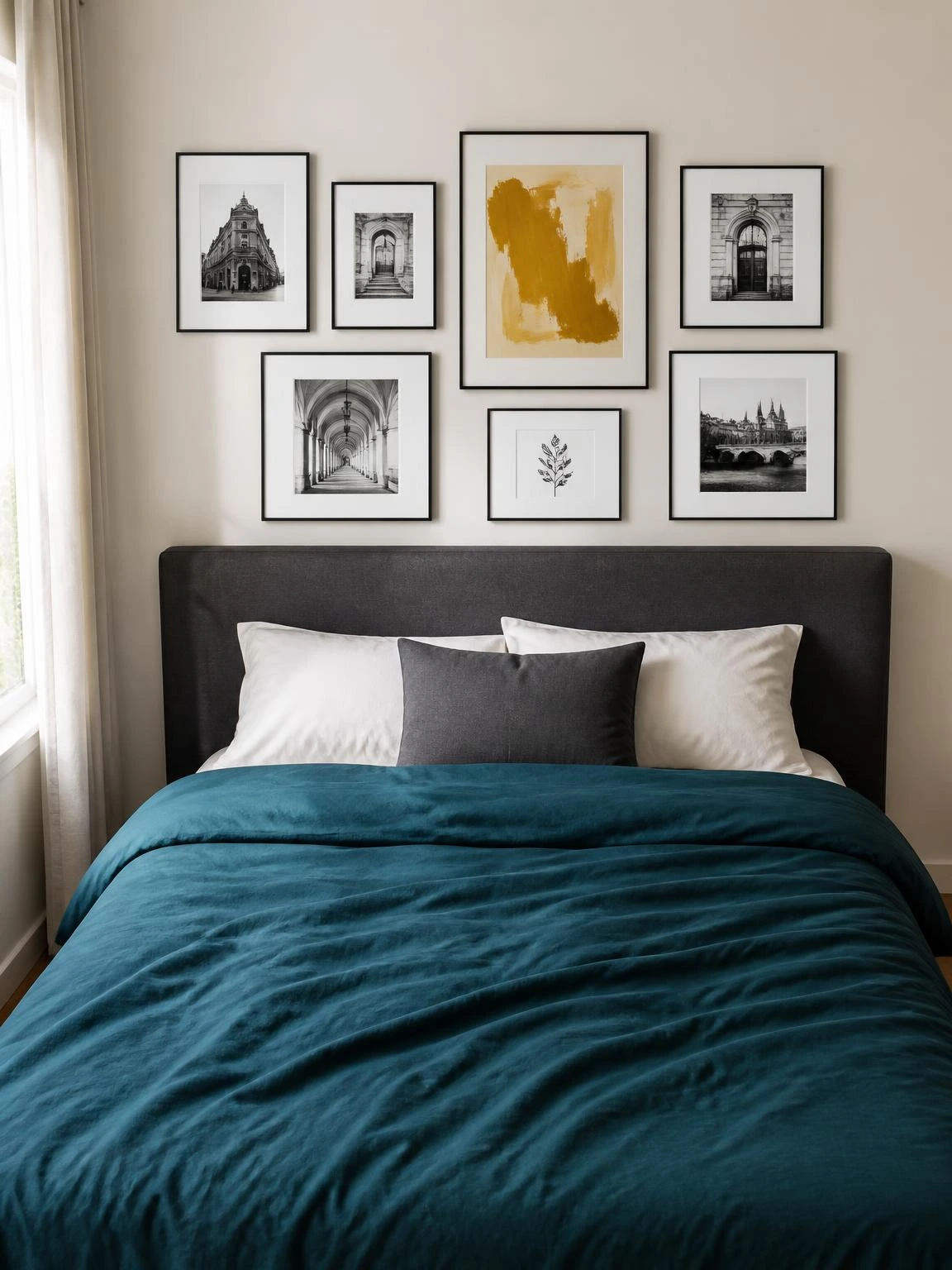
A gallery wall above the headboard is a practical way for two people to display something that reflects both of their tastes without one person’s preference dominating the room’s main focal wall.
Seven frames in two sizes arranged in a tight symmetrical grid feels balanced and deliberate; a mustard-toned abstract print as the center piece ties the wall to the bedding colors below.
Black metal frames and white mat board work with almost any surrounding palette and keep the gallery from looking dated as the room’s other textiles change over the years.
Lay the entire arrangement on the floor before marking the wall, keeping frames 2 to 3 inches apart consistently, and the spacing translates accurately when transferred to the wall.
Adhesive hanging strips handle most standard frame weights cleanly, but any frame over 16 pounds needs a wall anchor into a stud rather than strips alone.
A deep teal duvet below the gallery gives the whole bed wall enough color weight to hold the artwork rather than let it float.
11- Room-Dividing Bookshelf
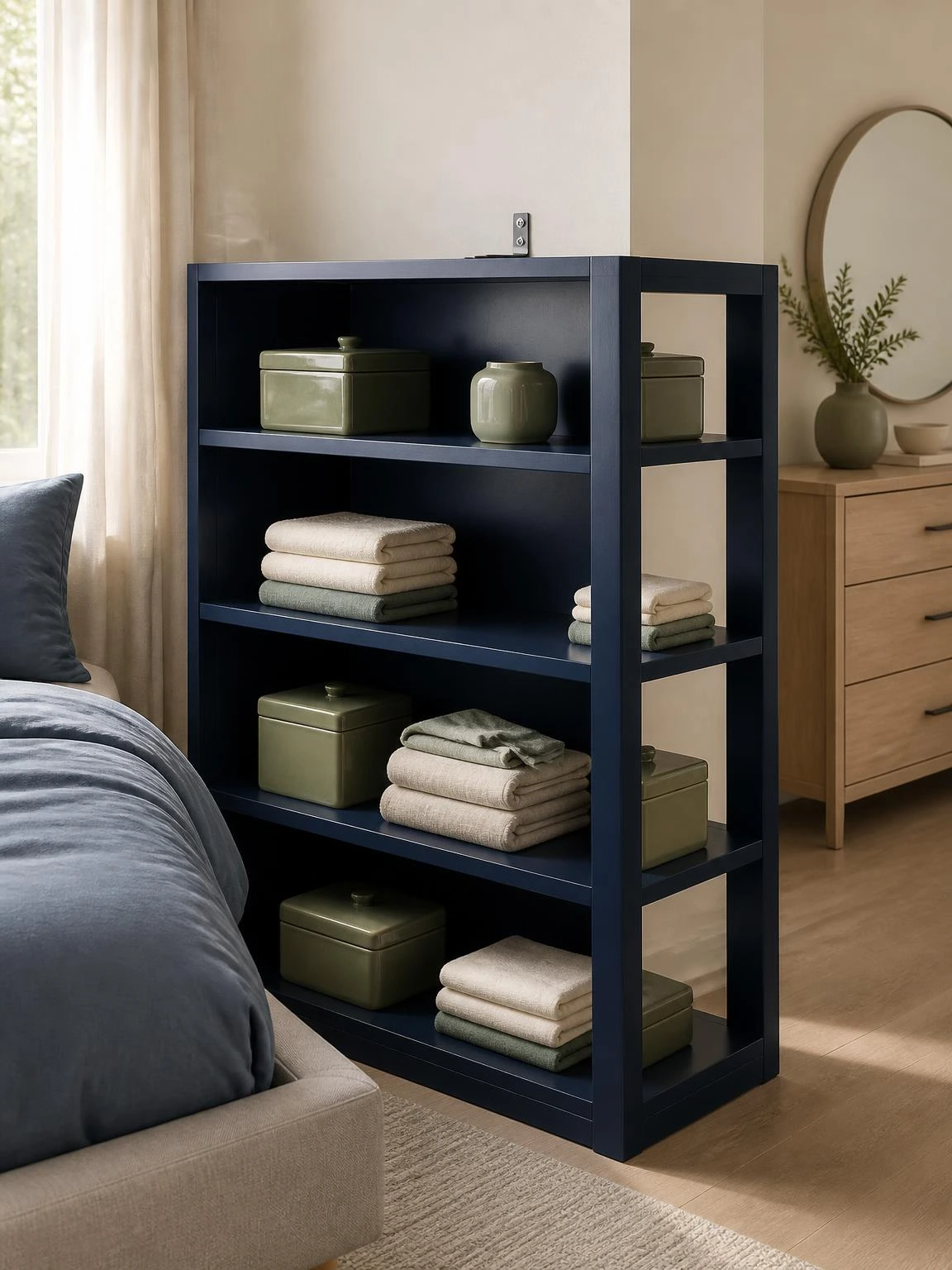
In a bedroom large enough to have a distinct dressing area, a freestanding open bookcase placed perpendicular to the wall gives both zones a sense of separation without closing off light or air.
A navy four-shelf open bookcase reads as a piece of furniture rather than a partition wall, which keeps the room from feeling cut up.
Muted green ceramic objects and folded textiles on the shelves look considerably better from both sides than a mix of spines and miscellaneous items, which is the honest reality of a bookcase used as a divider.
An open-back unit used this way is visible from both the sleeping and dressing sides, so both faces need to be kept tidy for the idea to hold up daily.
Anchor the top of the bookcase to the wall with a furniture strap regardless of how stable it feels when empty; loaded shelves shift the center of gravity significantly.
12- Shared Vanity Mirror Area
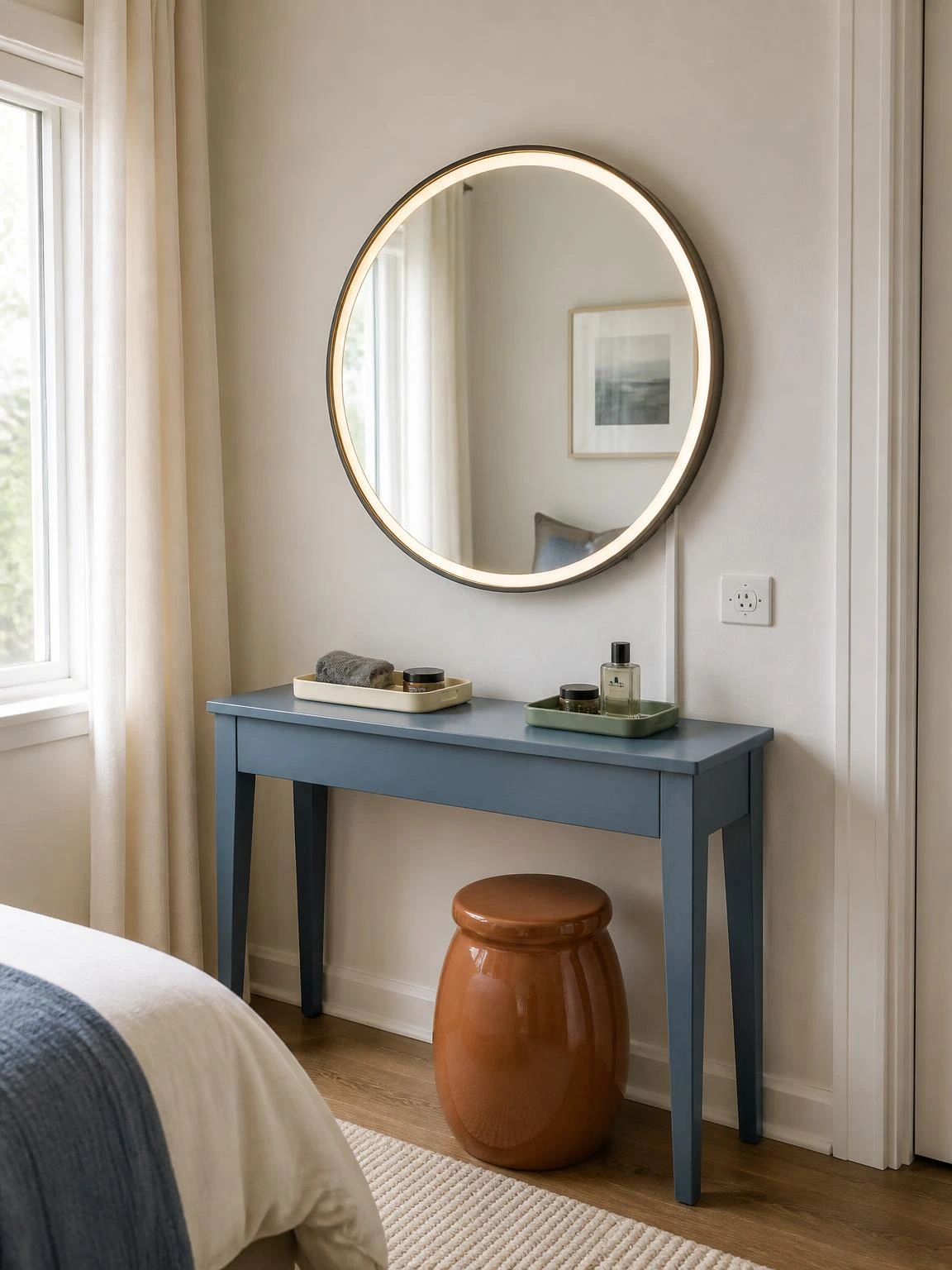
A narrow console table with a wall-mounted mirror above it gives both partners a dedicated morning routine spot without requiring a separate room or a full built-in vanity.
A dusty blue console against a warm white wall keeps the area feeling like part of the bedroom rather than a bathroom annex dragged into the wrong space.
A round mirror with a thin metal frame and integrated LED strip lighting is practical for both partners because the light surrounds the face evenly rather than casting shadows from one side.
A color temperature dial on the mirror light is genuinely useful here; warm light works for evening wind-down routines and daylight-balanced light works for applying makeup or checking a fresh shave in the morning.
Integrated lighting needs a nearby outlet, and the wiring should be planned before the mirror is mounted to avoid an exposed cord running down the wall.
A terracotta-toned stool tucked under the console is proportional to a narrow table and adds warmth to what can otherwise feel like a clinical corner.
13- Matching Bedside Wall Sconces
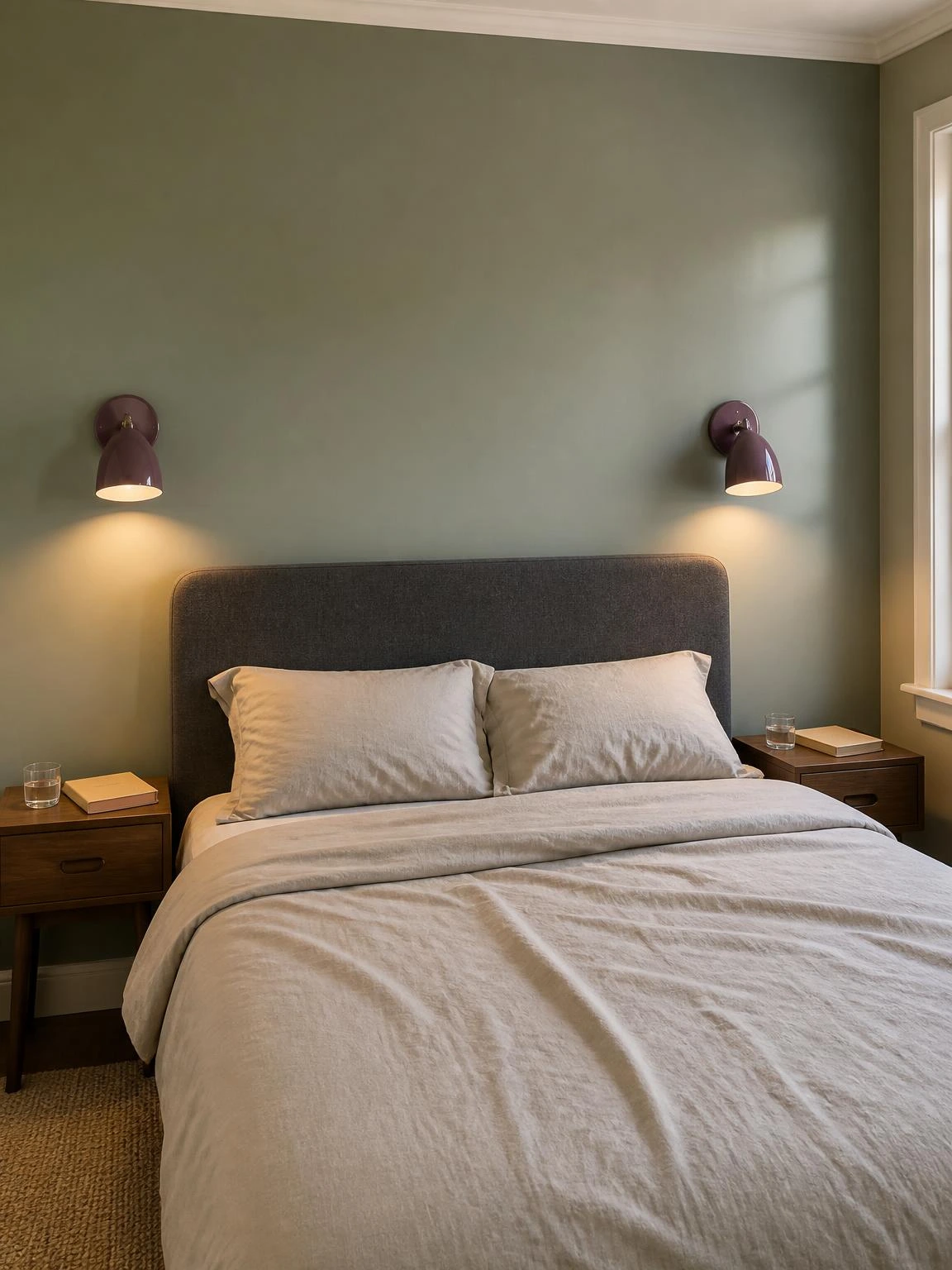
Plug-in wall sconces on each side of the bed free up the entire nightstand surface, which is a meaningful gain on a small unit with a single drawer and a lamp already competing for space.
Muted plum and stone ceramic sconce bodies against a soft green wall hold their own as decorative objects even when the lights are off during the day.
Mount each sconce 24 inches above the mattress surface and 8 to 10 inches from the center of the headboard on each side for reading light that hits the page without shining into a sleeping partner’s eyes.
Routing the cord behind the headboard panel to a nearby outlet is the cleanest solution, but where that is not possible a paintable cord cover channel along the baseboard does the job without obvious visual damage to the wall.
The plug-in format means no electrician is needed, which makes this one of the more accessible couple room decor upgrades for renters.
14- Window Seat with Shared Storage
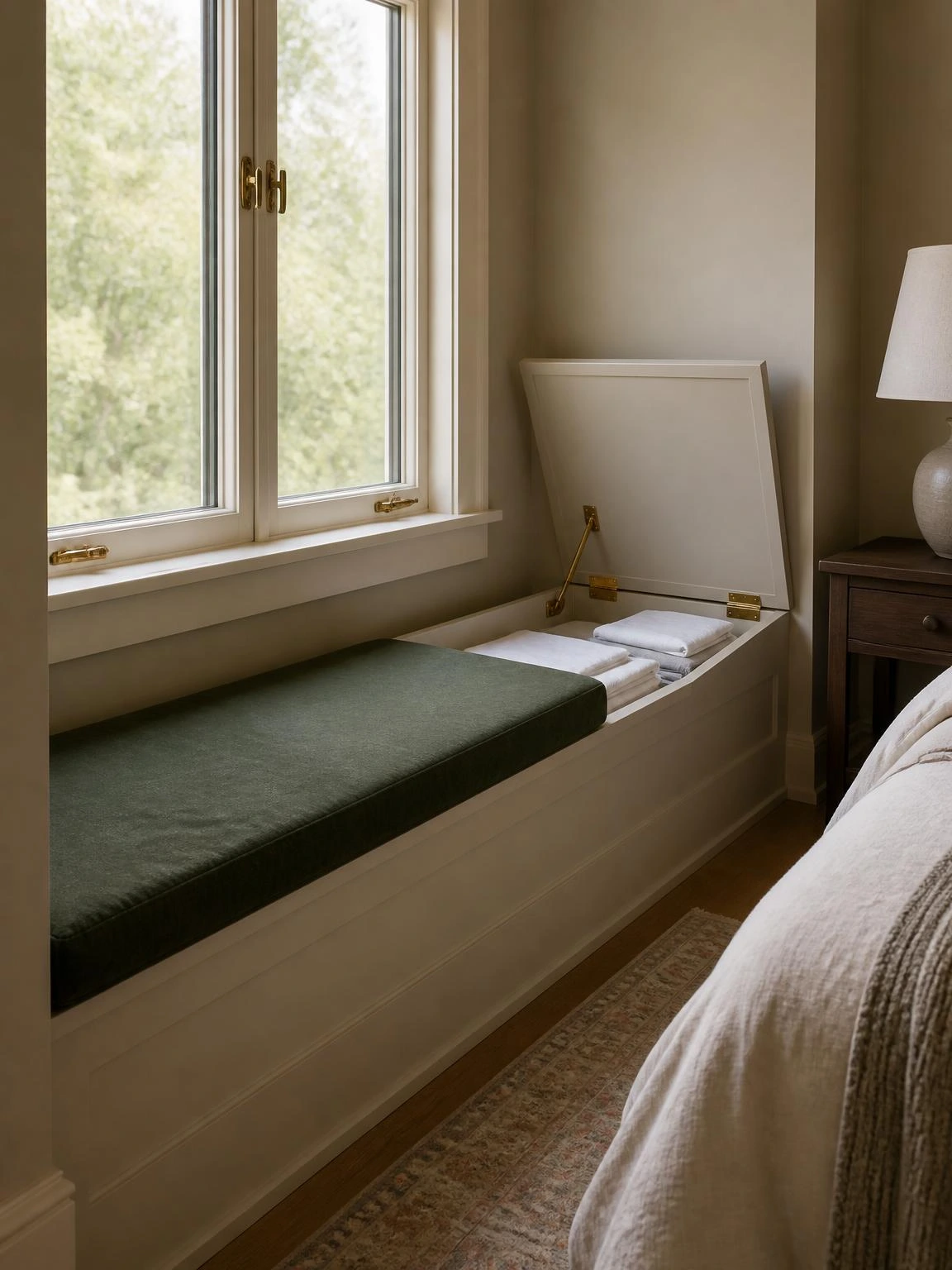
A bedroom bay window or alcove that currently holds nothing useful is a reasonable place to build a storage bench that both partners actually reach for regularly.
A forest green upholstered seat spanning the full width of the alcove looks like a proper architectural feature rather than a storage box with a cushion on top, which is the version most people end up with.
The hinged lid conceals folded linens neatly, and a lid support hinge is worth the small additional cost because it keeps the lid open hands-free while retrieving items stored at the bottom.
Restrained brass hardware on the hinges and window fittings ties the seat visually to other warm metal accents in the room without requiring a perfectly matched finish.
An MDF seat box must be anchored to the wall or floor; a unit that slides when weight is applied to one side is unsafe as regular seating regardless of how solid it looks when built.
15- Two-Tone Bedroom Wall Paint
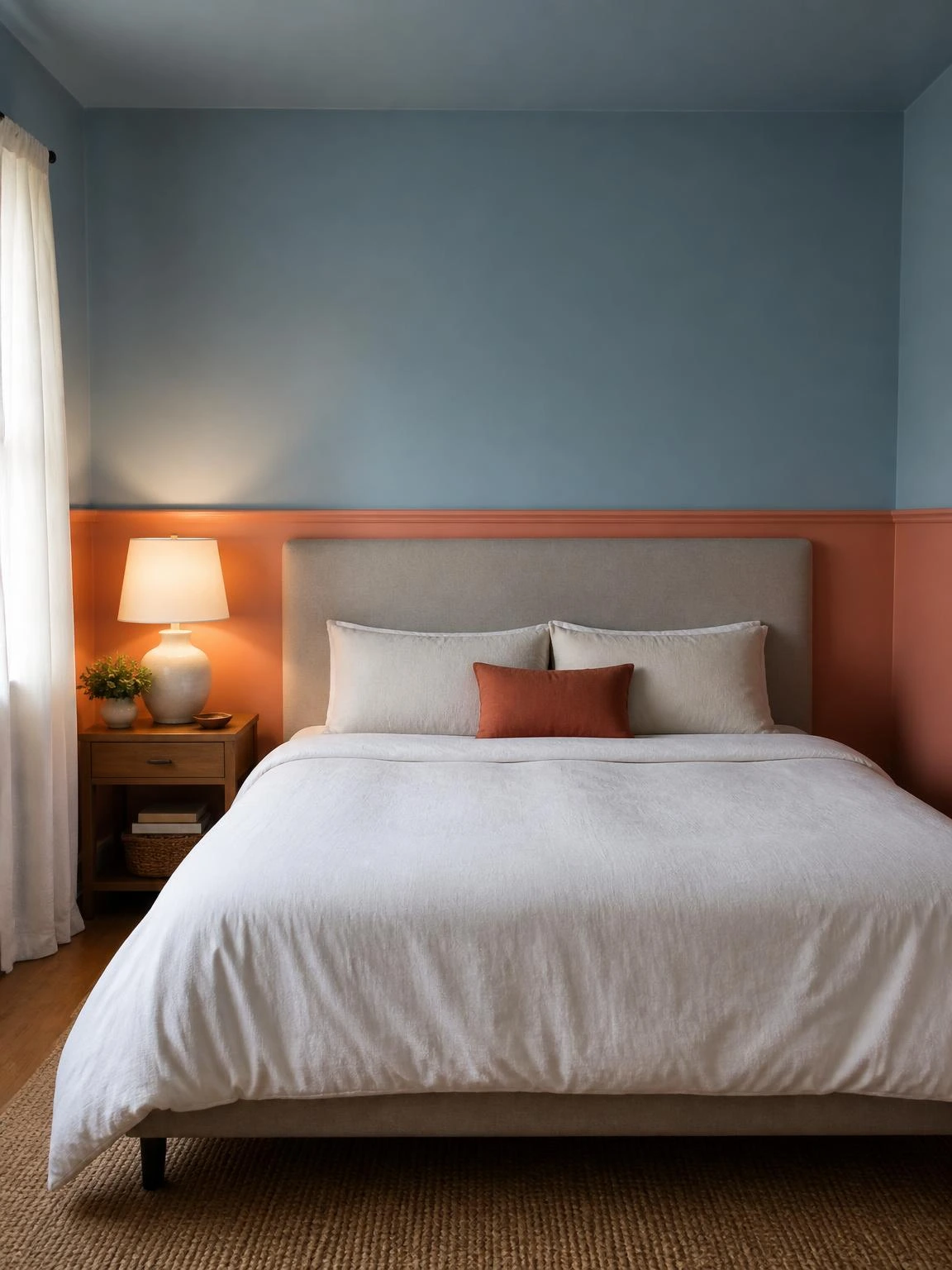
A horizontal paint divide with a darker lower half and a lighter upper half is one of those wall treatments that photographs as a design decision but functions as a neutral background both partners can live with daily.
Soft coral on the lower band up to chair-rail height with muted blue above reads as intentional rather than unfinished because the proportions reference a traditional dado-rail treatment.
A stone-colored upholstered headboard centered against the divide connects the two tones without competing with either one.
Apply painter’s tape at the dividing line from both sides and pull it off while the second coat is still slightly tacky; waiting until the paint is fully dry produces ragged edges on most interior wall paints.
Both colors should be tested as large swatches in the actual room under morning light, afternoon light and evening lamp light before the full walls are painted, because both coral and blue shift considerably across the day.
16- Couple’s Mood Lighting Setup
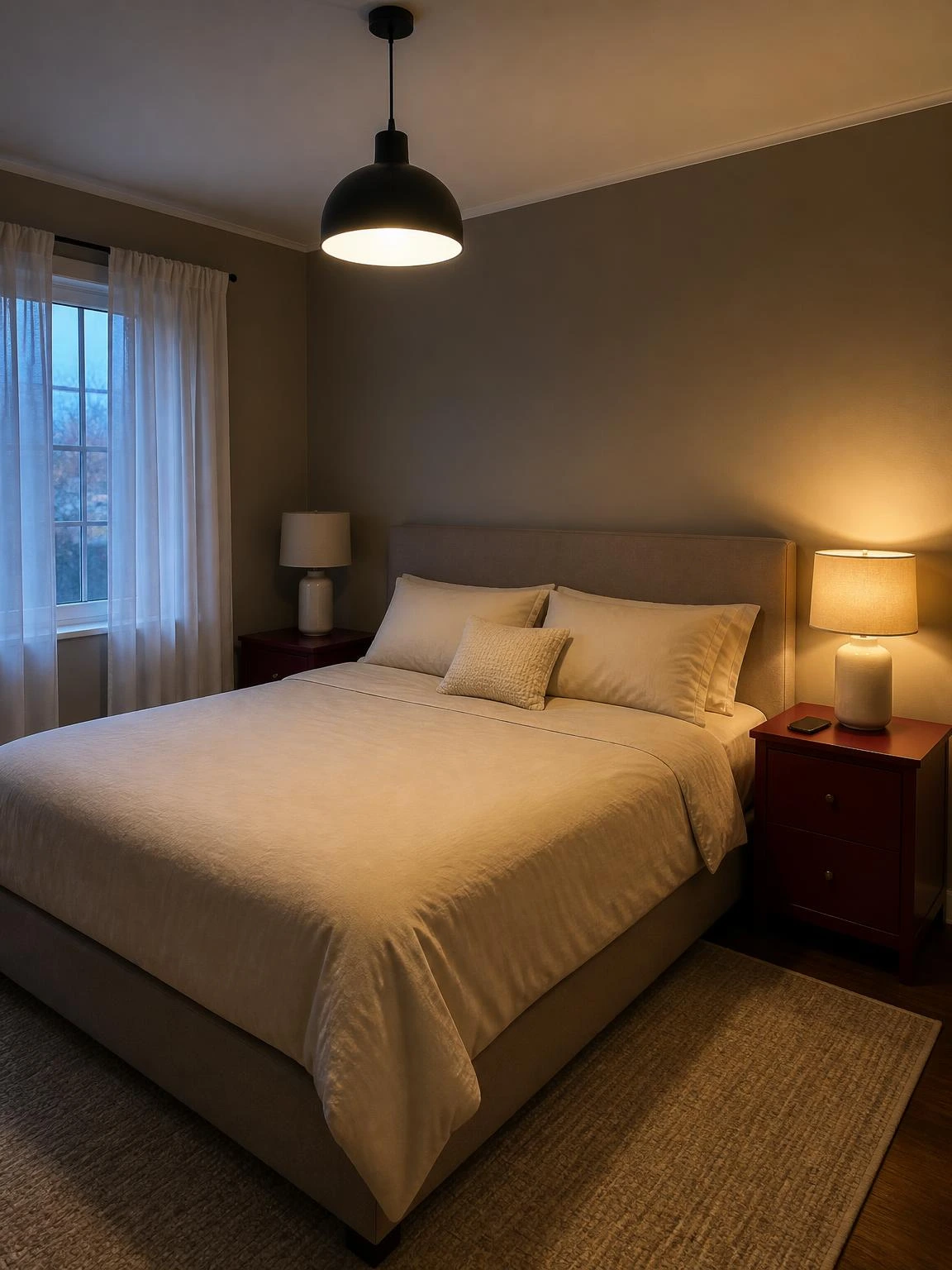
A single overhead light controlled by one switch is the root cause of most late-night bedroom lighting disagreements between partners, and a dimmable pendant combined with individual bedside lamps solves the problem structurally.
A dimmable ceiling pendant centered over the room handles general light for getting dressed and tidying; the individual ceramic lamps on burgundy-painted nightstands handle reading and winding down independently.
Smart bulbs in the bedside lamps let each partner adjust brightness and color temperature from a phone without reaching across the other person to hit a switch.
Warm gray walls and ivory bedding make the shift from bright overhead to warm lamp light feel gradual rather than abrupt, which is part of why the room’s palette matters as much as the fixtures themselves.
Before purchasing smart bulbs, walk to the far corner of the bedroom and check phone signal strength; a weak Wi-Fi signal at the bed makes smart bulbs unreliable enough to be more frustrating than a standard switch.
Where do you want to go next?

Explore by topic
Recently viewed
17- Bedroom Door Hook Rail
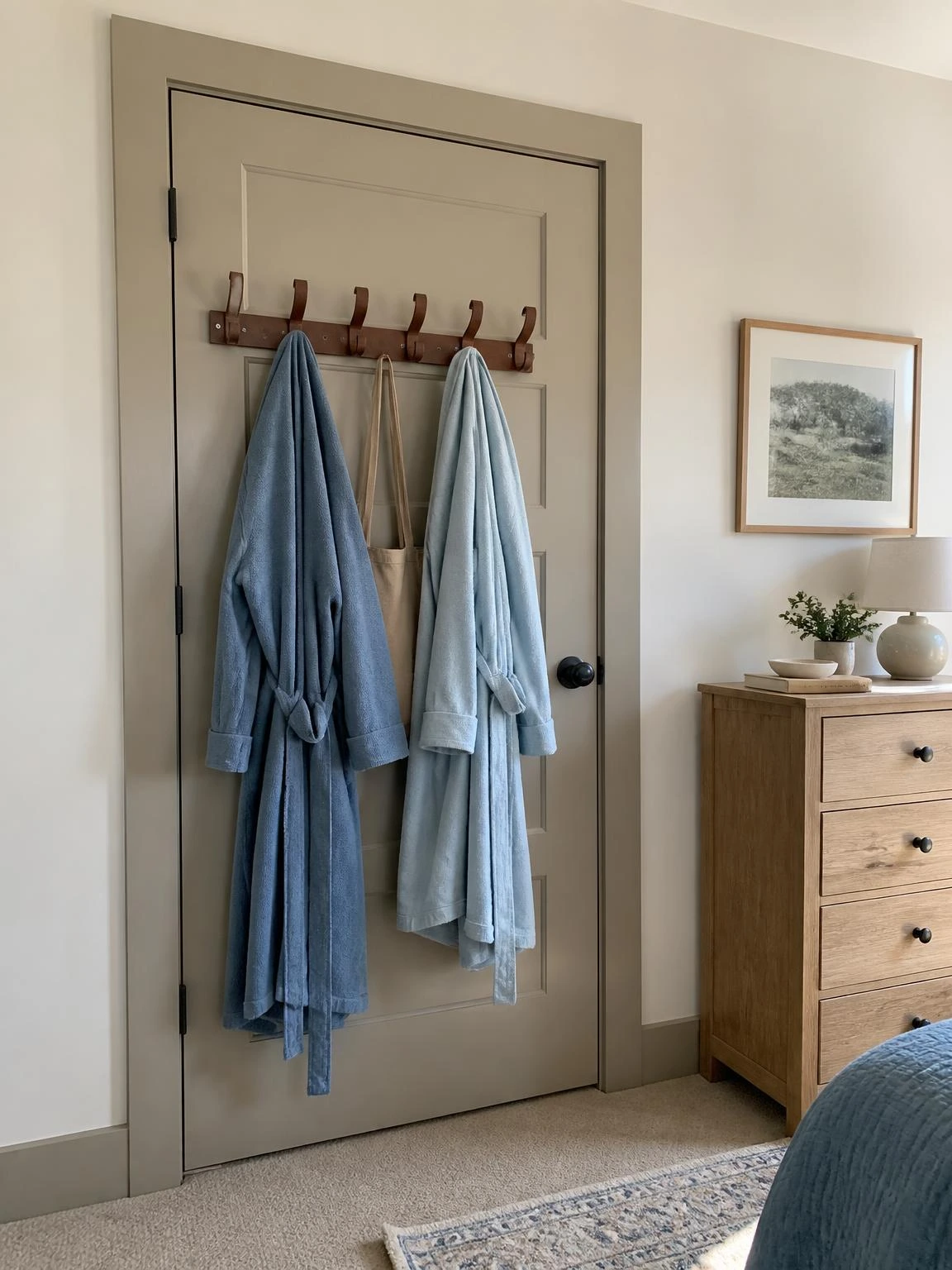
The back of a bedroom door is the most overlooked storage surface in most shared bedrooms, and a six-hook metal rail mounted there solves the robe-on-the-chair problem permanently.
A rust-finish metal rail at shoulder height holds two robes in soft blue on alternating hooks with enough space left for a bag or a belt without the door looking overwhelmed.
Use screws long enough to pass through the door panel and into solid material; hollow-core doors, which are standard in most tract homes and apartments, need a backing plate behind the door surface to distribute the loaded weight without the screws pulling through.
Before choosing a hook depth, close the door fully with the rail in place and check that the hooks clear the door frame without preventing the latch from catching.
This is one of the fastest couple room decor additions to install and one of the most consistently used once it is up.
18- Neutral Rug Anchoring the Bed
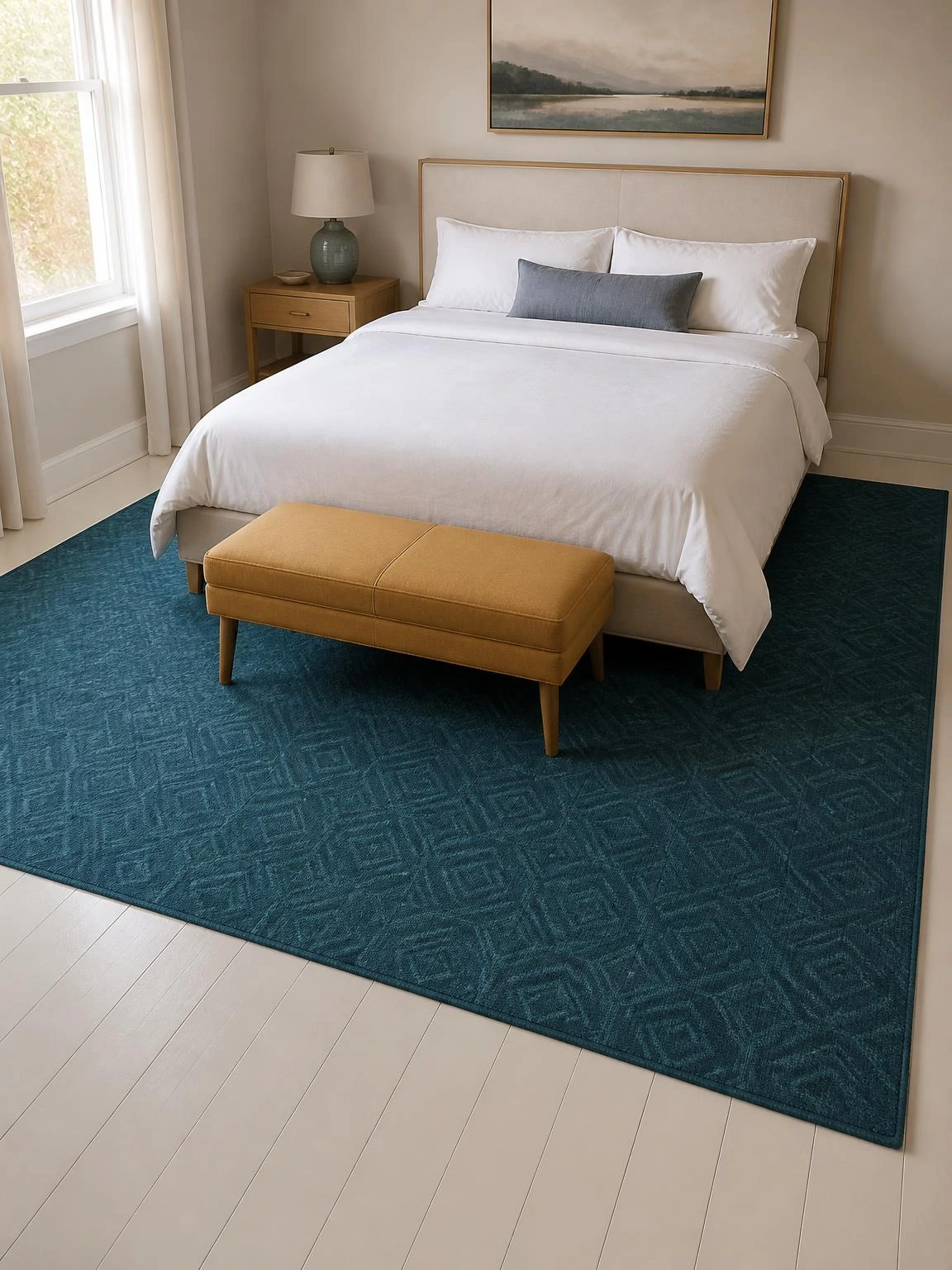
A large area rug that extends roughly two feet beyond each side of the bed and two feet past the foot gives both partners equal soft floor to step onto in the morning, which sounds minor until one person has been landing on cold hardwood for a year.
A deep teal low-pile rug with a subtle geometric pattern on a warm white wide-plank floor is visually substantial enough to anchor the bed as the room’s central element rather than decorate a corner of it.
A mustard-toned upholstered bench at the foot of the bed sitting entirely on the rug reinforces the bed zone without adding another large piece of furniture to navigate around.
Cut a non-slip rug pad one inch smaller than the rug on all sides; a pad the same size as the rug pushes the rug edges up at the corners, which creates a trip hazard and looks sloppy within a week.
For a queen bed, a rug smaller than 8 by 10 feet will look like it belongs in a bathroom; that minimum size is worth the investment because an undersized rug undermines every other decor decision in the room.
Making a Shared Bedroom Feel Like It Belongs to Both of You
The ideas that hold up over time in couple room decor are the ones that solve a daily irritation and happen to look good, not the other way around.
Symmetry, whether in nightstands, sconces or drawer assignments, does quiet work in a shared space by removing the low-grade friction of contested territory.
Color choices that neither partner strongly dislikes are more durable than a palette one person loves and the other tolerates through politeness.
A room that works for two people on an ordinary Tuesday morning, when one is rushing and the other is still asleep, is the actual measure of whether the setup succeeded.