




17 Bathroom Lighting Inspiration Ideas for Every Home
A bathroom that feels dim before 8 a.m. sets a flat tone for the whole morning.
Bathroom lighting inspiration covers a wider range than most people expect, from hardwired sconces to a simple plug-in night light that costs almost nothing.
The frustrating part is that most bathrooms ship from builders with one overhead fixture doing all the work, and one overhead fixture almost never does it well.
Layering a few light sources, even just two, changes how a room reads and how easy it is to actually use.
The ideas below cover everything from a small powder room to a full master bath, so there is likely something useful regardless of the size or rental status of the space.
1- Vanity Mirror Side Sconces
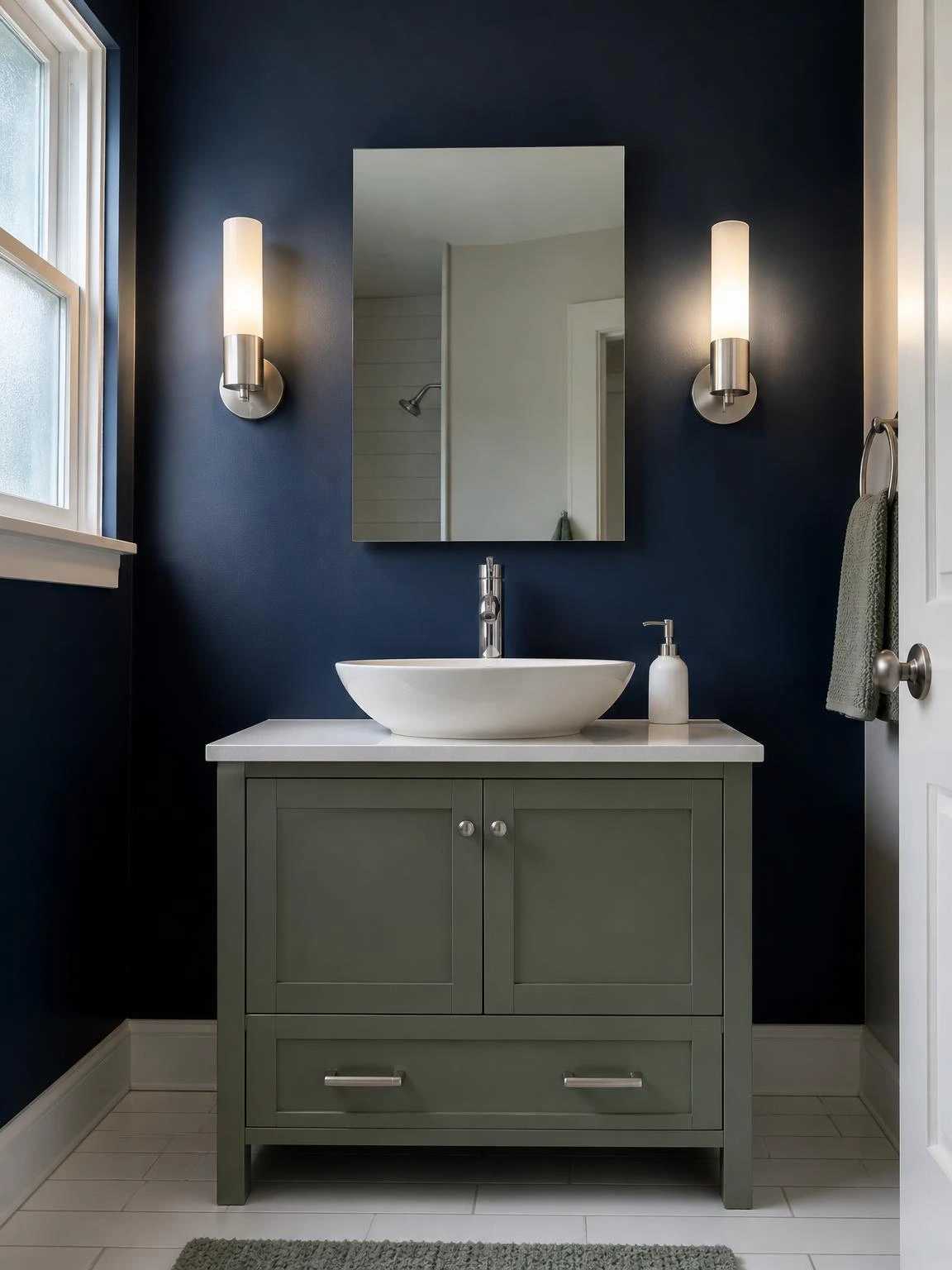
Side sconces flanking a mirror solve the single most common bathroom lighting problem: shadows falling directly across the face.
Mount the center of each sconce at roughly 60 inches from the floor, which places the light at eye level for most adults standing at the sink.
Space them 28 to 30 inches apart to bracket a standard 24-inch mirror without the fixtures sitting awkwardly wide.
Brushed-nickel cylindrical bodies with frosted glass diffusers work well against a navy or deeply saturated wall because the metal reads quietly without disappearing.
The frosted diffuser matters here; a clear glass shade throws a bright spot that reflects directly in the mirror and defeats the whole purpose.
If no junction box exists at that wall position, the wiring work needs a licensed electrician since sconces require a wet-location-rated box.
2- Recessed Ceiling Lights Over Shower
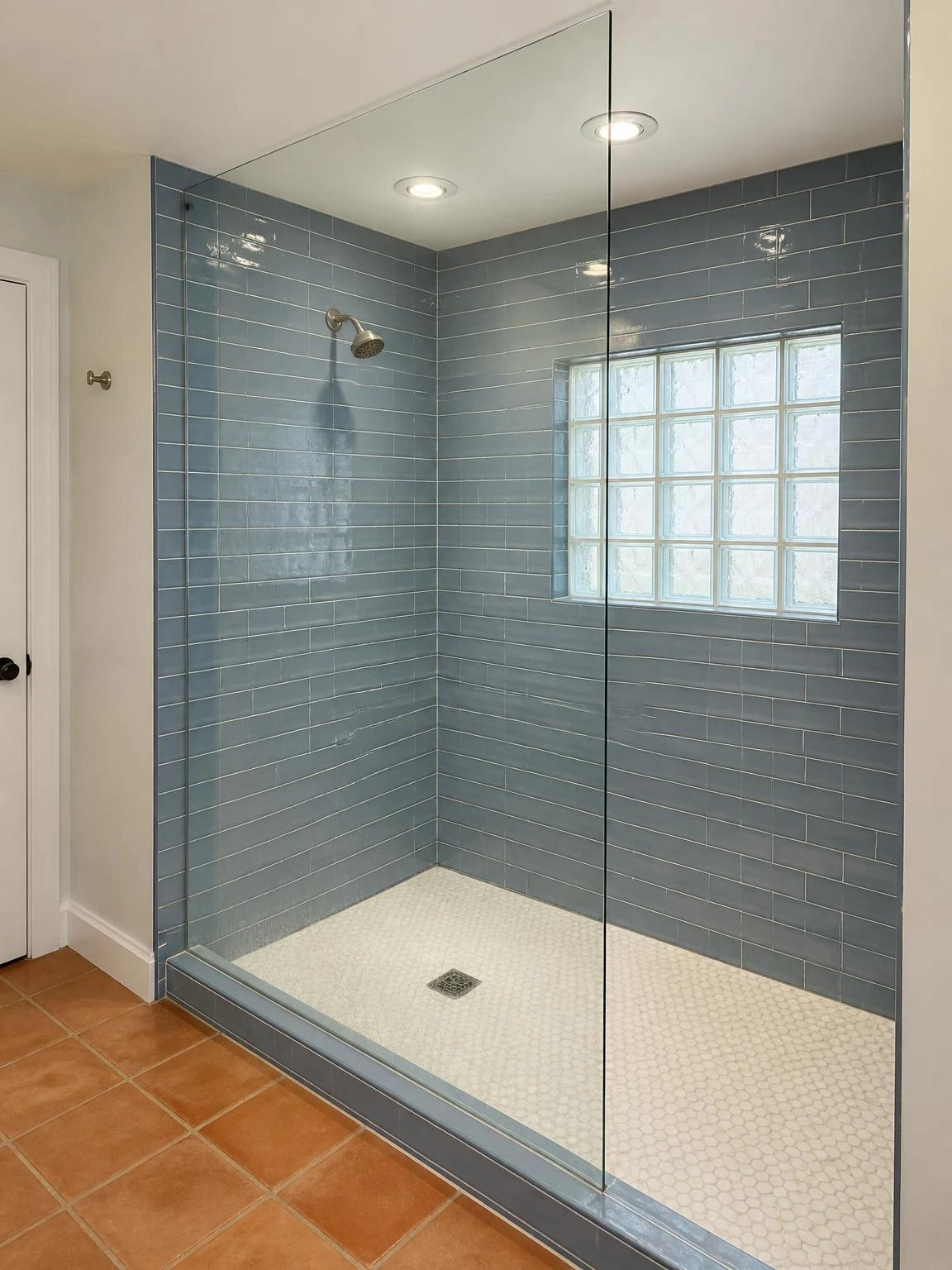
A shower without its own dedicated light relies on whatever spills in from the rest of the bathroom, which is rarely enough.
Two recessed downlights positioned directly over the shower footprint make a real difference, particularly in an enclosed or glass-panel enclosure where ambient light does not reach the floor.
Only fixtures with a UL wet-location rating belong inside a shower zone; standard recessed cans are not appropriate regardless of how well the ceiling is painted.
ICAT-rated housings are the right choice since they seal against air infiltration into the ceiling cavity, which matters in a steamy room.
Chrome trim rings hold up better than painted rings in a high-humidity shower environment and read cleanly against dusty-blue subway tile.
Inside a shower counts as a Zone 1 wet area under the NEC and most Canadian provincial codes, so verify local GFCI requirements with a qualified electrician before the work starts.
3- Backlit Bathroom Mirror
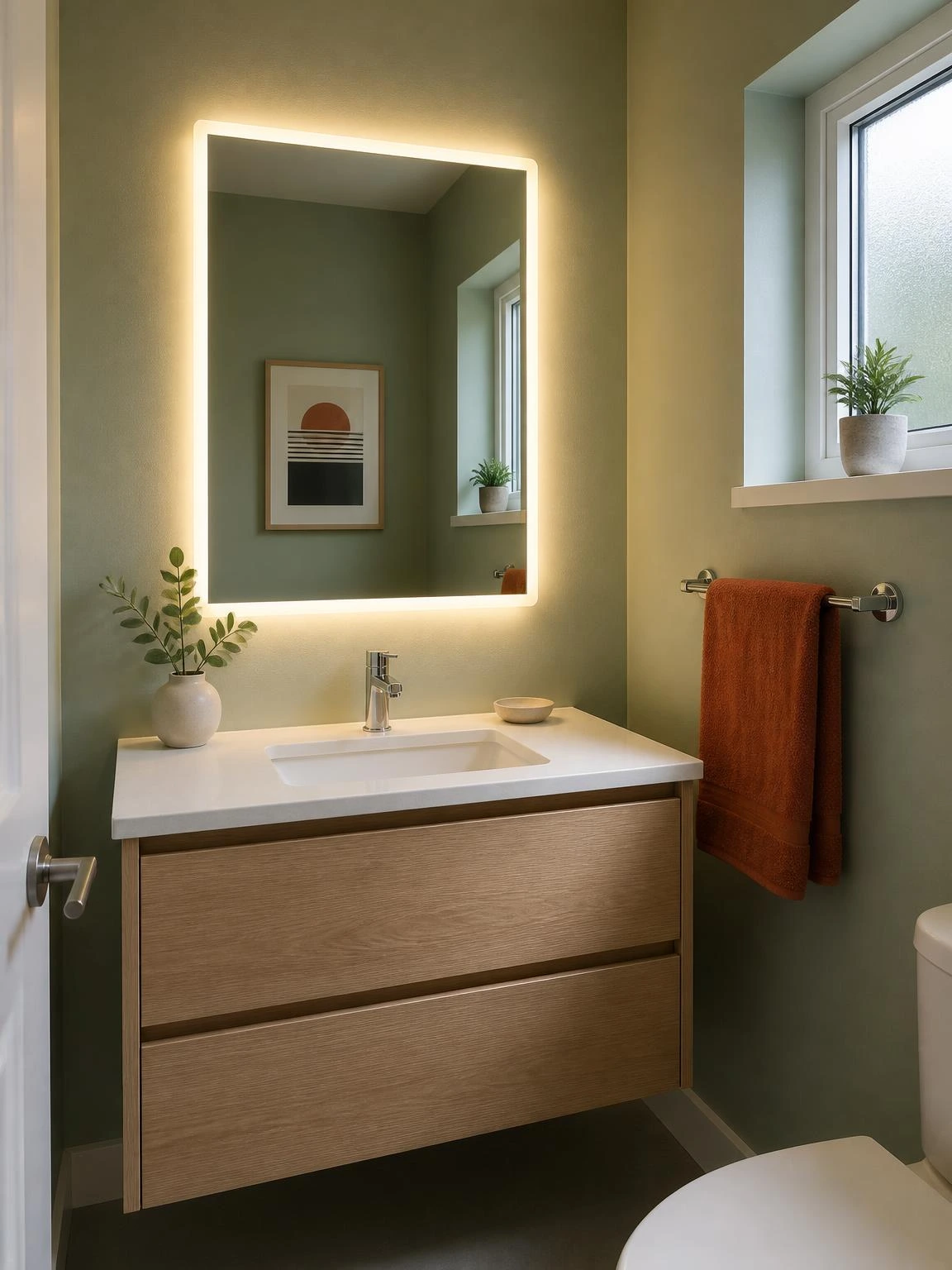
A backlit mirror handles ambient and task light simultaneously, which is genuinely useful in a 5 by 7 foot bathroom where wall space for separate fixtures is limited.
The halo of light around the mirror perimeter bounces off the wall behind it and softens the whole room without adding a ceiling fixture.
Look for a mirror with a CRI of at least 90 and a color temperature in the 3000 to 4000 K range; anything lower than that makes skin tones hard to read accurately.
Warm oak laminate or sage-green walls pair well with a 3000 K output, which reads warm without going yellow.
These mirrors need a dedicated switched circuit, and many are not compatible with existing dimmers without checking the integrated driver’s specifications first.
It is worth confirming compatibility before purchasing the dimmer, not after the mirror is already on the wall.
4- Pendant Light Above Freestanding Tub
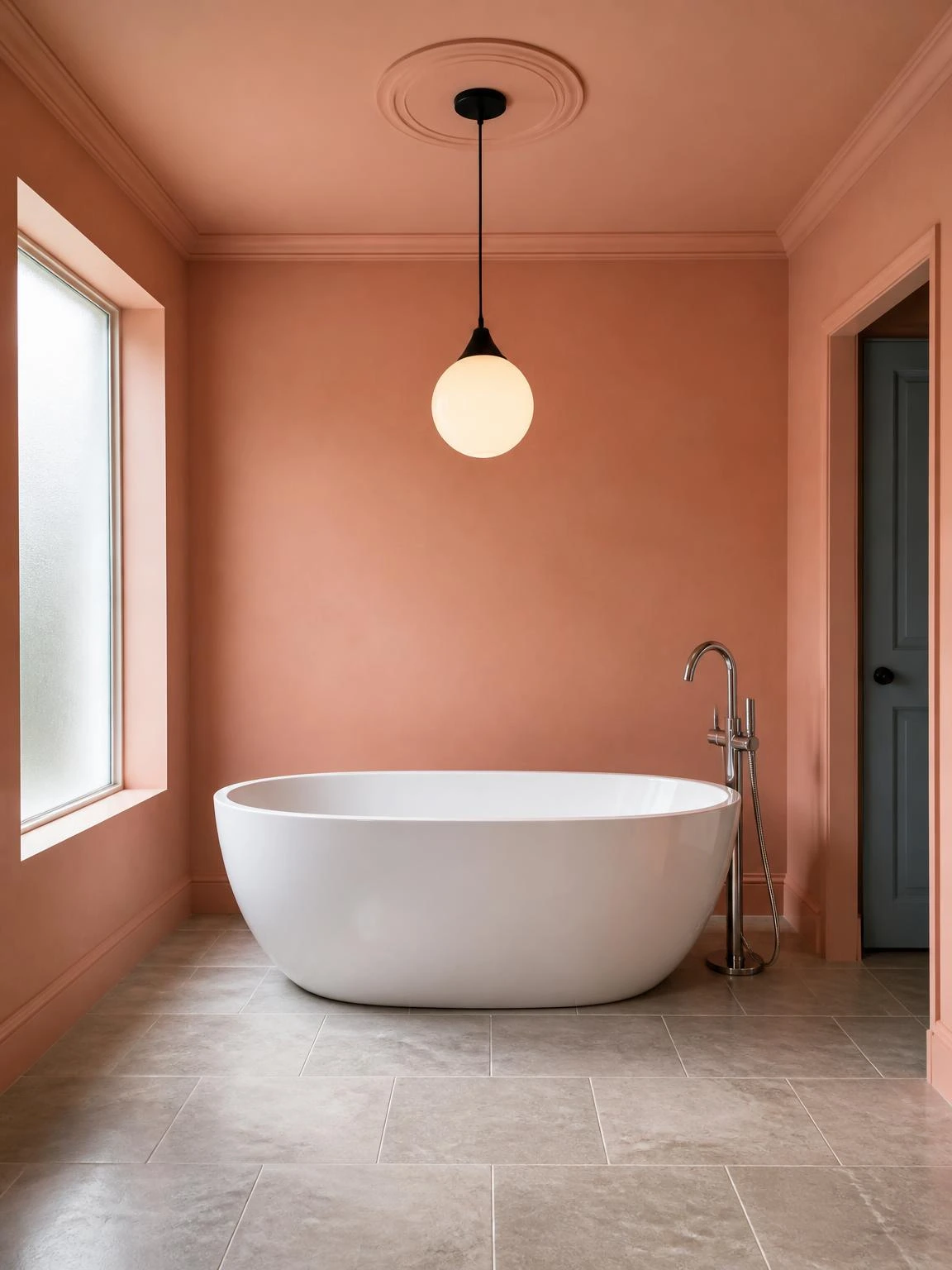
A pendant centered over a freestanding soaking tub is more about atmosphere than task light, and that is a perfectly legitimate reason to install one.
A matte-black globe pendant on a ceiling medallion reads well against coral or warm-toned walls and does not compete with the tub as the room’s focal point.
The fixture must be rated for damp locations at minimum, and it needs to hang so the lowest point sits at least 8 feet above the tub rim, or outside the 3-foot horizontal prohibited zone, per NFPA 70 requirements.
Stone-look porcelain tile on the floor grounds the space so the pendant does not feel like it is floating in an otherwise hard-surfaced room.
An opal glass globe shade diffuses light evenly without casting a bright spot on the water or the ceiling directly above.
Whether a new circuit is feasible without opening the ceiling depends on joist direction, so an electrician’s assessment before committing to the location saves significant frustration later.
5- Hollywood Strip Bulb Mirror
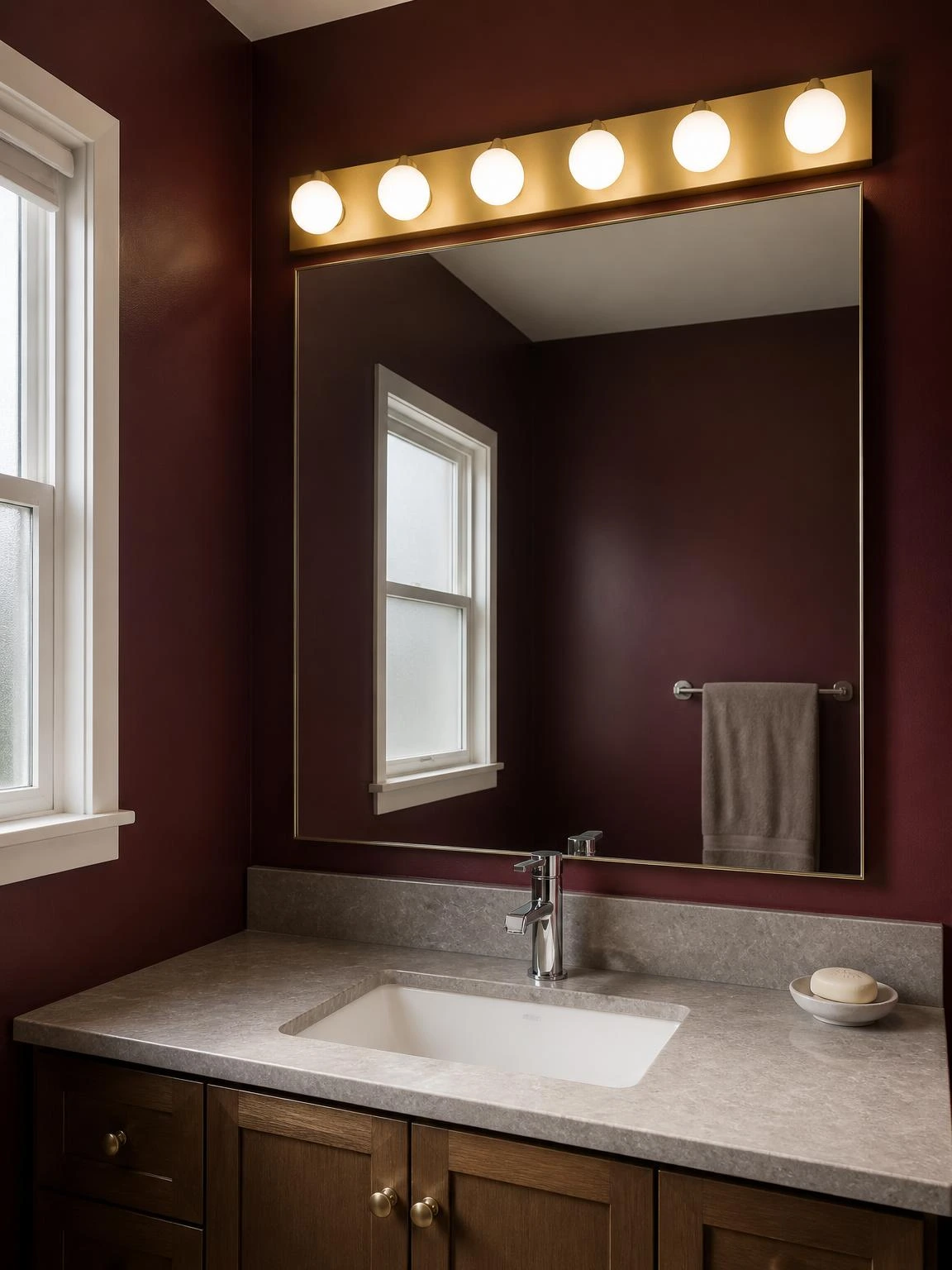
A Hollywood-style light bar across the top of a bathroom mirror is one of the most flattering vanity lighting arrangements available because the light faces forward and evenly.
Six round globe bulbs in a brushed-brass bar spanning the full mirror width give an even spread that eliminates the side shadows that overhead-only lighting creates.
Frosted G25 bulbs rather than clear ones are the right call here; clear globes produce glare that bounces directly off the mirror surface during close-up grooming tasks.
Against burgundy walls and a warm-gray quartz countertop, brushed brass reads rich without tipping into gold-toned overkill.
A six-socket bar draws meaningful wattage, so confirm the circuit can support the load or switch to LED globe equivalents, which produce the same aesthetic at a fraction of the draw.
LED G25 frosted equivalents are widely available now and fit standard medium-base sockets without any hardware modification.
6- Dimmer Switch for Vanity Lights
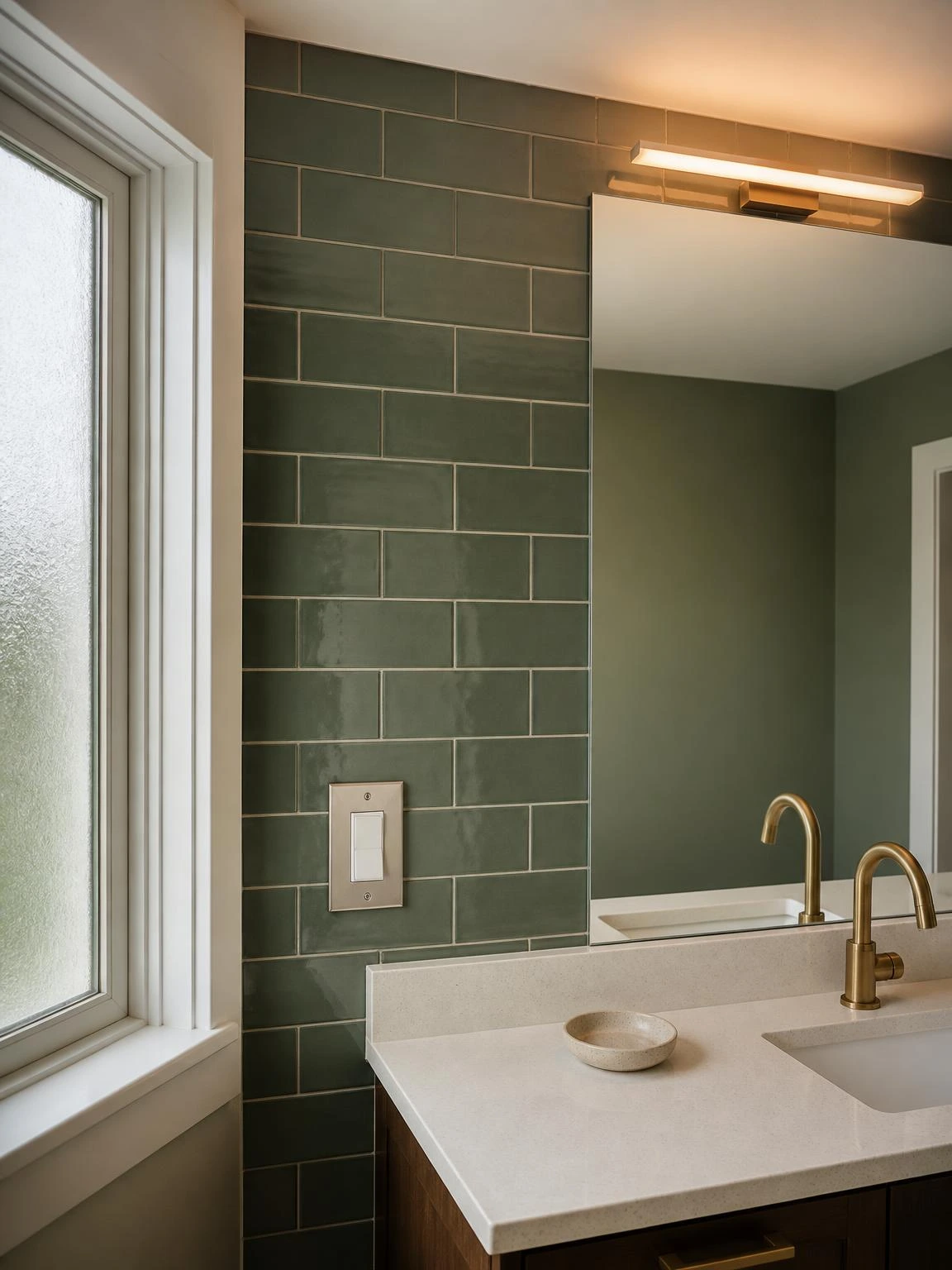
A dimmer switch beside the vanity is one of the lowest-cost changes that produces a noticeable shift in how a bathroom feels at different times of day.
Full brightness works for getting ready in the morning; dialing back to around 20 percent at midnight is significantly easier on the eyes than flipping on full overhead light.
The critical detail is compatibility: standard incandescent dimmers cause LED fixtures to flicker or buzz, sometimes loudly, so the dimmer must be rated for LED and CFL loads.
Beyond the rated type, the specific dimmer needs to match the LED driver in the fixture; manufacturers publish compatibility lists that are worth checking before purchasing.
A rocker-style dimmer in brushed nickel on a forest-green subway tile wall is a small, quiet detail that reads finished without drawing attention to itself.
If the existing switch box has only two wires and no neutral, some smart dimmers will not function; a standard LED-compatible rocker dimmer is the simpler and more reliable solution in that situation.
7- Skylight Natural Light in Bathroom
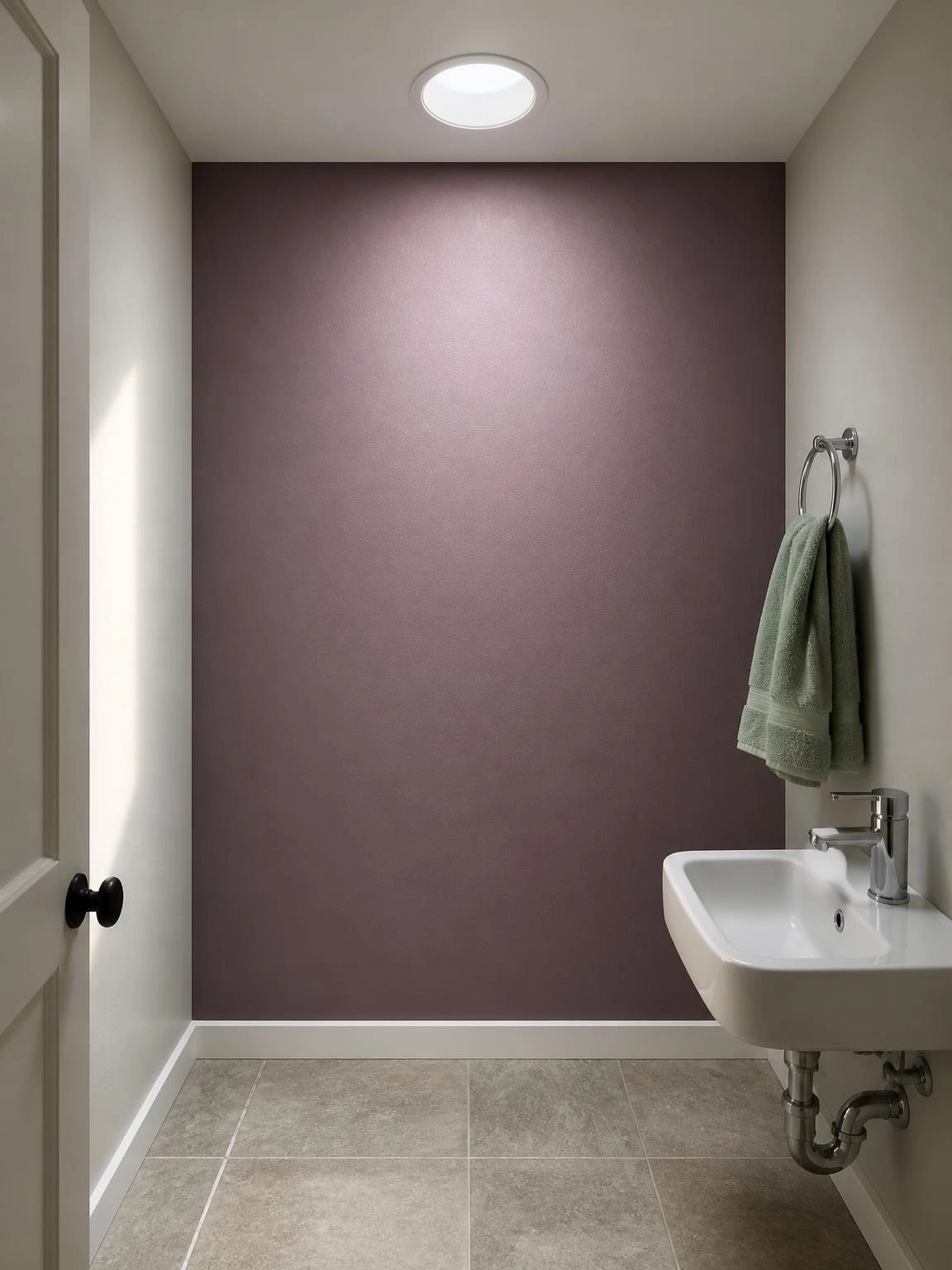
An interior bathroom with no exterior walls and no windows is one of the more depressing rooms to spend time in, and a tubular skylight is the practical fix.
A 10-inch tubular skylight routes daylight from a rooftop dome down a reflective tube to a flush diffuser disk in the ceiling, and the resulting light reads genuinely natural rather than artificial.
The tube can accommodate up to 90-degree bends, which means interior bathrooms without a clear vertical path to the roof are still viable candidates.
A plum accent wall and stone-colored floor tile look noticeably different under natural light than under incandescent, and most people find the natural version far more appealing.
The diffuser dome sits only slightly proud of the ceiling surface, so it does not read as an intrusive fixture in a low-ceilinged room.
Professional installation is required to maintain roof waterproofing integrity; cutting and flashing the roof penetration yourself risks voiding the roofing warranty if something goes wrong.
8- Flush Mount Ceiling Light Small Bathroom
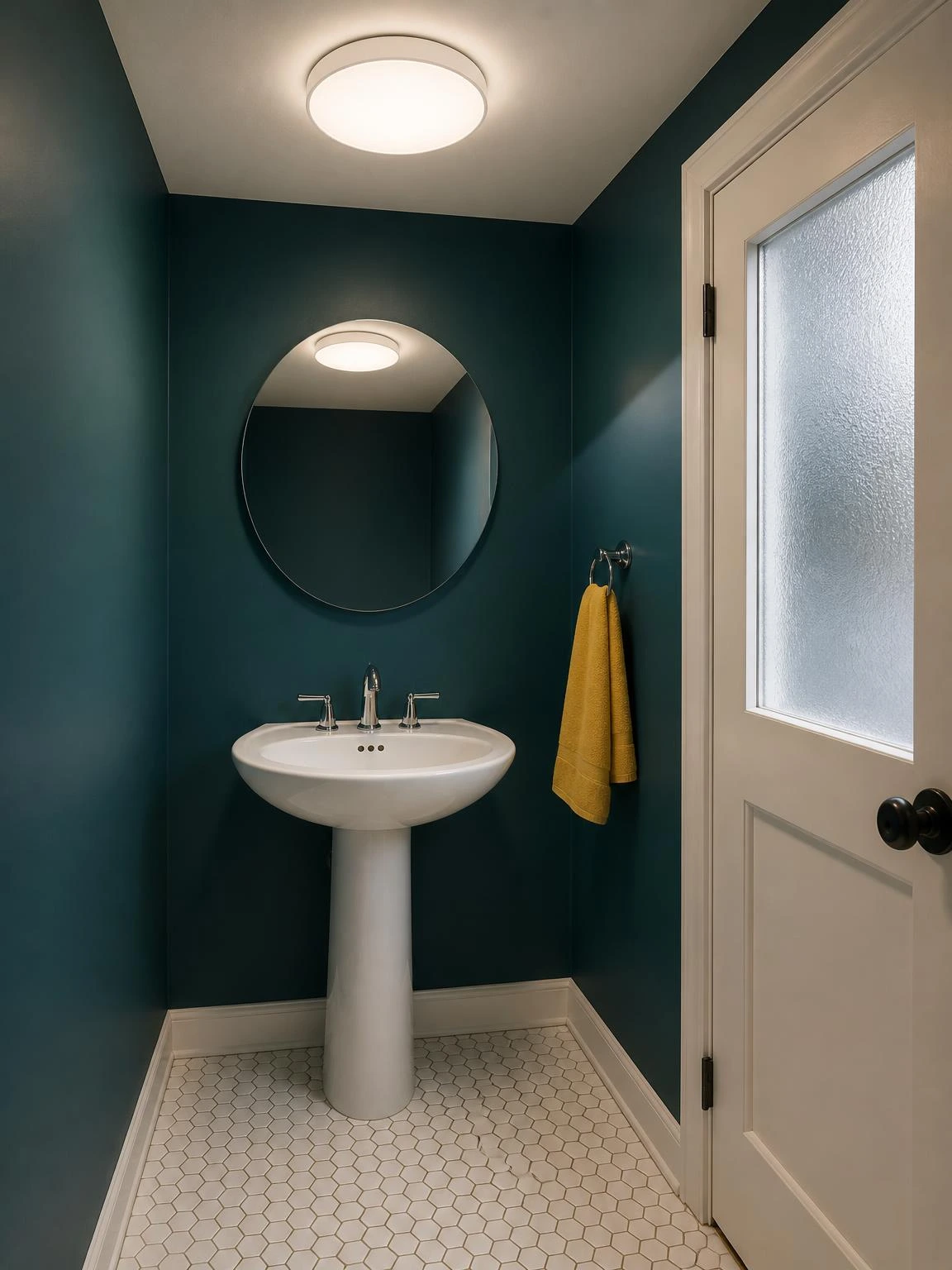
A powder room or small bathroom under 5 by 5 feet usually has room for exactly one ceiling fixture, and a flat-profile flush mount in matte white with an opal acrylic diffuser is the sensible choice.
Low-profile means no headroom sacrifice in a ceiling under 8 feet, which matters more in a compact space where people move close to the fixture.
Target 50 to 75 lumens per square foot for adequate ambient light in a small bathroom; a single flush mount in the 800 to 1000 lumen range covers most powder rooms comfortably.
Against deep teal walls, a matte-white housing disappears visually while the opal diffuser spreads light evenly without a hot center spot.
A mustard-yellow hand towel on a chrome hook reads vividly under a good diffuser, which is a small reminder that light quality affects how everything else in the room looks.
A ceiling-only fixture creates face shadows at the mirror, so a second light source near the mirror is worth adding if the room sees regular grooming use.
9- Vanity Light Bar Upgrade
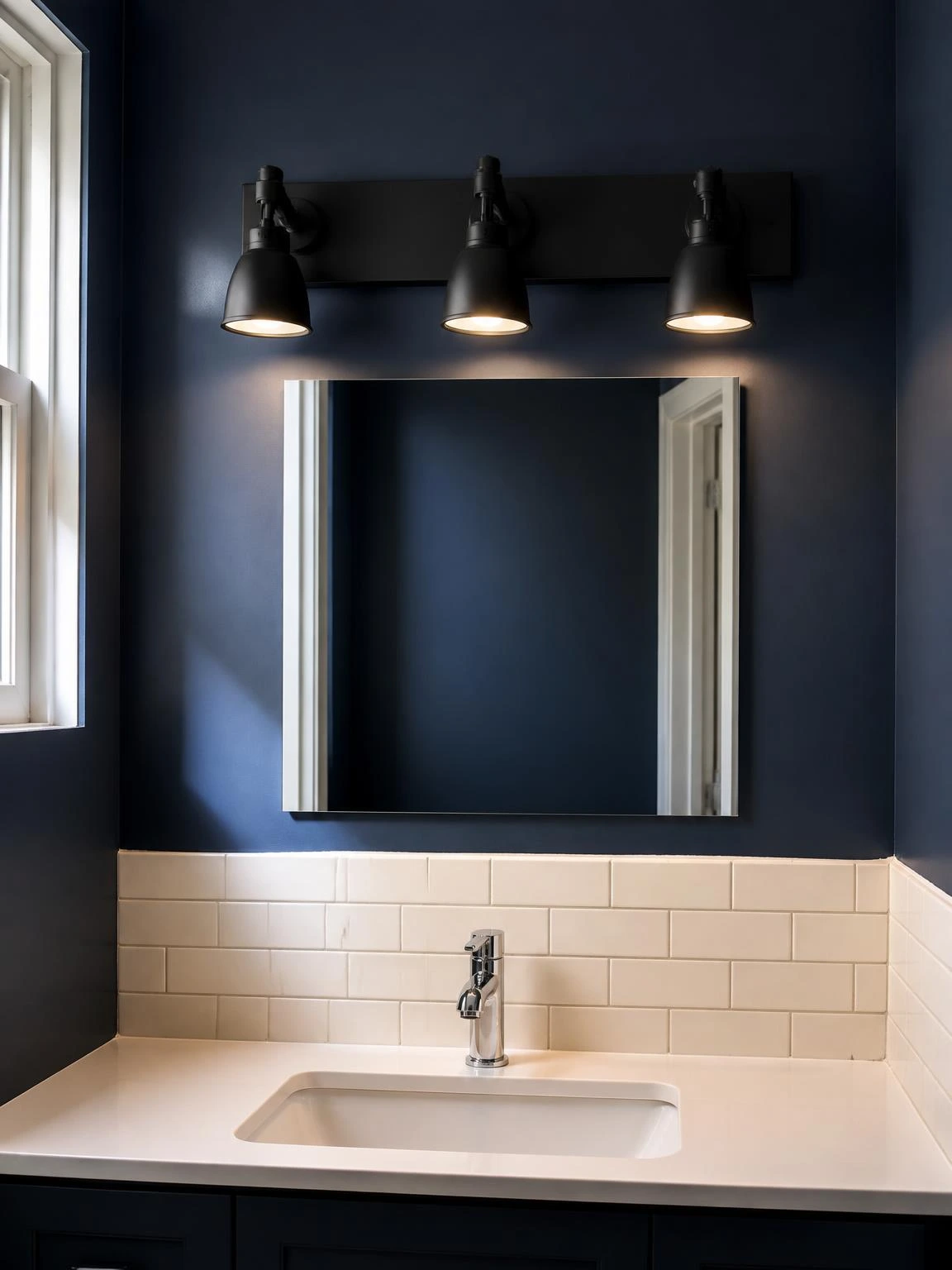
The single-bulb bracket that comes standard in many builder bathrooms is usually undersized, poorly positioned, and held in place by the world’s most optimistic mounting screws.
A three-head adjustable-arm light bar in matte black centered above a frameless mirror is a direct replacement that takes the same junction box and covers substantially more of the mirror width.
Each swivel head aimed slightly downward toward the mirror face keeps the light directed where it is actually useful rather than straight at the ceiling.
The new backplate needs to be at least as wide as the old fixture’s mounting holes; if it is not, patching and repainting the wall becomes part of the project.
Confirm the mounting hole spacing on the new fixture matches the existing junction box, or pick up a crossbar adapter plate rated for the fixture’s weight before starting the swap.
Against navy walls with an ivory tile backsplash, matte black hardware reads clean and deliberate rather than fussy.
10- Night Light Outlet in Bathroom Hall
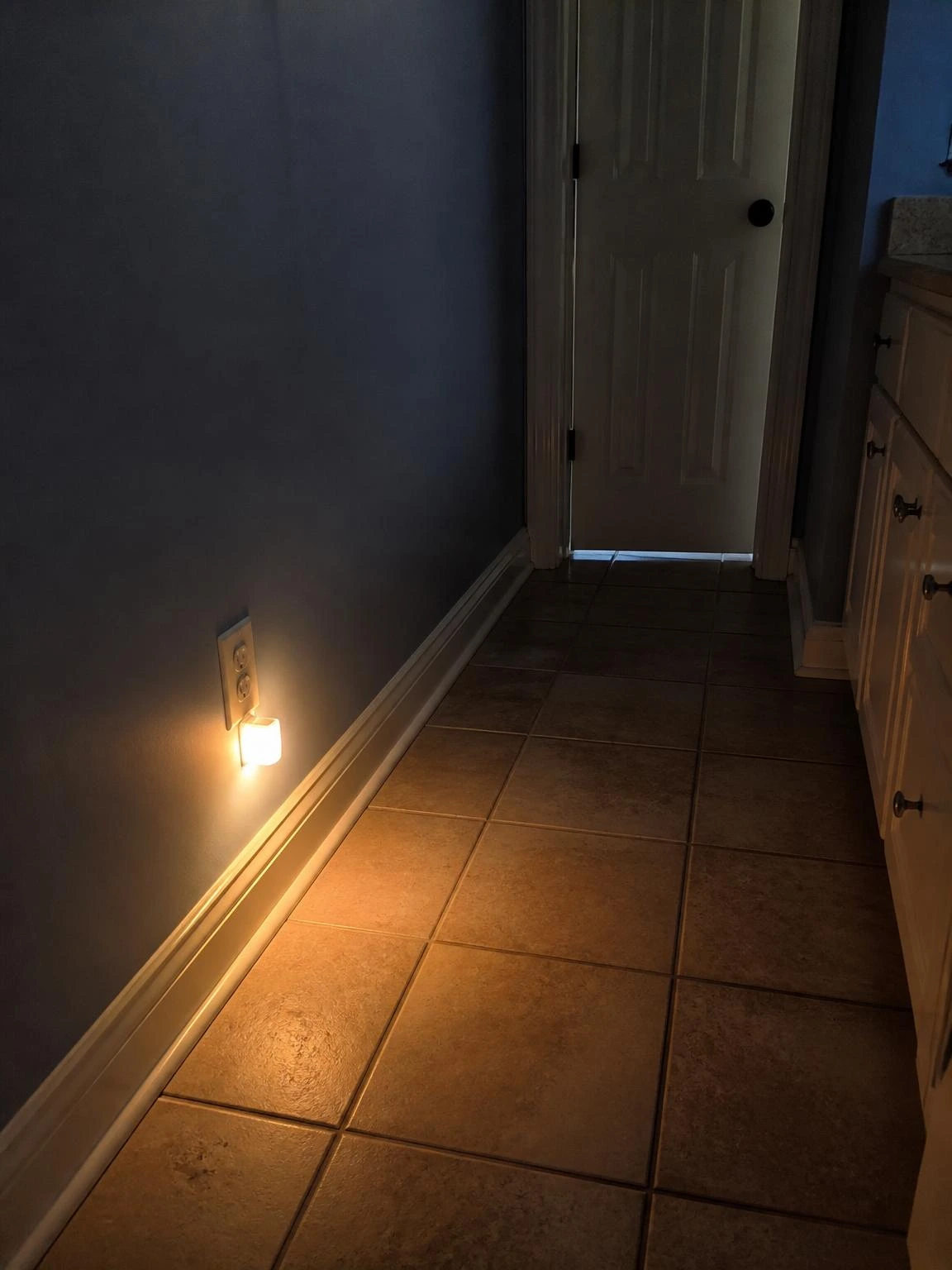
A plug-in LED night light in a low bathroom outlet is one of those small additions that earns its place the first time someone avoids turning on the overhead light at 3 a.m.
A dusk-to-dawn sensor model switches on and off automatically and draws under half a watt, which makes it essentially free to run.
Pale amber output is easier on adjusted eyes in a dark hallway than cool white, and it illuminates the floor tile immediately around the outlet without flooding the room.
Dusty-blue walls and warm white baseboard trim look quiet and intentional under a low amber glow, which is a pleasant side effect of a purely functional product.
The one practical consideration is whether an oversized night light body blocks the second socket on the outlet, particularly if a GFCI outlet or appliance cord needs that position.
Low-profile plug-in models that sit parallel to the wall rather than protruding outward avoid the blocking problem entirely.
11- Sconce Either Side of Bathroom Window
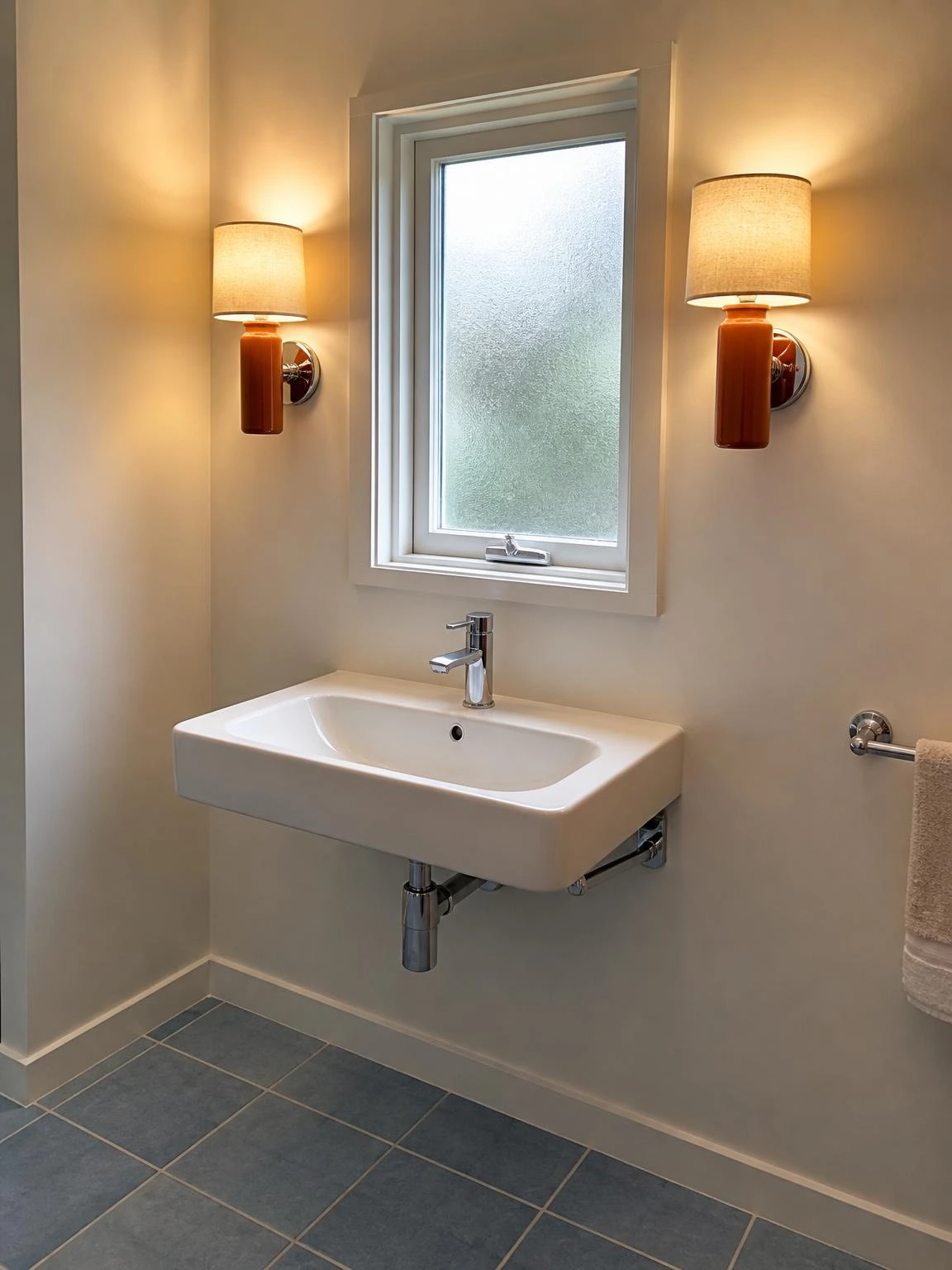
When the sink sits below a window and there is no clear mirror wall, flanking sconces on either side of the window serve as vanity lighting in an arrangement that is less common but works well.
Position the sconce centers level with the top third of the window so the light angle is closer to eye level than if they were mounted higher up the wall.
Ceramic cylindrical sconces in a terracotta glaze suit warm-white walls with muted blue floor tile; the earthen material handles bathroom humidity better than fabric alone.
If the sconces have linen drum shades, they need to be positioned well away from any direct water spray, which practically means the sink should sit at least 18 inches back from the window.
Overcast daylight through a frosted casement window and warm sconce light merge into a surprisingly even, flattering combination that works for both grooming and general use.
This layout also means the window provides natural ventilation without any fixture in the way, which is a useful side benefit in a smaller bathroom.
12- Lighted Medicine Cabinet
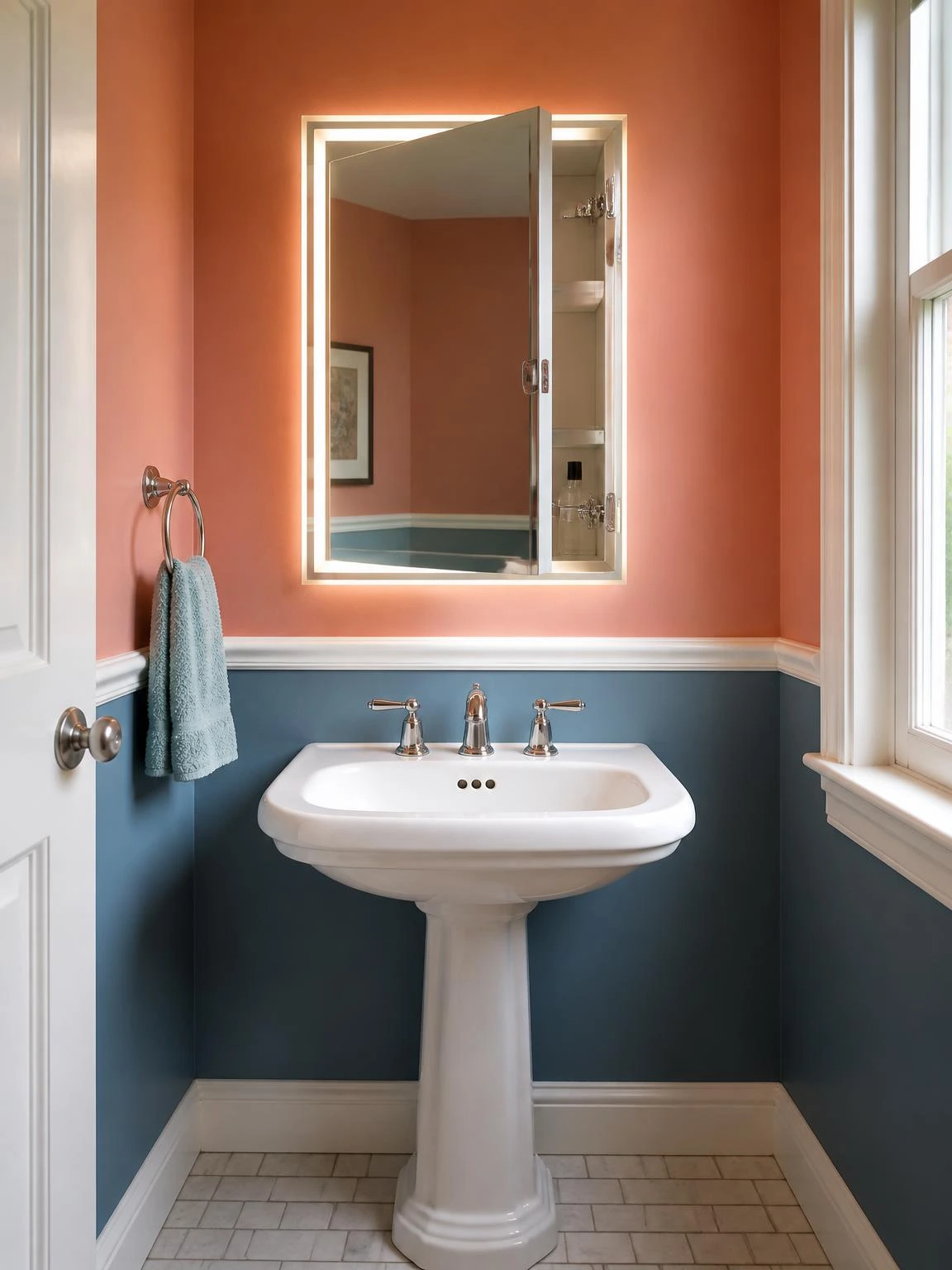
A recessed lighted medicine cabinet replaces both the mirror and the vanity light in a single installation, which is a reasonable trade in a bathroom where wall space is genuinely limited.
The integrated LED perimeter strip casts light forward from around the mirror frame, which is a similar principle to side sconces but built into the unit.
The cabinet needs a minimum 3.5-inch wall cavity, which most interior partition walls provide; the important step before cutting is confirming no plumbing or wiring runs through that specific section.
Soft coral walls around the cabinet and a white pedestal sink below make the recessed installation look intentional rather than like a space-saving compromise.
Chrome hinges and a magnetic catch on the mirrored door keep the hardware simple and compatible with the faucet hardware already in the room.
Cutting into an exterior wall is a different situation entirely since it can compromise insulation and vapor barrier; a recessed cabinet is a much safer project on an interior partition wall.
13- Warm vs Cool LED Color Temperature
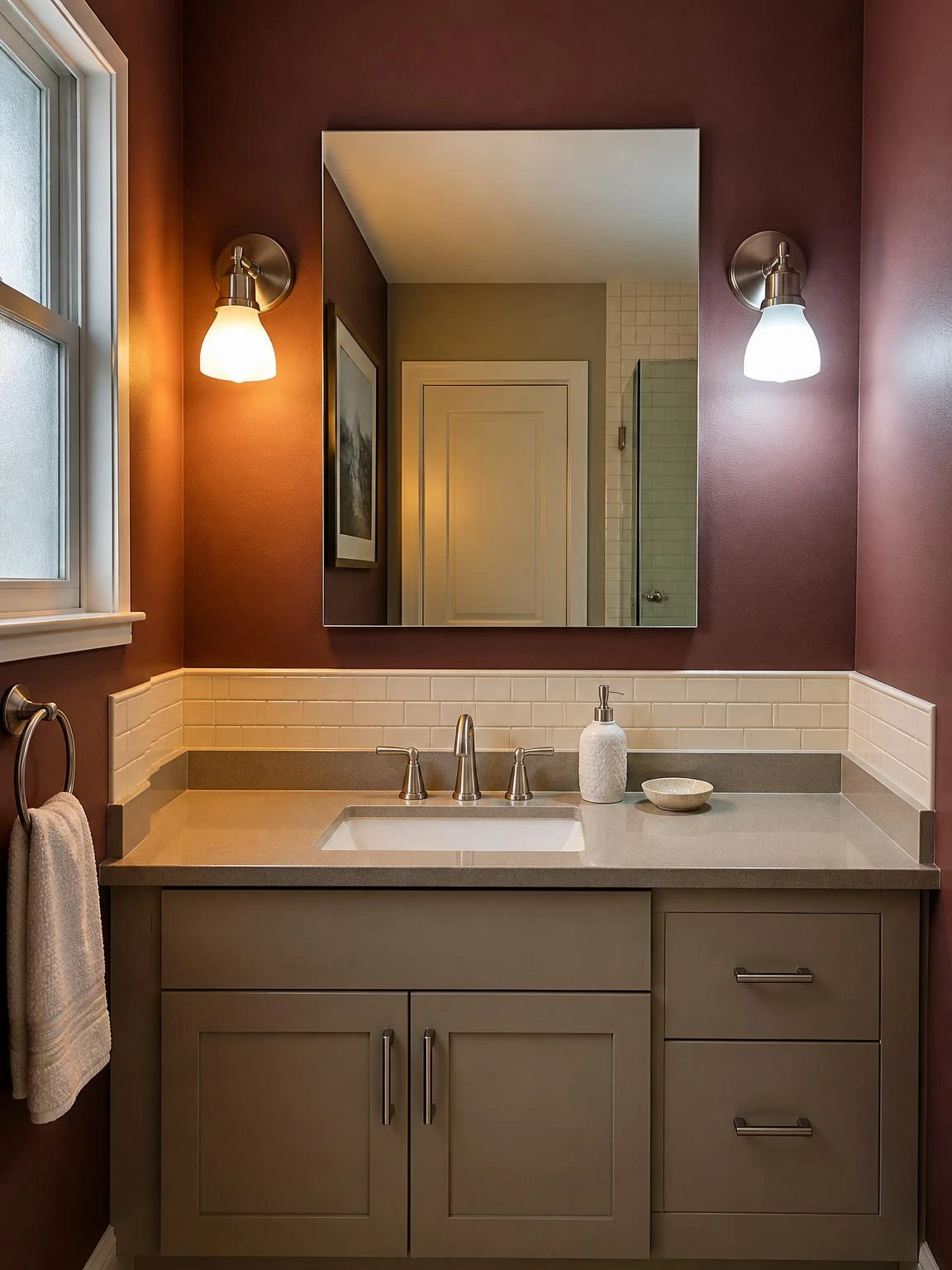
Color temperature is the one LED specification that affects everyday satisfaction with bathroom lighting more than almost anything else, and it is still the detail most people skip when buying bulbs.
The visible difference between a 2700 K bulb and a 5000 K bulb in the same fixture is significant: one reads warm amber-white and the other reads distinctly blue-white.
For grooming accuracy, the 3000 to 3500 K range is the practical sweet spot; below 2700 K obscures skin tones in ways that matter for makeup, and above 5000 K reads clinical in a home bathroom.
Against burgundy walls and a warm-gray countertop, a 2700 K bulb can make the room feel cozy but makes color matching difficult; the same room at 3000 K keeps warmth while adding usable accuracy.
Wall color shifts the apparent temperature of the light in the room, so testing the actual bulb in the actual bathroom before buying a full set is always worth the step.
Most hardware stores sell single LED bulbs, which makes a direct side-by-side comparison in the space easy and inexpensive to do before committing.
14- Toe-Kick LED Strip Under Vanity
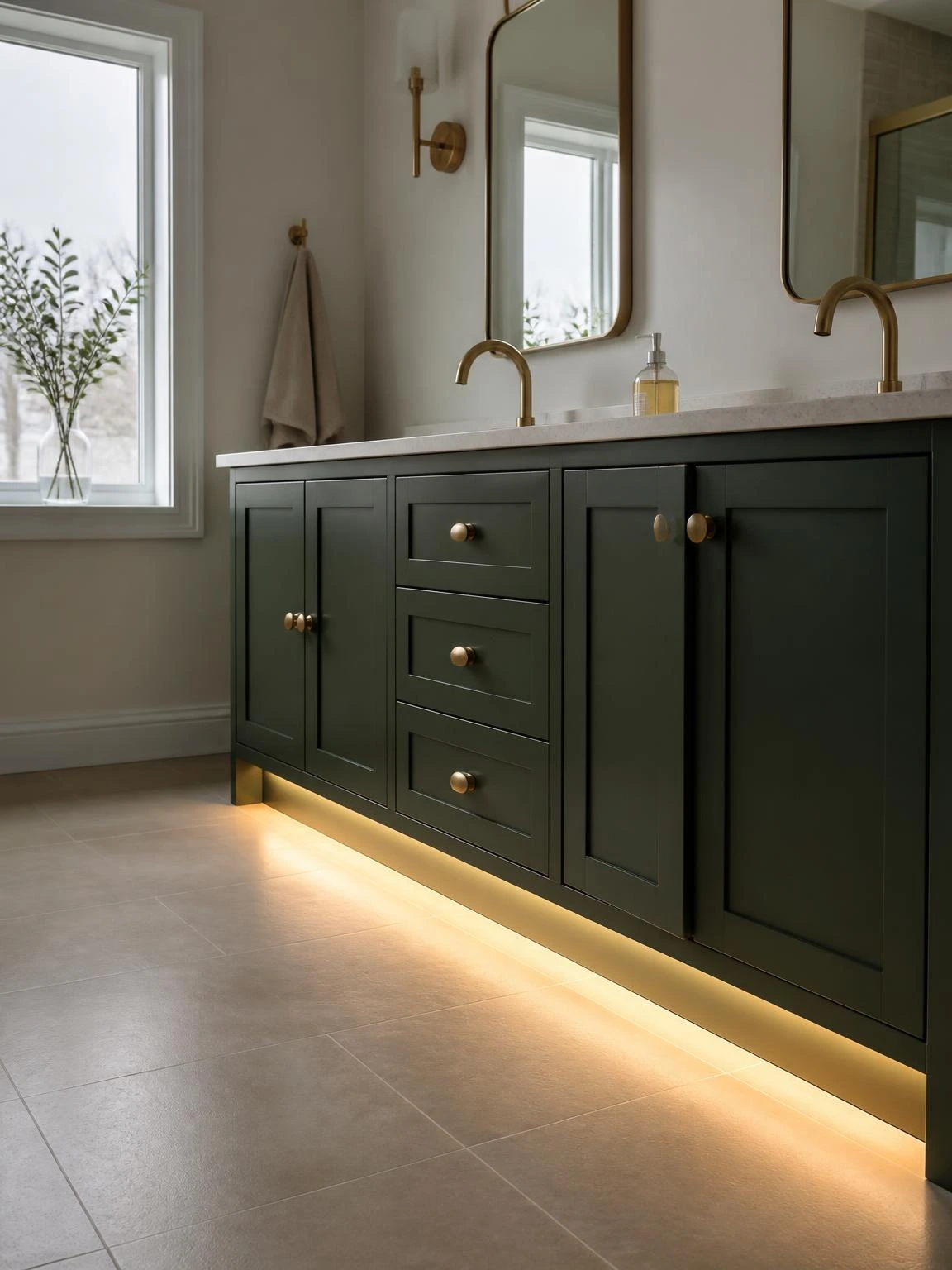
An LED strip in the toe-kick recess of a bathroom vanity creates a floating visual effect for the cabinet and adds enough floor-level glow to navigate the room at night without overhead light.
A continuous warm-white strip running the full length of the toe-kick on a forest-green double vanity picks up the brass hardware above it and the warm-neutral floor tile below simultaneously.
Use an IP65-rated strip in an aluminum channel; the channel diffuses the individual LED dots into an even line and protects the strip from any water that reaches the floor.
Power the strip through a plug-in transformer inside the vanity cabinet, with the cord routed through the cabinet interior so no connections are exposed near floor level.
All splice points need to sit inside the cabinet above floor level; exposed low-voltage connections near standing water in a bathroom are a problem even at 12 volts.
An IP44 rating is the minimum for a bathroom environment; IP65 is a better choice here given the proximity to a floor that gets mopped and occasionally wet.
15- Separate Toilet Compartment Light
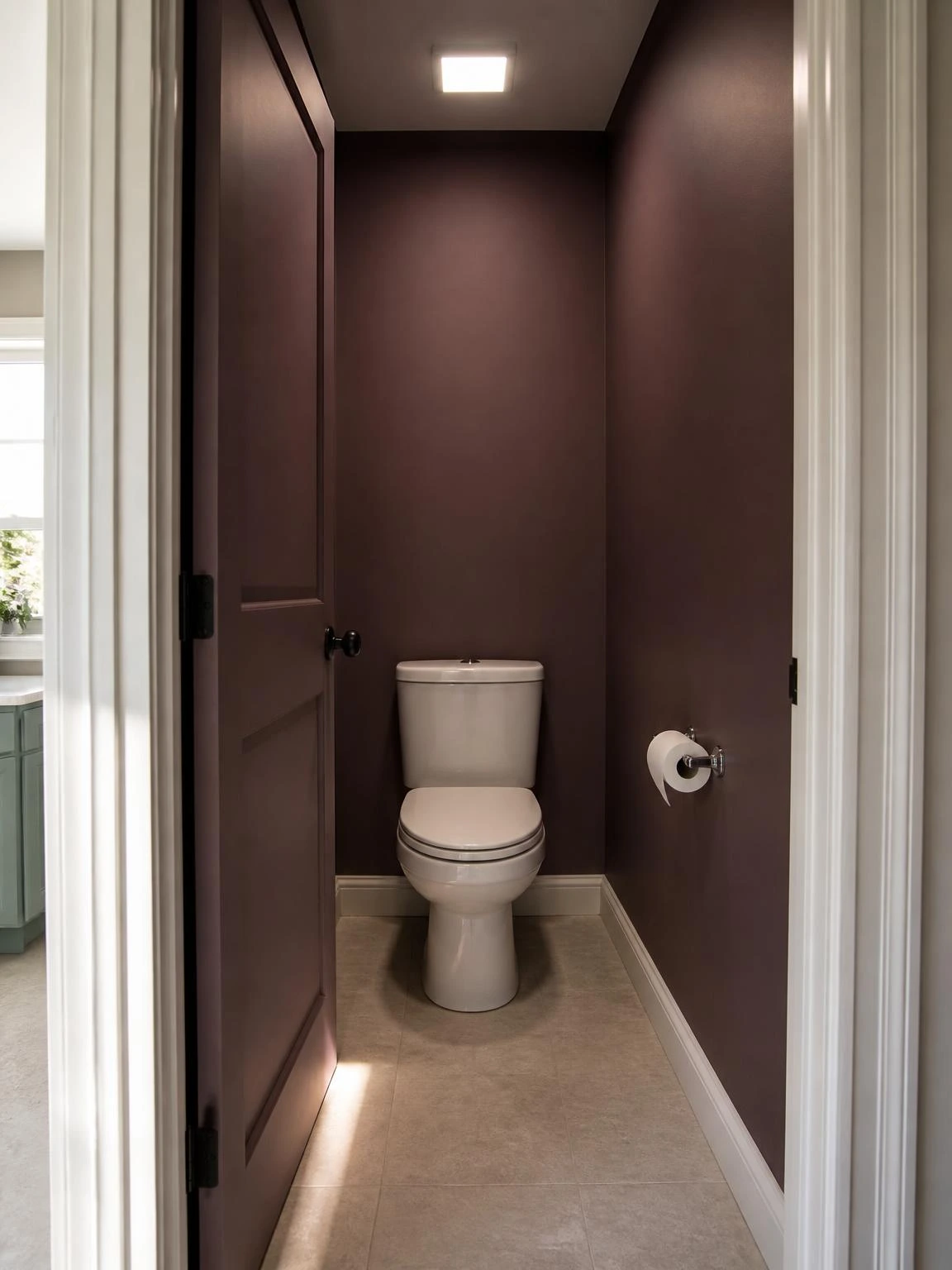
A toilet compartment with its own door genuinely needs its own light fixture, and relying on borrowed light from the main bathroom through a gap under the door is not a real solution.
A compact square flush-mount LED fixture centered on the ceiling of a 30-inch-wide compartment fits the space without looking oversized or creating glare in a small enclosed area.
One 600-lumen fixture is adequate for a compartment under 50 square feet; exceeding that in a small enclosed space creates uncomfortable glare with no functional benefit.
Muted plum walls and stone porcelain floor tile in a compartment read dramatically different under a good cool-white fixture versus a warm one, so the 3000 K range applies here too.
A motion-activated fixture is a practical choice in a toilet compartment since it eliminates the fumble for a switch in the dark and turns itself off reliably.
The compartment needs its own switched circuit or a switched leg from the main bathroom panel; a licensed electrician can confirm the best approach for the existing panel configuration.
Where do you want to go next?

Explore by topic
Recently viewed
16- Chandelier in Master Bathroom
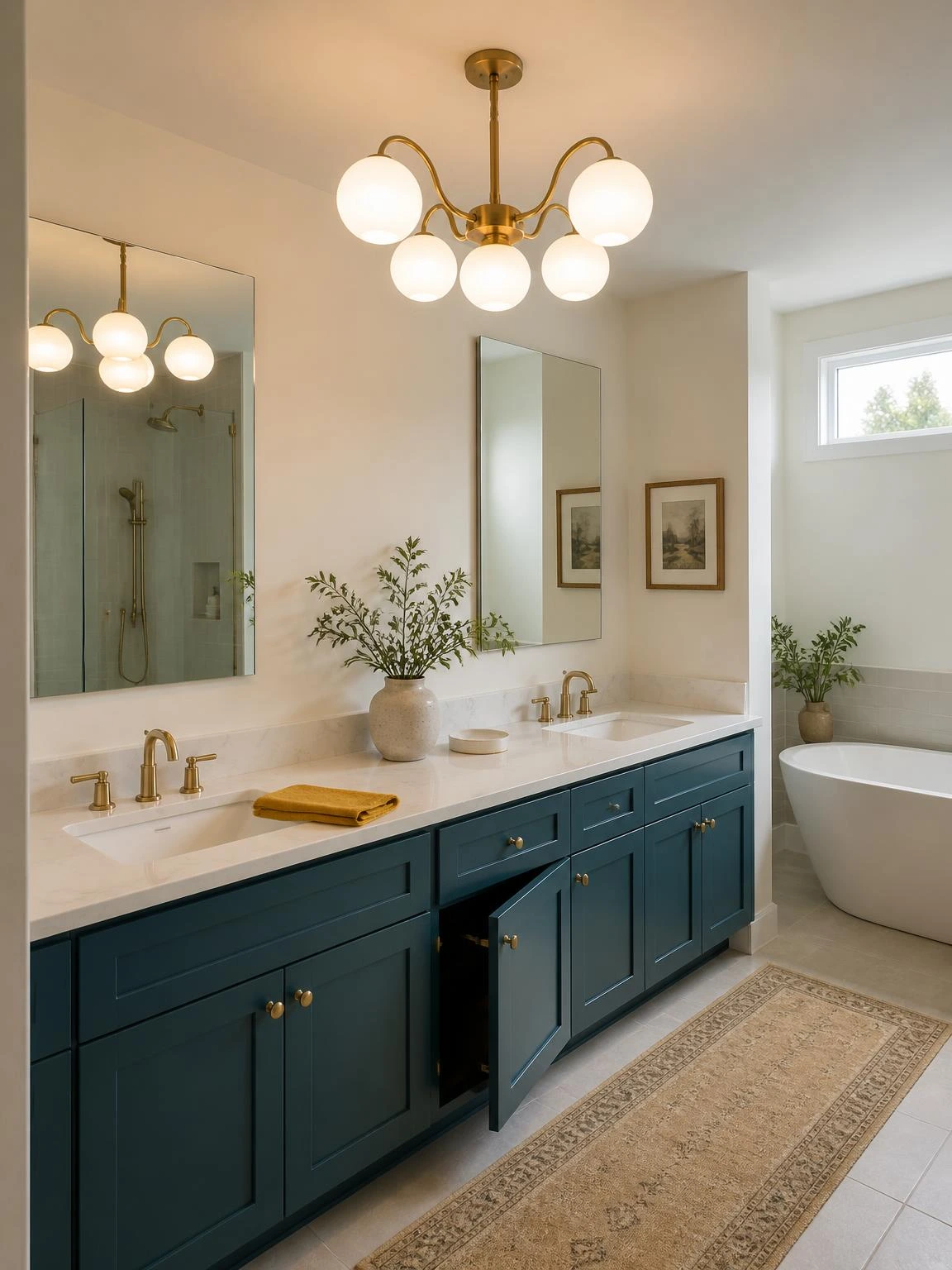
A small chandelier in a master bathroom is a fully functional choice, not an indulgence, as long as the ceiling height supports it and the fixture carries a damp-location rating.
A five-arm aged-brass chandelier with opal globe shades centered over a double-sink vanity in deep teal cabinetry gives the room a clear focal point between two mirror panels.
The lowest point of the chandelier needs to sit at least 7 feet from the finished floor; in a bathroom with an 8-foot ceiling, that leaves only 12 inches of drop, which limits fixture choice considerably.
Opal glass globe shades handle humidity far better than fabric shades, which are not appropriate in a high-moisture bathroom unless specifically rated for the exposure.
Marble-look porcelain countertop and a mustard-yellow accent towel both read well under the warm-white output of the opal globes, which is a small reminder that the countertop material affects how luxurious the room feels under decent light.
Verify joist load capacity before installation; a five-arm brass fixture weighs meaningfully more than a standard ceiling box is rated to support without a fan-rated brace.
17- Motion Sensor Bathroom Light Switch
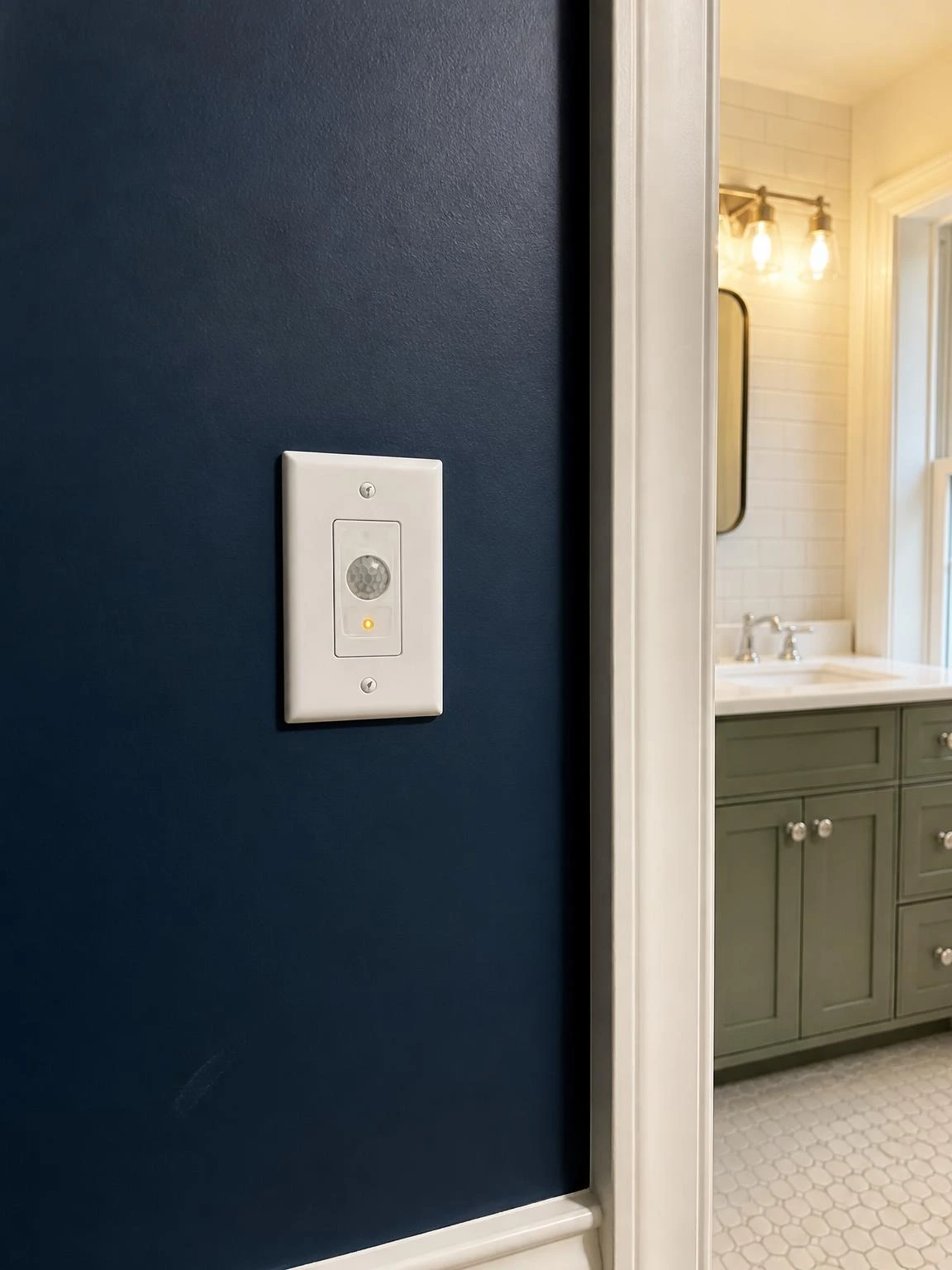
A passive infrared occupancy sensor switch in a standard single-gang box is a direct replacement for a manual switch and requires no new wiring in most bathrooms.
The main adjustment most people get wrong is the time-delay setting; a short delay of one or two minutes is appropriate for a hallway but not a bathroom, where the switch can turn off during a shower when steam limits detection range.
Set the delay to at least 5 to 10 minutes to account for steam interference in an enclosed bathroom, particularly one without strong ventilation.
Against a navy wall with ivory door trim, a white thermoplastic plate at standard switch height reads clean and unobtrusive; the sensor grille on the face is the only visual difference from a standard switch plate.
Compatibility matters before purchase: some motion sensors do not work with LED fixtures or three-way switch configurations, and the packaging usually states this clearly if the specifications are read carefully.
For households with young children or elderly family members, the automatic-on function is genuinely useful since it removes the need to locate a switch in a dark room entirely.
Making the Most of Your Bathroom Lighting
Good bathroom lighting rarely comes from a single fixture doing everything at once.
Layering ambient, task, and accent sources, even in a small bathroom, is what separates a room that works from one that merely has the lights on.
Most of these ideas are compatible with each other, so adding a dimmer to existing sconces or a toe-kick strip to an already-decent vanity setup costs relatively little and adds a lot of daily usefulness.
A well-lit bathroom is most noticeable at the moments when it counts: early mornings, late nights, and the times when the face in the mirror actually needs to be seen clearly.