
20 Kids Study Table Designs That Actually Work in Real Rooms
A homework session that starts with a lost pencil and ends in a meltdown is not really about the pencil.
The study table design for kids that a family chooses quietly shapes how smoothly those after-school hours go.
Most kids’ bedrooms in ordinary North American and British homes are not large, and the desk often has to share space with a bed, a wardrobe and whatever sporting equipment has migrated off the floor temporarily.
The twenty ideas here cover a range of room sizes, budgets and ages, from a toddler just starting to draw to a teenager managing a laptop and a full homework load.
Each one solves a specific problem rather than simply looking good in a photograph.
1- Corner Study Table with Built-In Shelves
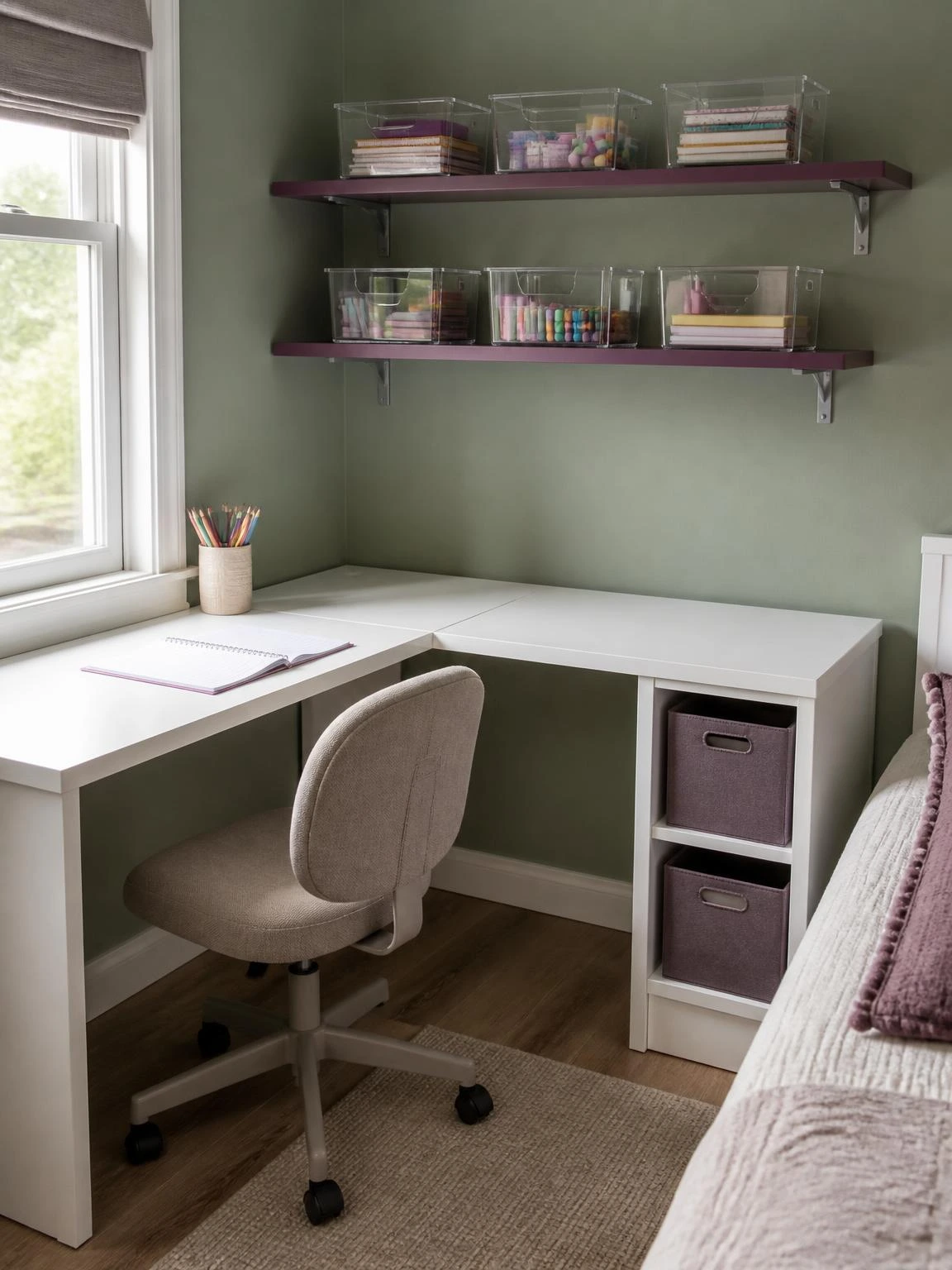
A bedroom corner is often the most wasted square footage in a child’s room.
An L-shaped white laminate desk fitted into the corner junction uses that dead space and gives a child two distinct surface zones, one for writing and one for a laptop or art project.
Wall-mounted shelves in muted plum above the desk, holding labeled clear acrylic bins, keep the actual desk surface open rather than buried under stacked books.
Position the lowest shelf at least 18 inches above the desk surface so a child has genuine headroom while seated and does not feel like they are sitting inside a cabinet.
A stone-colored upholstered adjustable chair completes the corner without adding visual noise, and the soft green accent wall behind the setup gives the corner a defined, intentional character.
Measure both walls of the corner carefully before ordering; an irregular wall junction may need a custom-cut worktop rather than a standard flat-pack L-desk.
2- Wall-Mounted Fold-Down Study Table
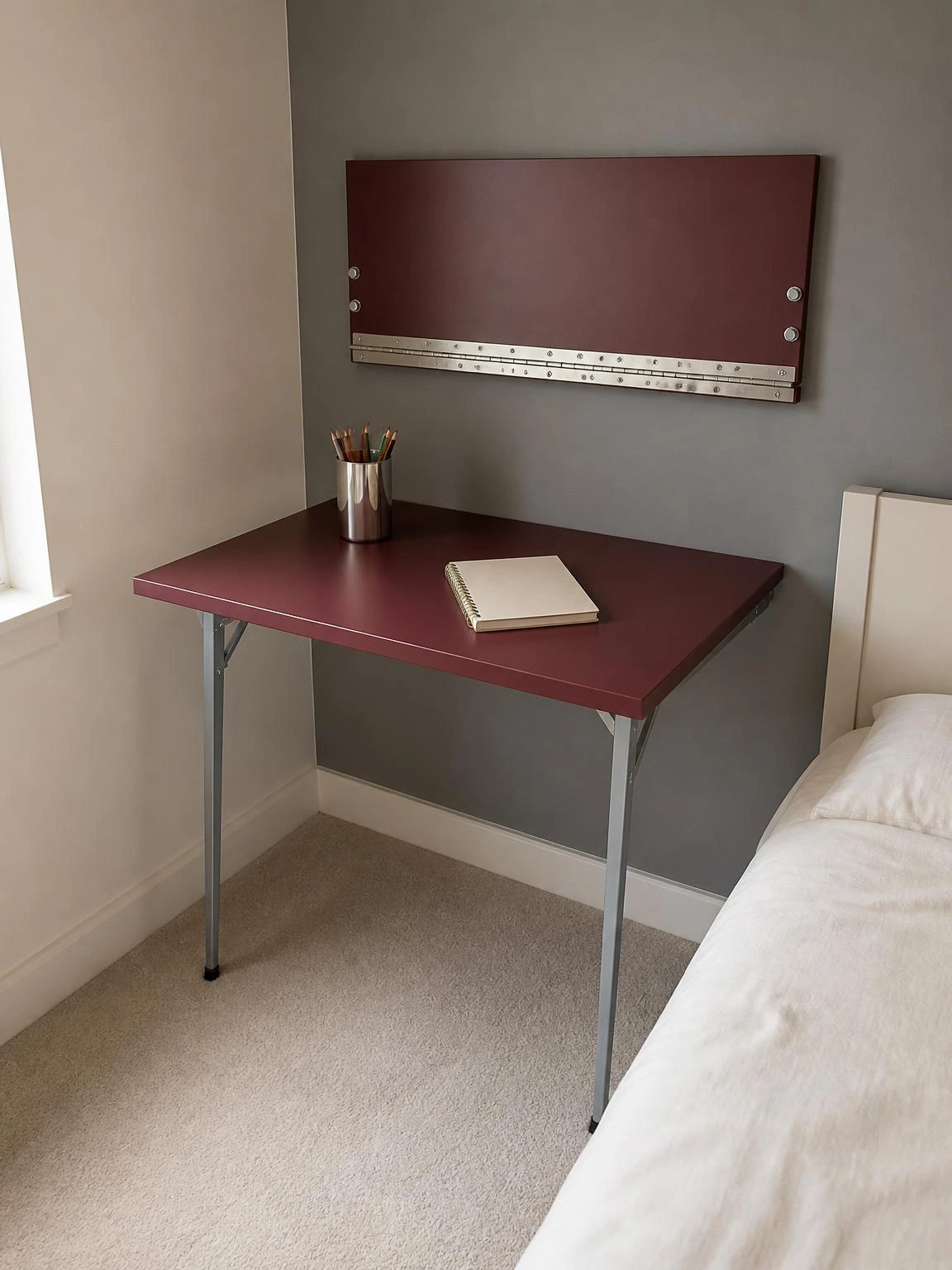
In a narrow kids’ bedroom where floor space is genuinely precious, a fold-down study table mounted to a warm gray wall can free almost the entire floor when homework is done.
A burgundy-painted MDF board hinged to the wall with a piano hinge drops open on folding metal support legs to create a usable surface at child desk height.
The hinge must be anchored into wall studs or fitted with masonry anchors rated for at least 50 pounds, because a child leaning on the open table puts real lateral stress on the mount.
An ivory painted side wall keeps the small room feeling open, and the contrast with the burgundy table makes the fold-down feel like a design choice rather than a compromise.
The surface area is genuinely limited, so this works best as a secondary desk or a dedicated homework station for a younger child who is not yet juggling large project materials.
A satin rather than gloss paint finish on the board resists fingerprints better and looks more considered in a room with natural light.
3- Height-Adjustable Study Table for Growing Kids
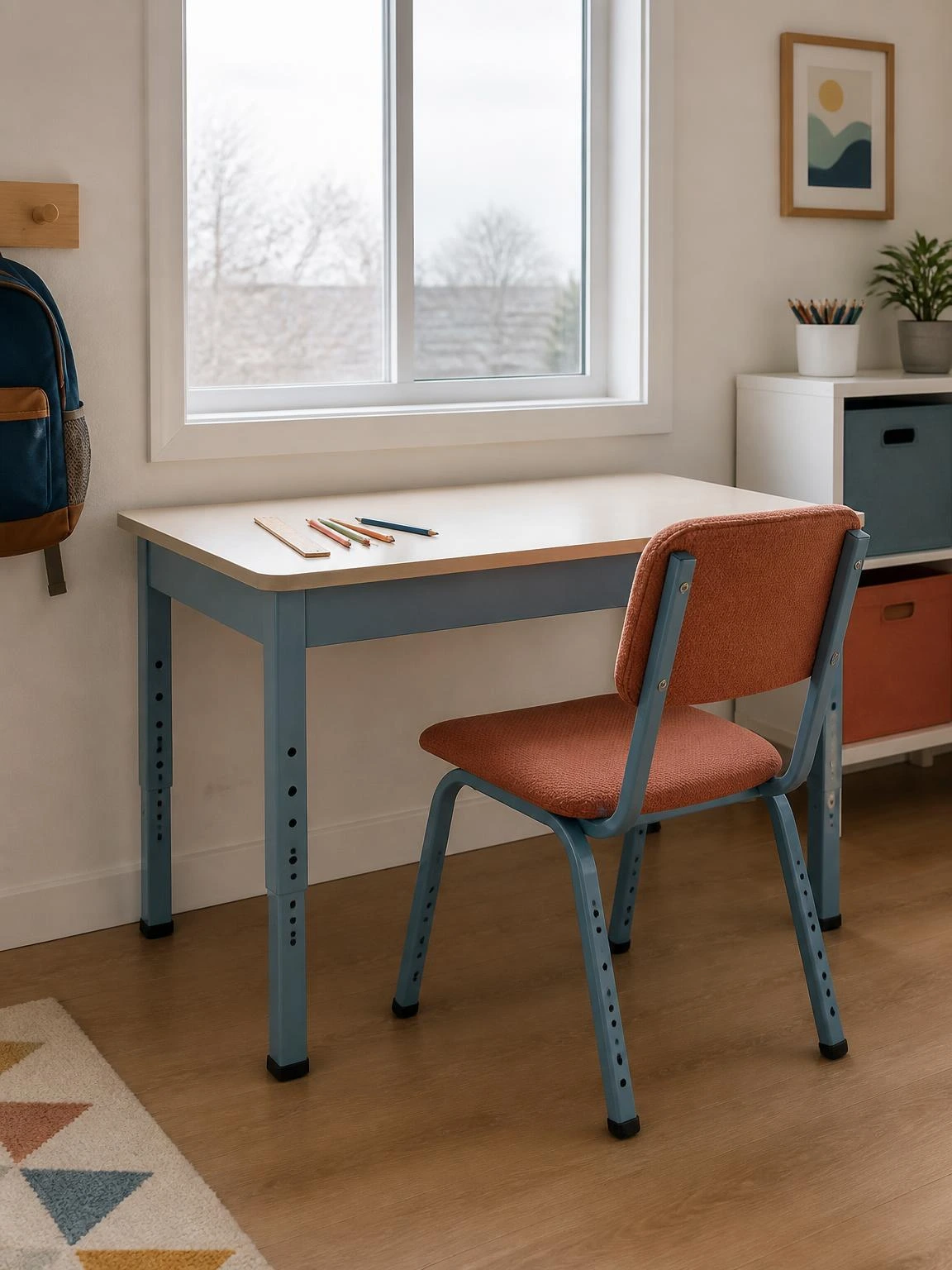
Children grow faster than furniture budgets allow, and a fixed-height desk that fitted a seven-year-old is wrong for the same child at ten.
A dusty blue steel-framed desk with pre-drilled height adjustment holes solves this without requiring a new purchase every few years.
The correct seated height places a child’s elbows at roughly 90 degrees with feet flat on the floor or a footrest, and that measurement changes noticeably each school year.
A terracotta fabric height-adjustable chair alongside a matching adjustable desk means both pieces grow together, which matters more than it sounds for sustained comfortable reading.
Pin-adjustment legs require an adult to briefly lift the tabletop during resetting; crank-mechanism models are easier for older kids to adjust independently without asking for help.
Rubber floor caps on all four legs protect wood floors and prevent the desk from creeping during energetic homework sessions.
4- Study Table with Pegboard Back Panel
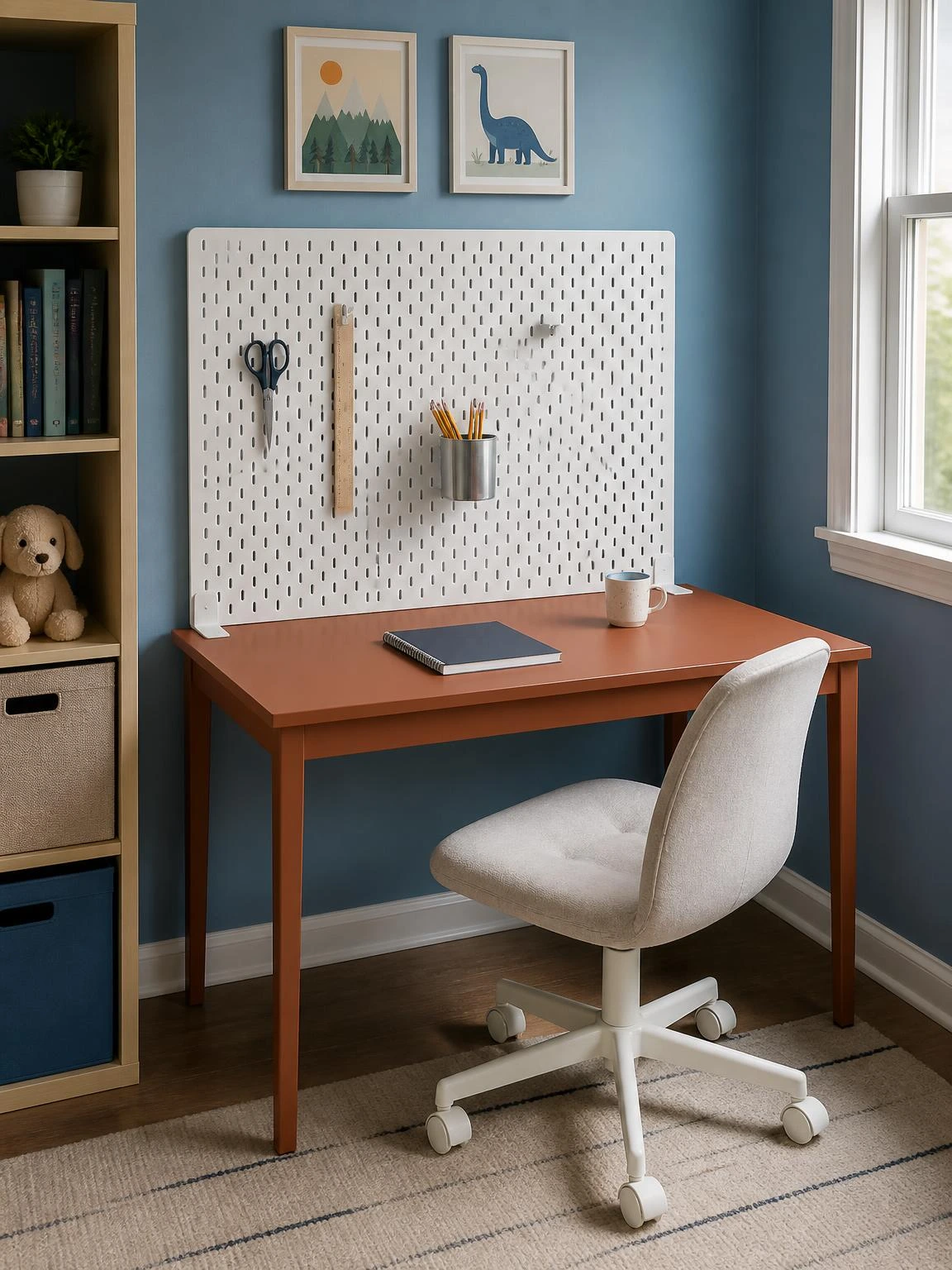
A pegboard panel rising from the back edge of a desk to near eye level turns an otherwise blank wall into an active supply wall that a child can actually manage themselves.
A white powder-coated steel pegboard behind a rust-colored laminate desk gives the setup a workshop quality that tends to appeal to kids who like their things visible and reachable.
Metal pegboard hooks hold scissors, a ruler and a small metal cup of pencils, all at a height the child can reach from the chair without stretching.
Keep the panel no taller than the child’s standing reach so they can hang things back up independently, which is the only way a pegboard system actually stays organized.
A soft blue wall visible on either side of the pegboard gives the setup visual breathing room and stops it from feeling like a workshop wall in a bedroom.
Use locking peg hooks rather than standard ones; ordinary hooks shift when bumped and supplies end up on the desk anyway.
5- Study Table with Hutch Organizer on Top
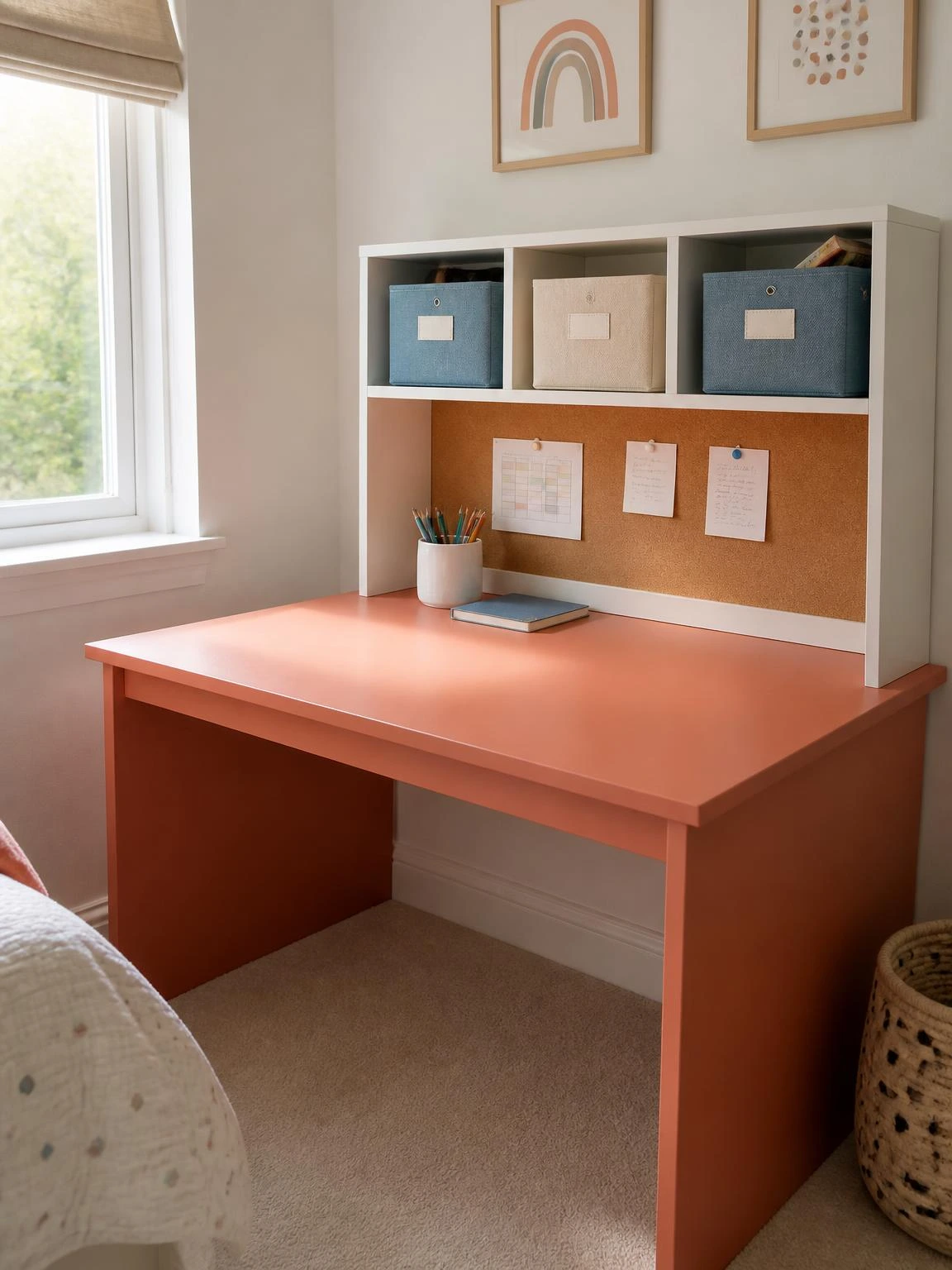
A hutch unit sitting on the rear half of a wide coral-toned laminate desk roughly doubles the storage of an ordinary desk without requiring extra floor space.
Open cubbies in the hutch holding labeled muted blue and stone cotton fabric bins give a child clear categories: one bin for each subject, or one for school and one for personal projects.
A cork strip inside the hutch is a small but useful detail, holding a weekly schedule or a few reminders at eye level without needing a separate pinboard.
Keep hutch cubbies no deeper than about 10 inches so a seated child can reach items at the back without standing up each time.
In a small bedroom, choose a hutch in a finish slightly lighter than the desk, because a heavy dark hutch on a dark desk can make a modest room feel quite closed in.
The front portion of the desk surface should stay clear for actual work; the hutch earns its place only if the system disciplines the storage rather than just relocating the clutter upward.
6- Shared Two-Child Side-by-Side Study Table
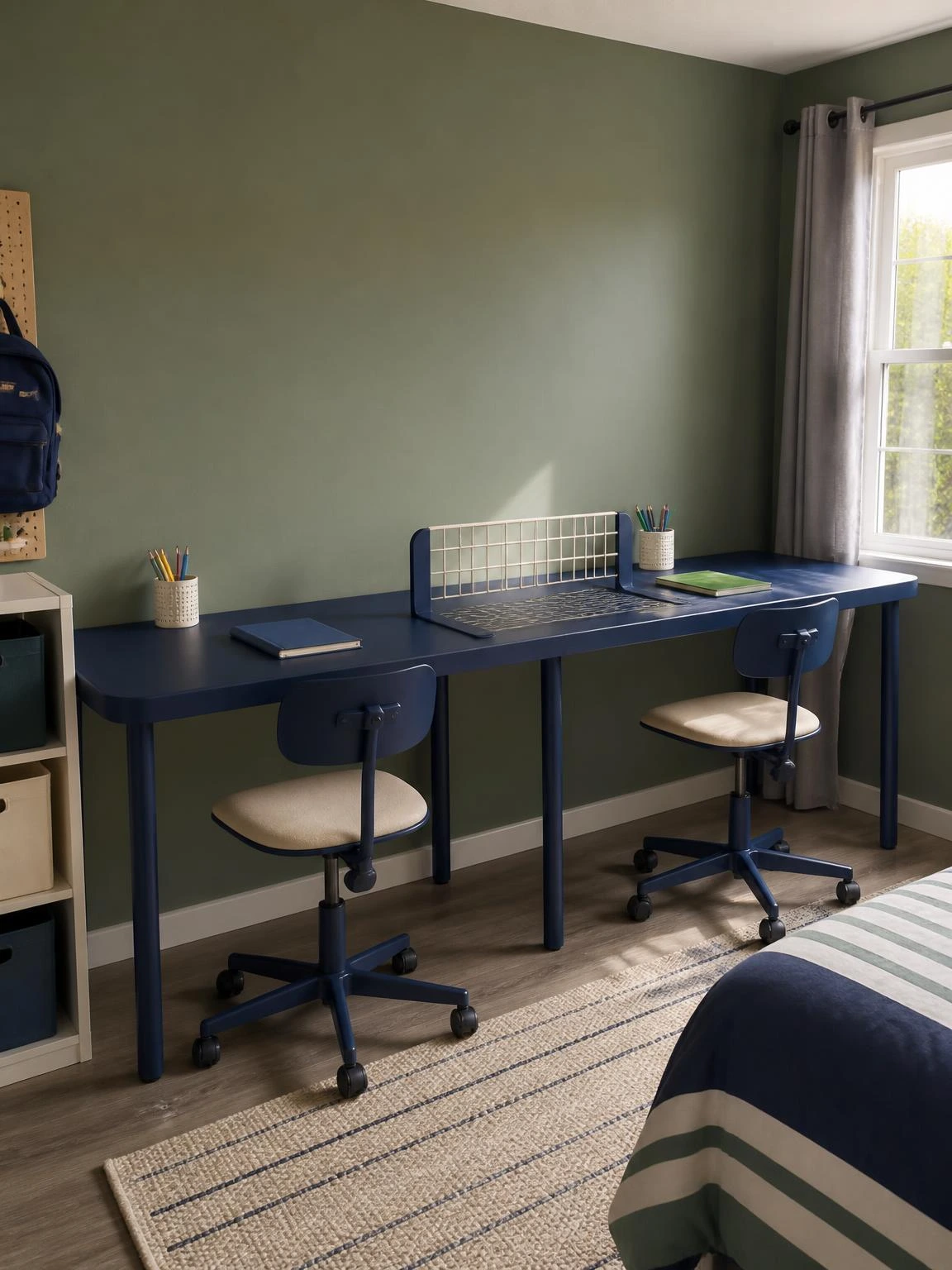
A long navy laminate table running the full width of a shared bedroom wall is a practical solution for siblings who need to study at the same time in the same room.
A low navy and ivory metal wire divider at the center creates two defined workstations without making the room feel partitioned, and at 8 inches tall it allows conversation without requiring it.
Each side gets its own pencil cup and supplies, which removes the single biggest source of desk-sharing conflict.
A muted green painted wall behind the whole setup ties both stations together visually so the long desk reads as furniture rather than an improvised arrangement.
Two matching adjustable chairs in the same finish matter here; mismatched seating at a shared desk tends to create a subtle sense that one child has the better setup.
Label each side’s storage from the start, because an unlabeled shared desk drifts toward the more assertive child’s territory within about a week.
7- Study Table with Dedicated LED Desk Lamp
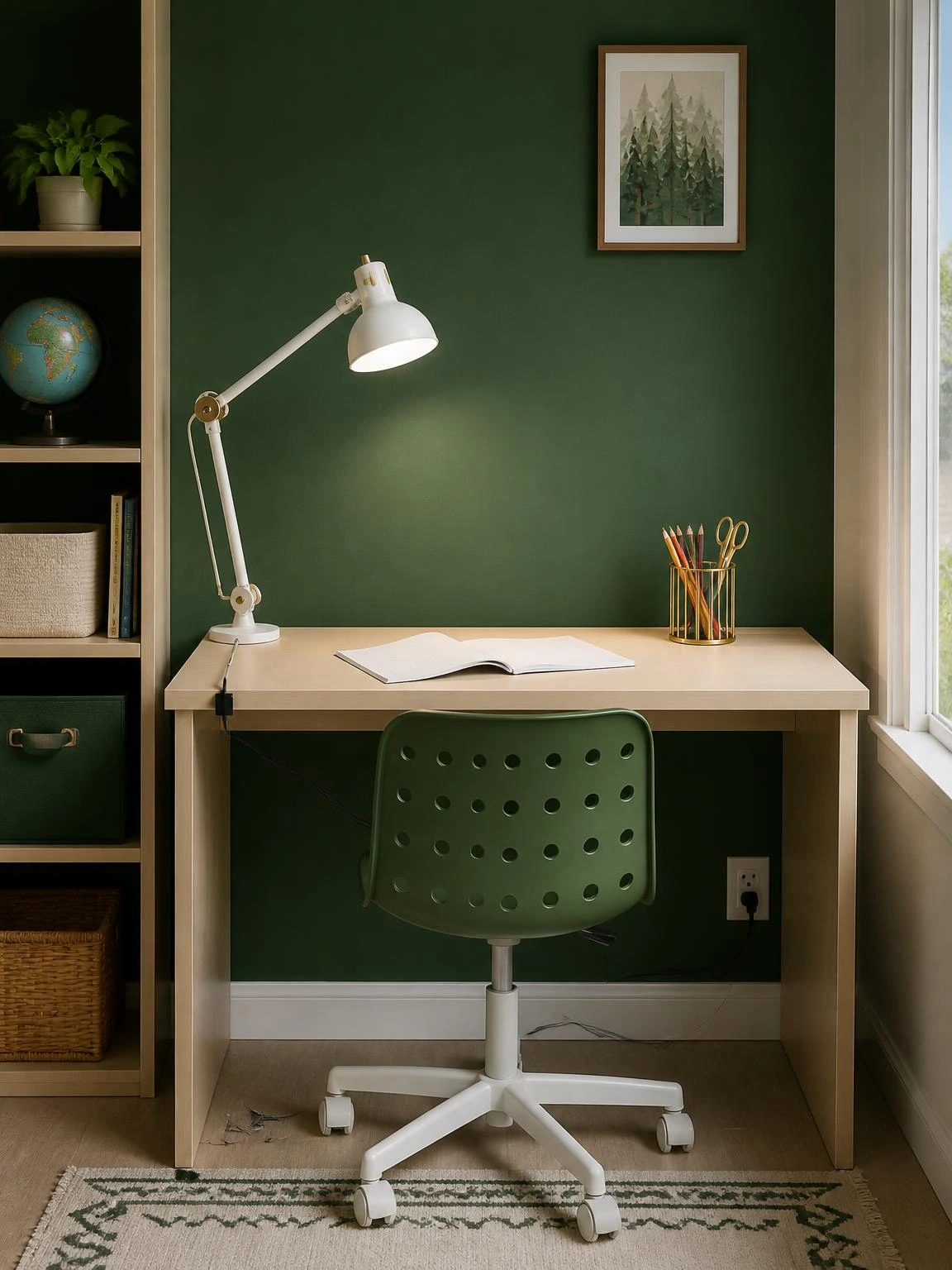
A forest green painted wall makes a warm neutral laminate desk feel anchored and intentional rather than just placed in a corner.
A matte white LED desk lamp clamped to the left rear corner of the desk is not decorative; it provides the focused task light that an overhead ceiling fixture alone rarely delivers on a work surface.
Position the lamp on the side opposite the child’s writing hand so their own arm does not shadow the notebook or the keyboard during use.
A clamp mount requires a desk edge of at least 1.5 inches; the thinner tabletops sold by several flat-pack retailers will not grip a clamp safely, and a weighted base lamp is the better choice in those cases.
A restrained brass-finish pencil organizer on the desk surface ties in with the lamp arm finish without making the setup feel overdone for a child’s room.
Running a cable management clip along the desk edge to a nearby outlet keeps the lamp cord off the floor, which matters in a room where a child and possibly a younger sibling are moving around.
8- Study Table with Under-Desk Drawer Pedestal
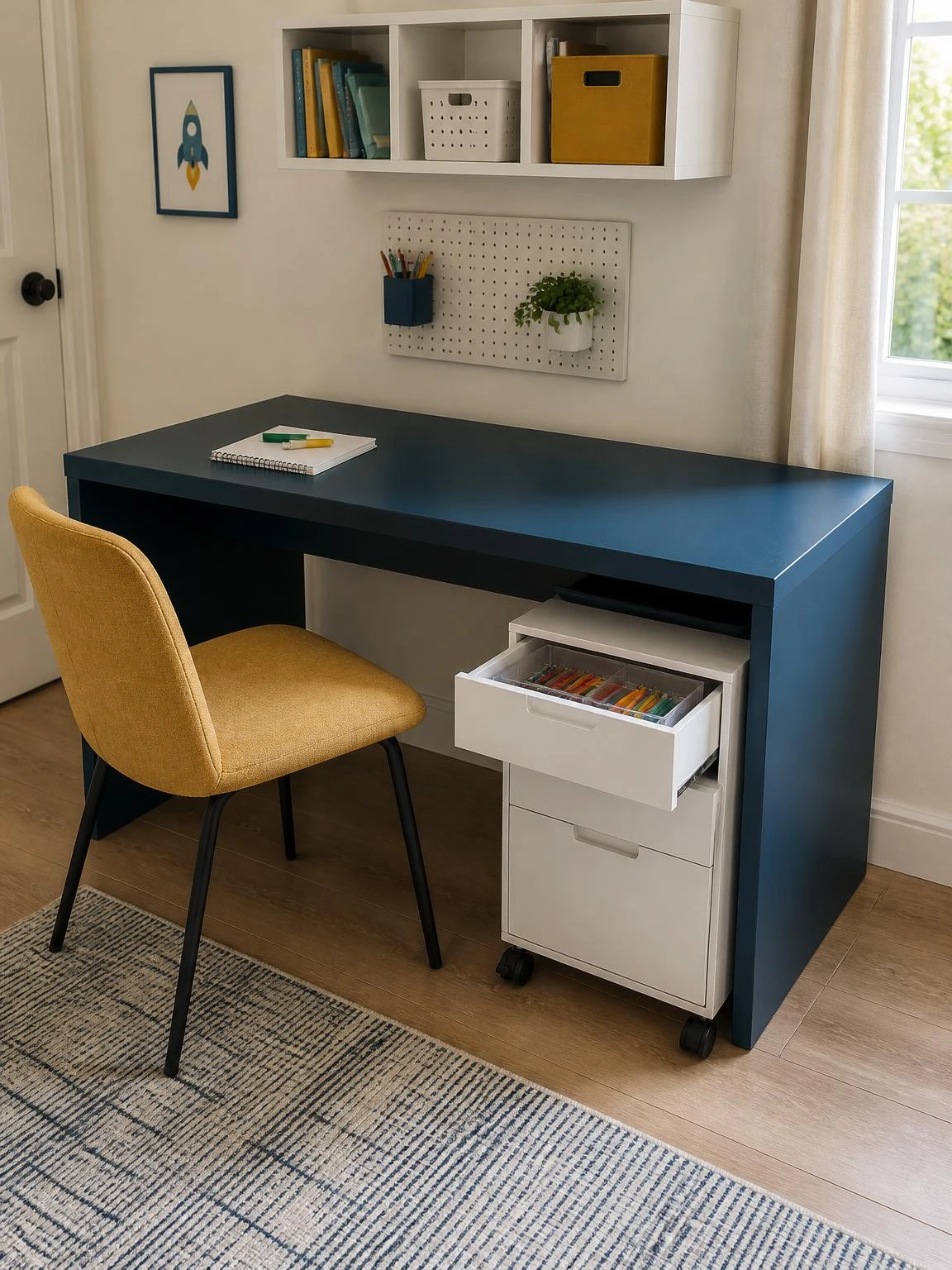
A rolling two-drawer pedestal tucked under the right side of a deep teal laminate desk keeps stationery, spare notebooks and art supplies out of sight but within arm’s reach.
The top drawer with a plastic pencil tray insert is one of those small organizational details that genuinely reduces the time spent searching before homework starts.
Choose a pedestal height at least 2 inches shorter than the desk’s underside clearance so it rolls in and out cleanly without scraping, which matters when a child is pulling it out quickly.
A restrained mustard-colored chair with metal legs against the warm white wall keeps the room feeling considered rather than purely utilitarian.
Castors on smooth flooring will let the pedestal drift during use unless the front wheels have a lock; a small lever castor lock takes about ten seconds to engage and prevents the pedestal from rolling away mid-session.
The diagonal three-quarter placement of the pedestal also gives a child a natural knee space on the left side of the desk and a storage zone on the right, which mimics how adults tend to organize a work setup instinctively.
9- Study Table Built into a Closet Nook
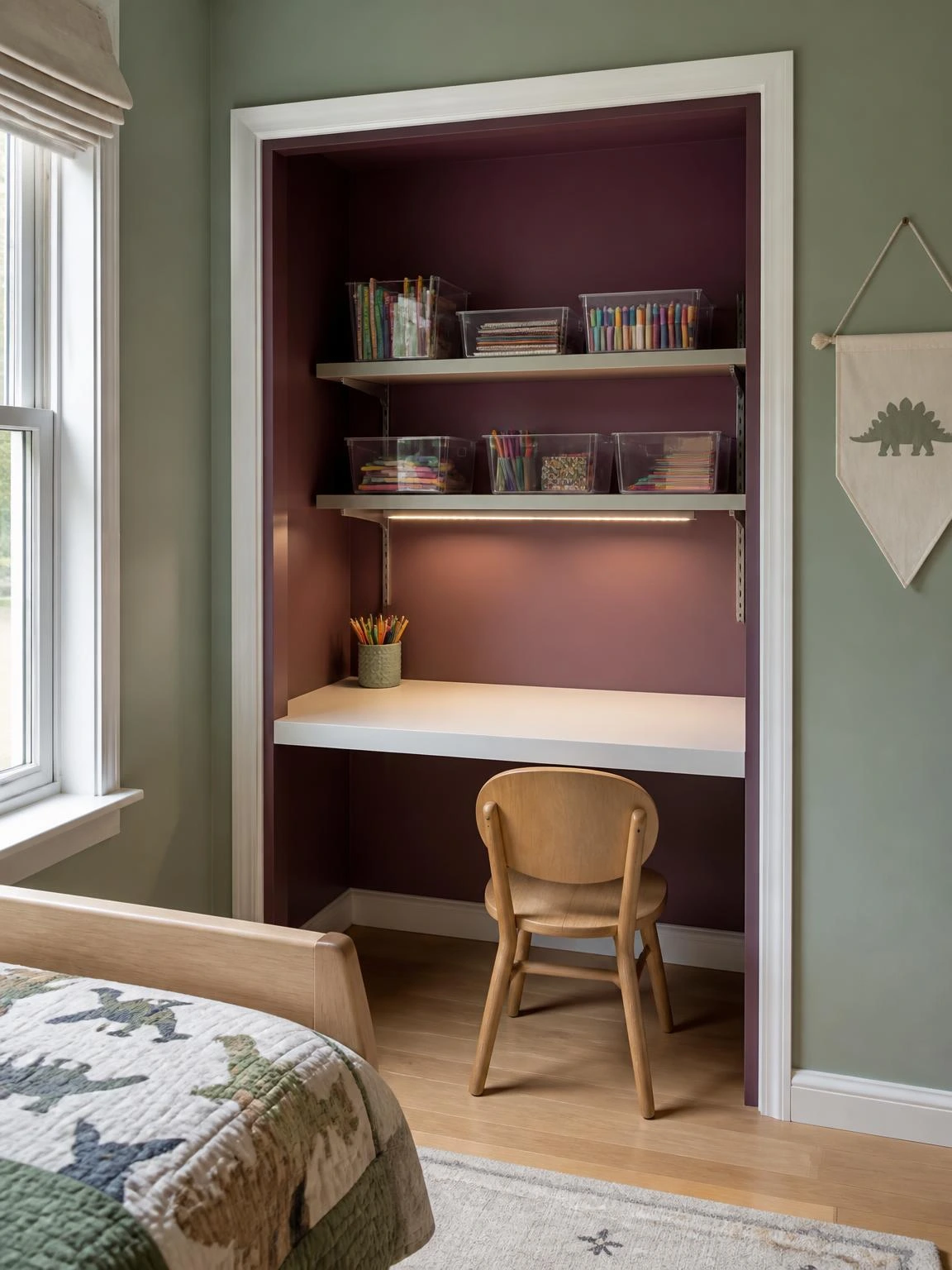
A standard wardrobe opening, typically about 24 inches deep and 36 to 48 inches wide, converts into a tidy study nook with a laminate desk board cut to fit the full width at child desk height.
Painting the alcove interior in muted plum while the bedroom wall outside is soft green makes the nook feel intentional and separate, like a small room within the room.
Wall-mounted shelf standards inside the alcove hold clear acrylic bins on stone-tone shelves above the desk surface, using the full height of the closet opening for storage.
The 24-inch depth that most wardrobes offer is workable for a child’s desk, but confirm that the chosen chair fits underneath with enough knee clearance before removing the wardrobe doors permanently.
Soft left window light entering the bedroom gives the nook indirect daylight, which is usually enough for daytime study; an under-shelf LED strip can supplement for evening homework.
The main appeal of this setup is psychological as much as physical: a child with a defined enclosed study zone tends to associate it with focused work in a way that an open desk in a busy room does not always achieve.
10- Study Table with Magnetic Whiteboard Panel
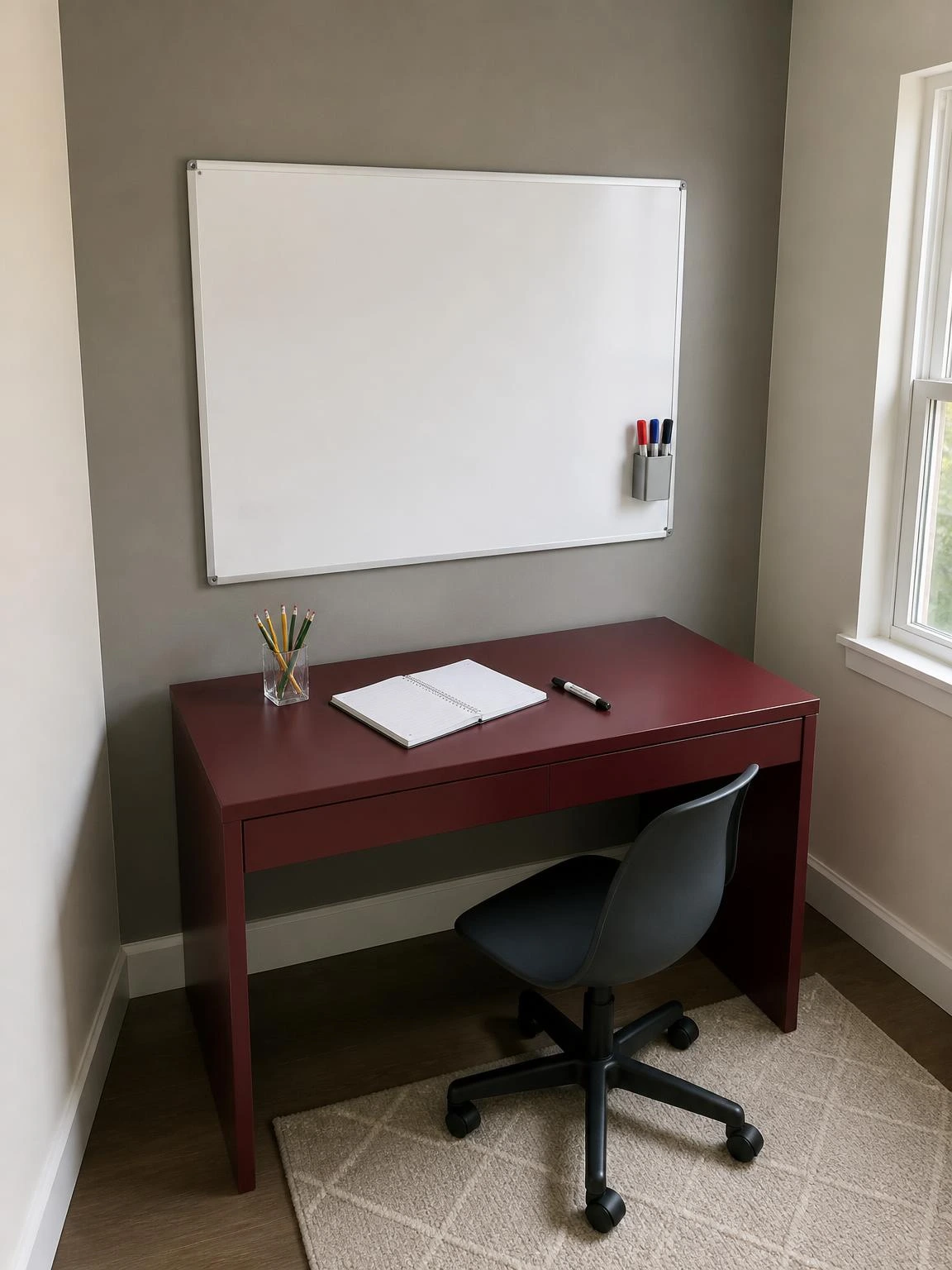
A large white magnetic whiteboard mounted flush to the warm gray wall above a burgundy laminate desk gives a child a working surface for reminders, homework plans and subject notes that does not involve printing anything out.
Mount the bottom edge of the board at the child’s standing eye level so they can write across the whole surface comfortably, because a board mounted for adult height becomes a board that only gets used in the top third.
A magnetic cup holder on the board itself holds dry-erase markers without them migrating to the pencil cup, the floor or the laundry.
Ivory painted side walls prevent the warm gray and burgundy combination from feeling too heavy, and the morning window light from the right keeps the whiteboard surface clearly visible during daytime use.
A porcelain-steel whiteboard surface resists the ghosting that appears on painted-steel boards after several months of heavy use; for a child who will use this daily, that difference becomes visible within a school year.
Anchor the board into studs or use anchors rated for the board’s weight; a whiteboard pulled from the wall by an enthusiastic child is a genuine hazard.
11- Study Table with Cable Management Tray
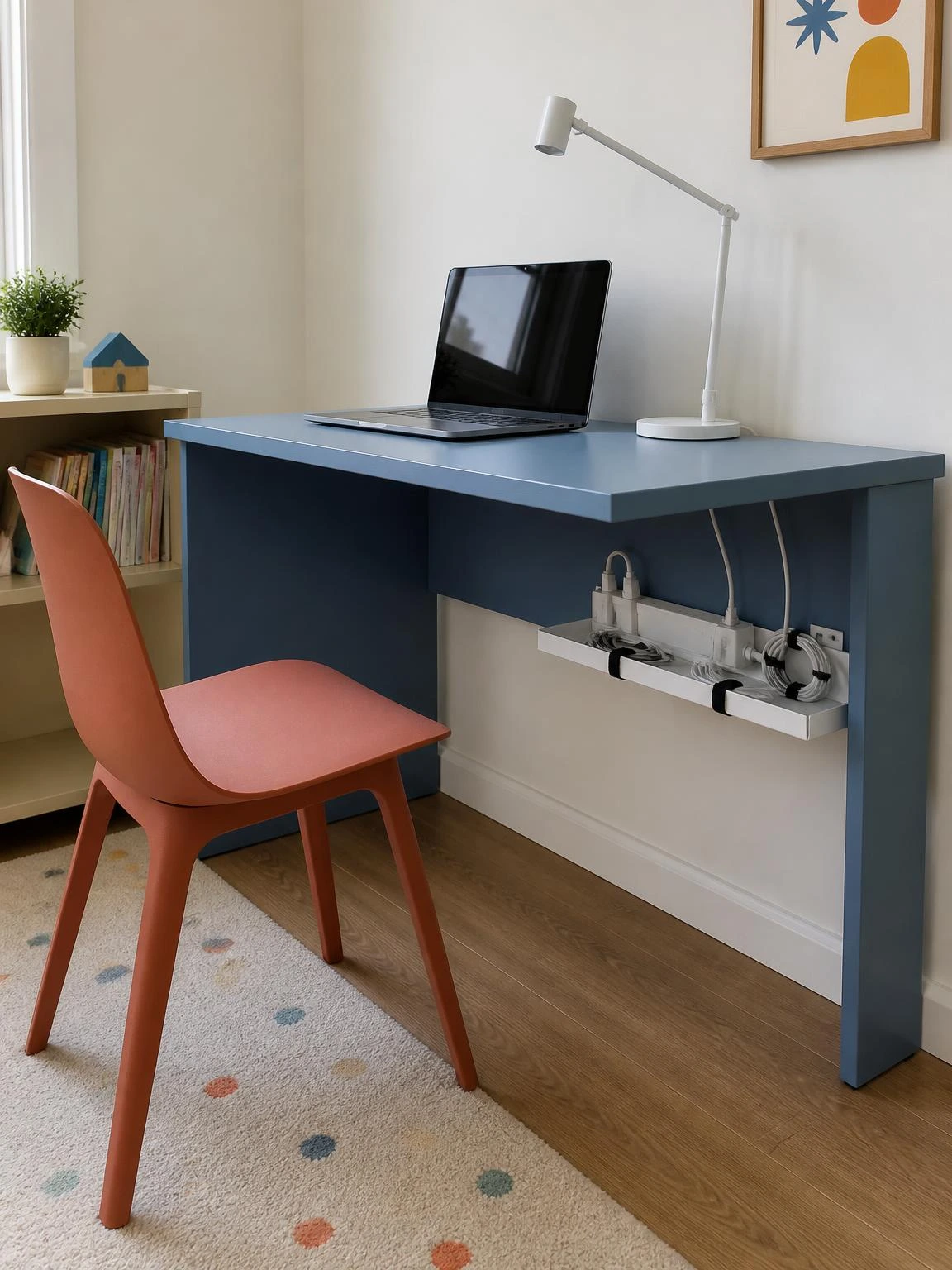
A dusty blue laminate desk with a laptop, a desk lamp and possibly a monitor quickly becomes a tangle of cords at floor level unless there is a system to catch them before they get there.
A white metal cable tray mounted under the right rear corner of the desk holds a power strip and bundled cables in hook-and-loop ties, so cords drop neatly into the tray rather than trailing across the floor.
Using a surge-protected power strip in the tray gives a child one point to switch off all desk devices at bedtime, which has practical value beyond just tidiness.
Check the total wattage of everything connected to the strip against its rated capacity; a power strip that runs a laptop, a monitor, a lamp and a phone charger simultaneously needs enough headroom for all of them.
A terracotta-colored chair against the warm white wall keeps the setup feeling like a considered kids’ room rather than a home office a child has been allowed into.
The three-quarter left view of this setup reveals how much visual calm a tidied underdesk actually contributes to the room, which sounds minor until the alternative is visible.
12- Study Table with Bookshelf Side Tower
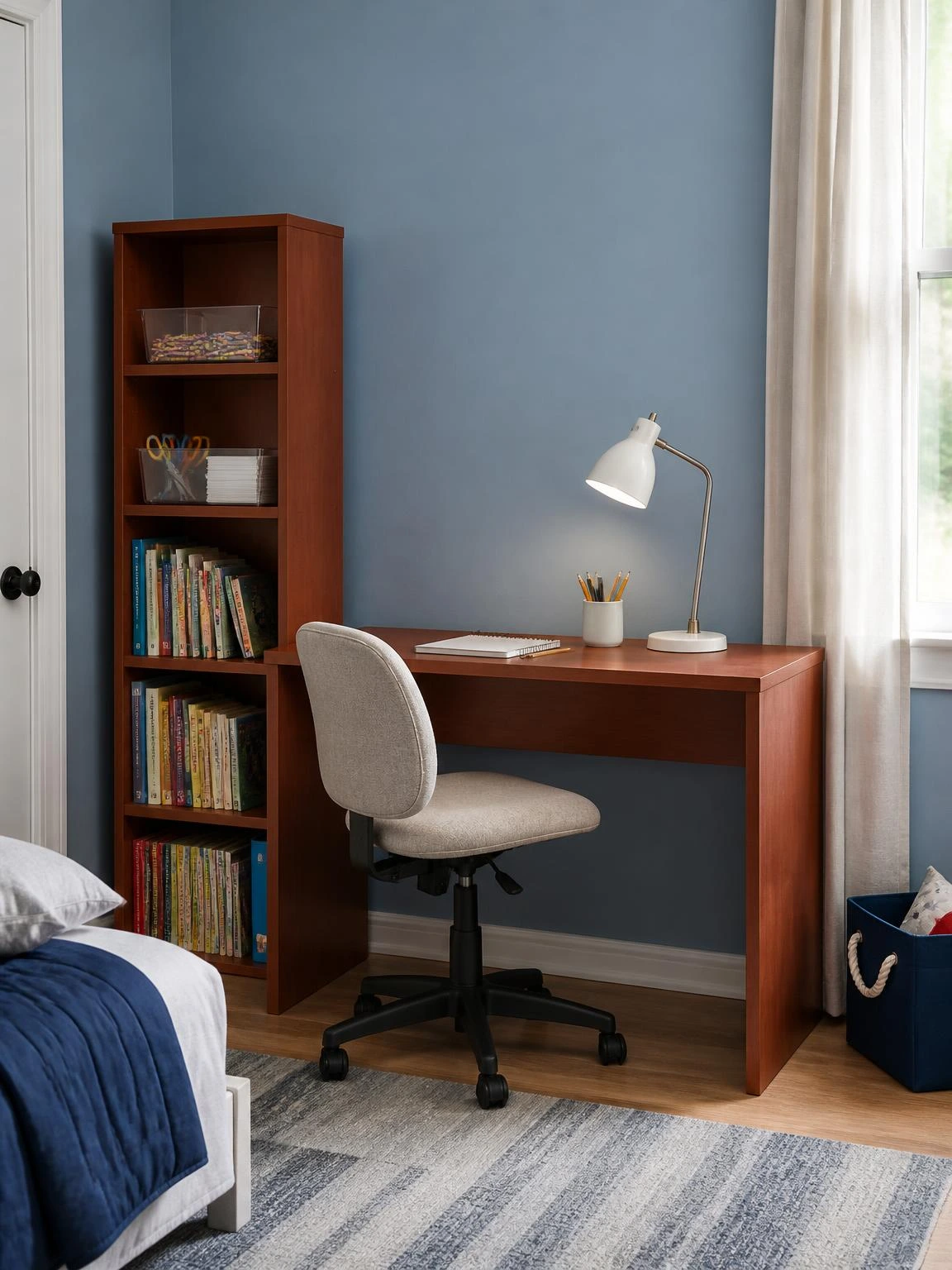
A narrow five-shelf laminate tower in the same rust finish as the desk, standing directly to the desk’s left, turns two separate pieces of furniture into one coherent study unit.
Lower shelves hold upright textbooks; upper shelves hold clear acrylic bins for loose supplies, which keeps the heavier items low and the lighter ones within reach from the chair.
The anti-tip wall anchor strap is not optional here; a tall narrow bookcase beside a desk is exactly the furniture a child will grab when standing up quickly from the chair.
A soft blue painted wall behind both pieces ties the setup together without requiring them to be physically connected, and the neutral upholstered chair completes the corner without competing visually.
Check the anti-tip strap annually, because the anchor bolt can work slightly loose in drywall over time, particularly in a room with a bouncy child in it.
The wider establishing view of this arrangement tends to reveal whether the tower is genuinely integrated or just a bookcase that happens to be nearby; matching finishes are the detail that decides it.
13- Study Table with Corkboard Wall Strip
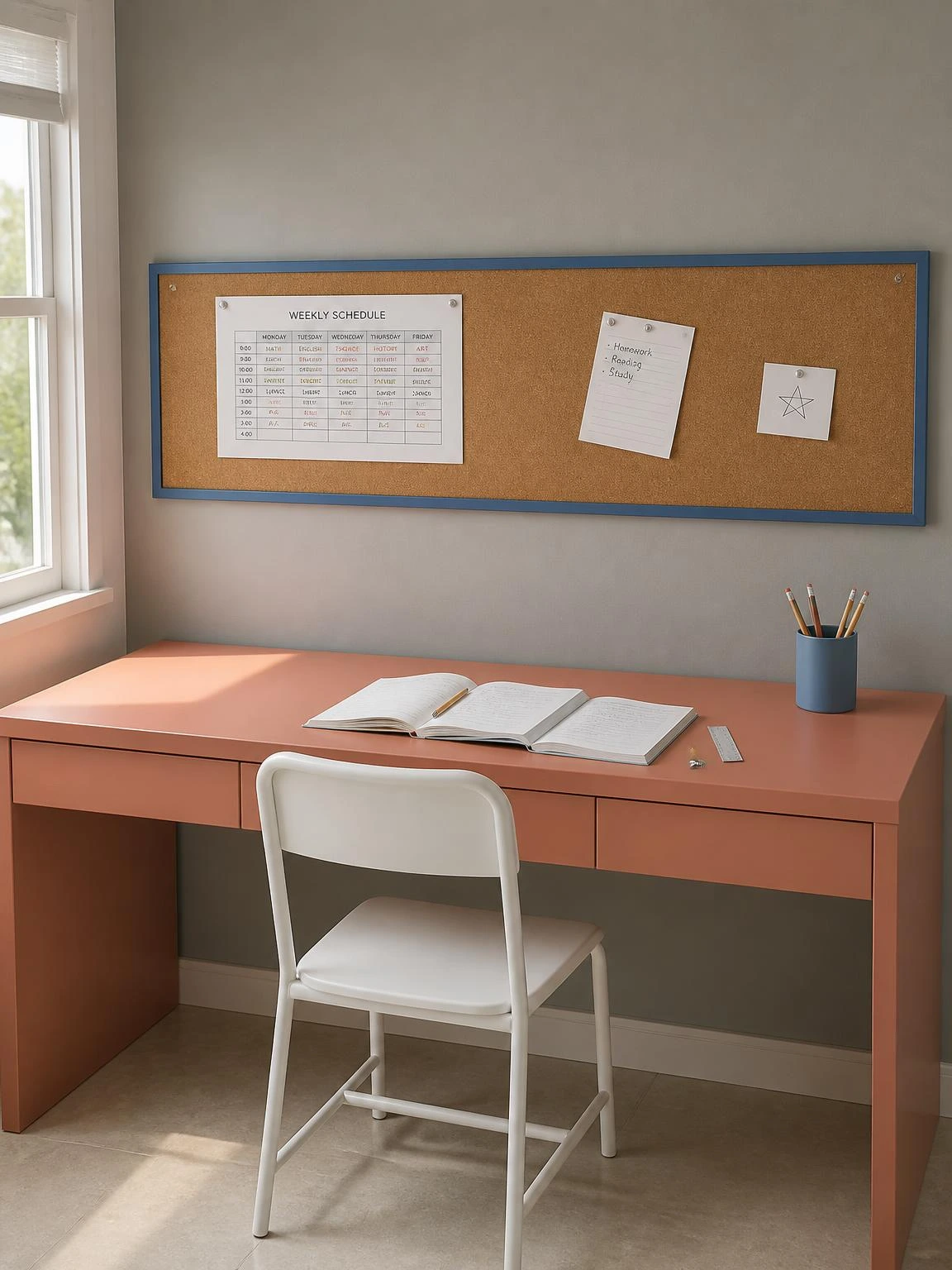
A horizontal corkboard strip in a thin muted blue frame, spanning the full width of a soft coral laminate desk and mounted 4 to 6 inches above the surface, gives a child a visual command center for the week’s tasks without taking up desk space.
A few pinned papers and a printed weekly schedule visible on the cork are enough to make the strip functional; it does not need to be a collage of decorations to earn its place.
Stone-painted walls and left window daylight keep this setup from feeling overstimulating, which matters in a room where a child also needs to settle down and concentrate.
The 4 to 6 inch gap between cork and desk surface is a practical detail: pinned papers hang in view above the writing zone rather than overlapping the actual working area.
Peel-and-stick cork tiles compress unevenly after a year of regular pin use; a solid cork sheet at least half an inch thick lasts considerably longer and holds pins without crumbling at the edges.
A plain white metal chair at the coral desk keeps the color balance right without adding a third accent tone to a setup that already has three considered palette choices.
14- Study Table with Monitor Riser and Keyboard Tray
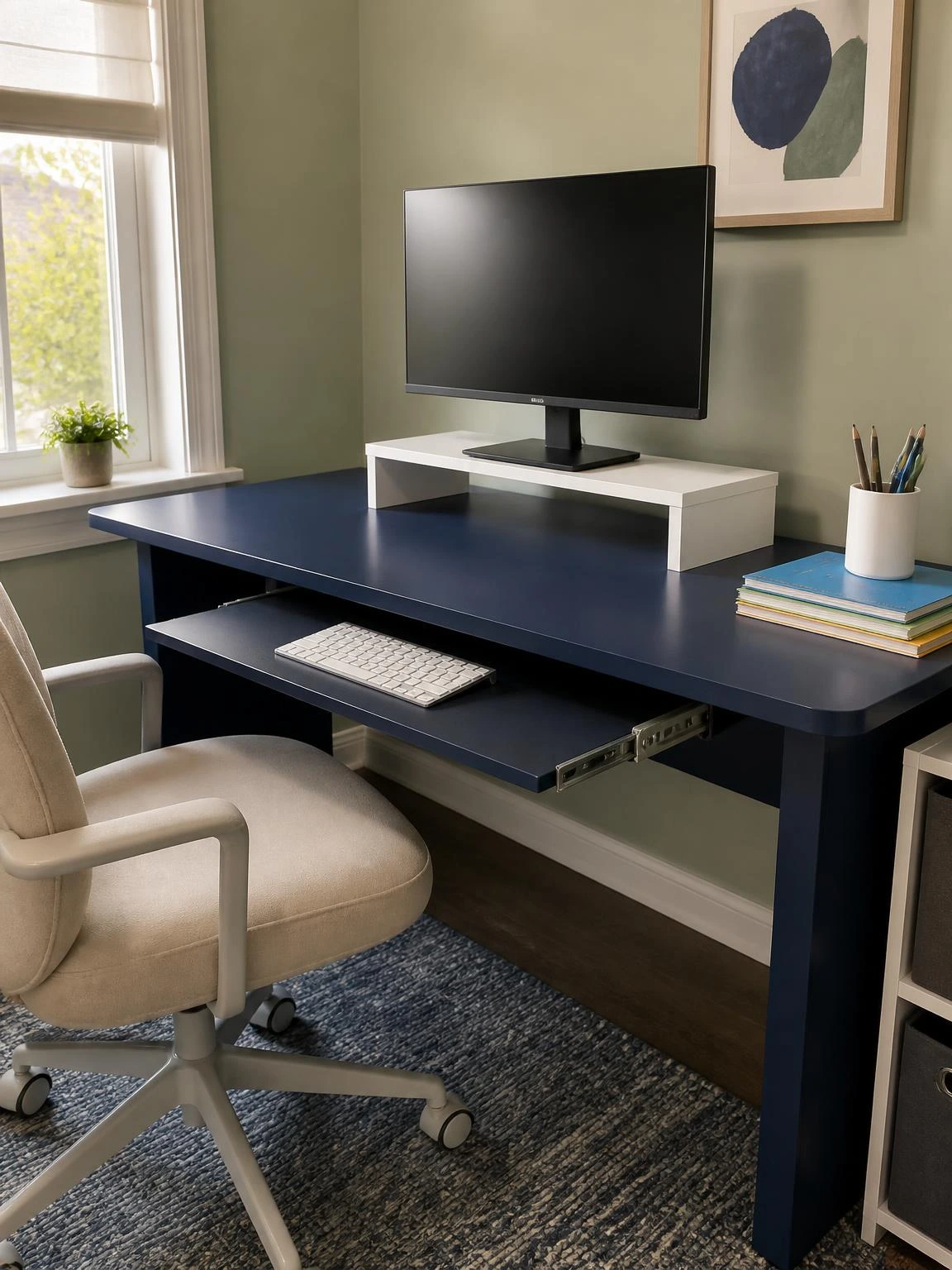
A wide navy laminate desk set up with a white monitor riser and a pull-out keyboard tray is a genuinely ergonomic study table design for kids who are spending meaningful time at a computer for school.
The monitor riser lifts a flat screen so the top of the display aligns with or sits just below the child’s seated eye level, which reduces the neck forward-tilt that a laptop flat on a desk produces over an hour of use.
The pull-out keyboard tray on a metal undermount track positions the keyboard at a lower height than the desk surface, which allows a child’s elbows to sit closer to 90 degrees without the chair being raised uncomfortably high.
Confirm that at least 7 inches of thigh clearance remains between the extended tray and the chair seat; a tray that rubs the knees is worse ergonomically than no tray at all.
An ivory fabric chair with armrests against the muted green wall completes a setup that looks more considered than a standard kids’ desk but functions better than most adult home office arrangements.
Morning window light supplementing the screen is useful here; position the monitor perpendicular to the window, not facing it, to avoid washout on the screen.
15- Study Table with Painted Chalkboard Desktop
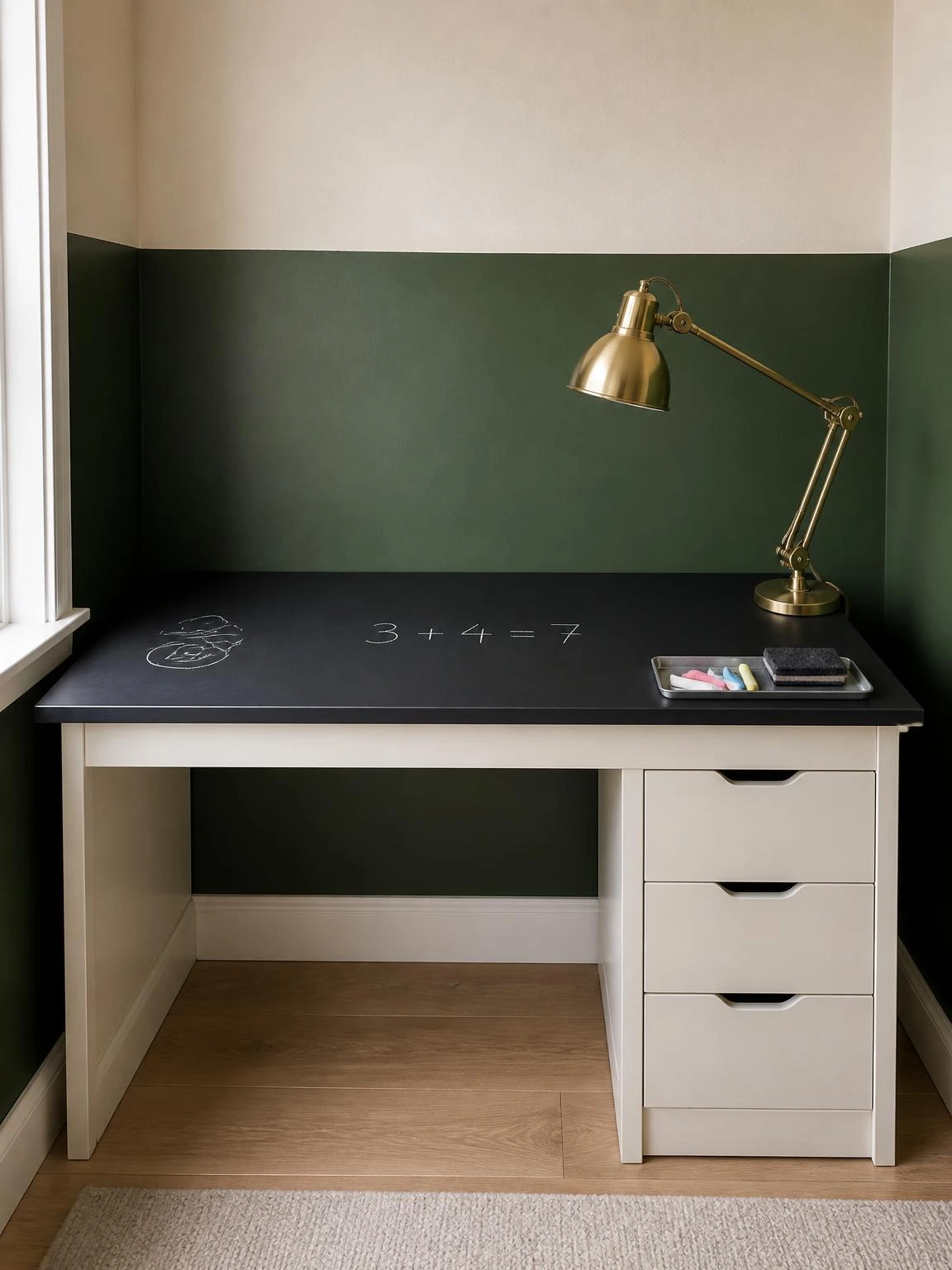
A desk surface painted with chalkboard paint turns the table itself into a drawing and notes surface, which works particularly well in a playroom study corner where a child moves between creative work and structured homework.
Forest green lower walls and a warm neutral upper wall give the matte black chalkboard surface a context that feels deliberate rather than industrial, and a restrained brass clamp lamp at one corner adds warmth to what could otherwise be a very dark surface.
Apply at least three thin coats of chalkboard paint, allow a full 24-hour cure, and season the surface by rubbing the flat side of a chalk stick across it before first use; skipping this step results in permanent chalk ghosts from the first marks made.
A small metal tray of chalk sticks kept at the desk edge is a tidier solution than loose chalk rolling onto the floor, and it makes the setup look intentional rather than improvised.
This surface works best for drawing, planning and notes rather than sustained pencil-pressure writing; a child pressing hard with a pen or pencil on chalkboard paint will scratch through the finish over time.
A felt eraser kept at the desk cleans the surface completely dry, which avoids the moisture that can lift the paint if a wet cloth is used too frequently.
16- Study Table with Open Cubby Shelf Below
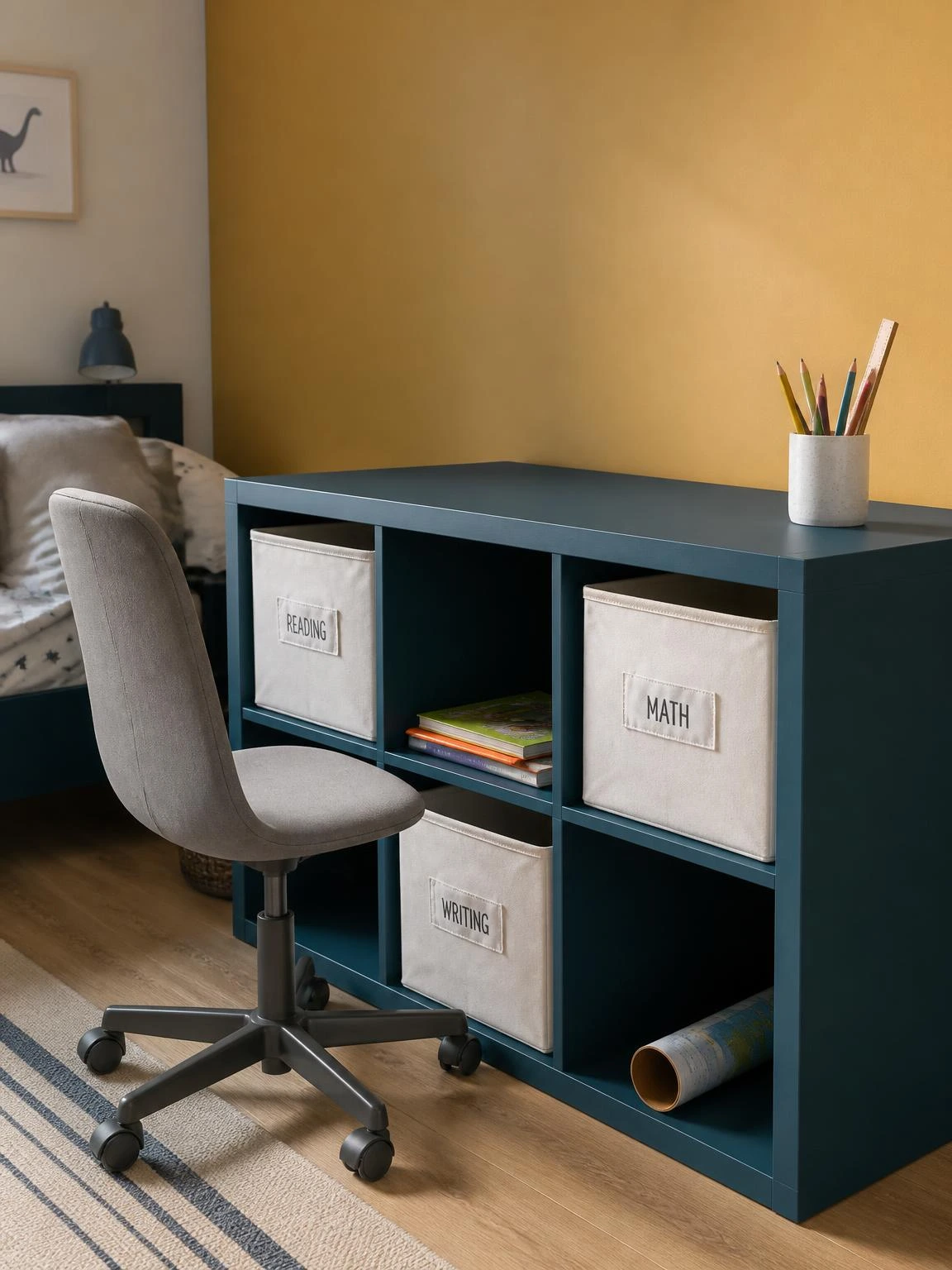
A deep teal laminate desk whose base consists of six open square cubbies in two rows is essentially a desk and a bookcase in one footprint, which is a reasonable trade in a small bedroom.
Three of the cubbies holding labeled warm white cotton fabric bins with sewn-on label tabs give a child a direct organizational system tied to the desk itself, so the school bag gets unpacked into the right cubby rather than onto the floor.
The restrained mustard accent wall behind the setup gives the teal desk a warm contrast that prevents the deep color from feeling cold in a north-facing room.
Keep cubby openings clearly sized for the bins rather than overfilling them; a cubby that requires a child to wrestle a bin out will stop being used within a fortnight.
The diagonal three-quarter view of this desk is the one that reveals whether the cubbies actually work as storage or just look organized in photographs; real daily use requires a child who cooperates with the system, which is more likely when the system is simple and the labels are readable.
An adjustable desk chair in a complementary neutral keeps the setup from being overwhelmed by the strong teal and mustard combination in the room.
17- Study Table with Window-Side Natural Light Position
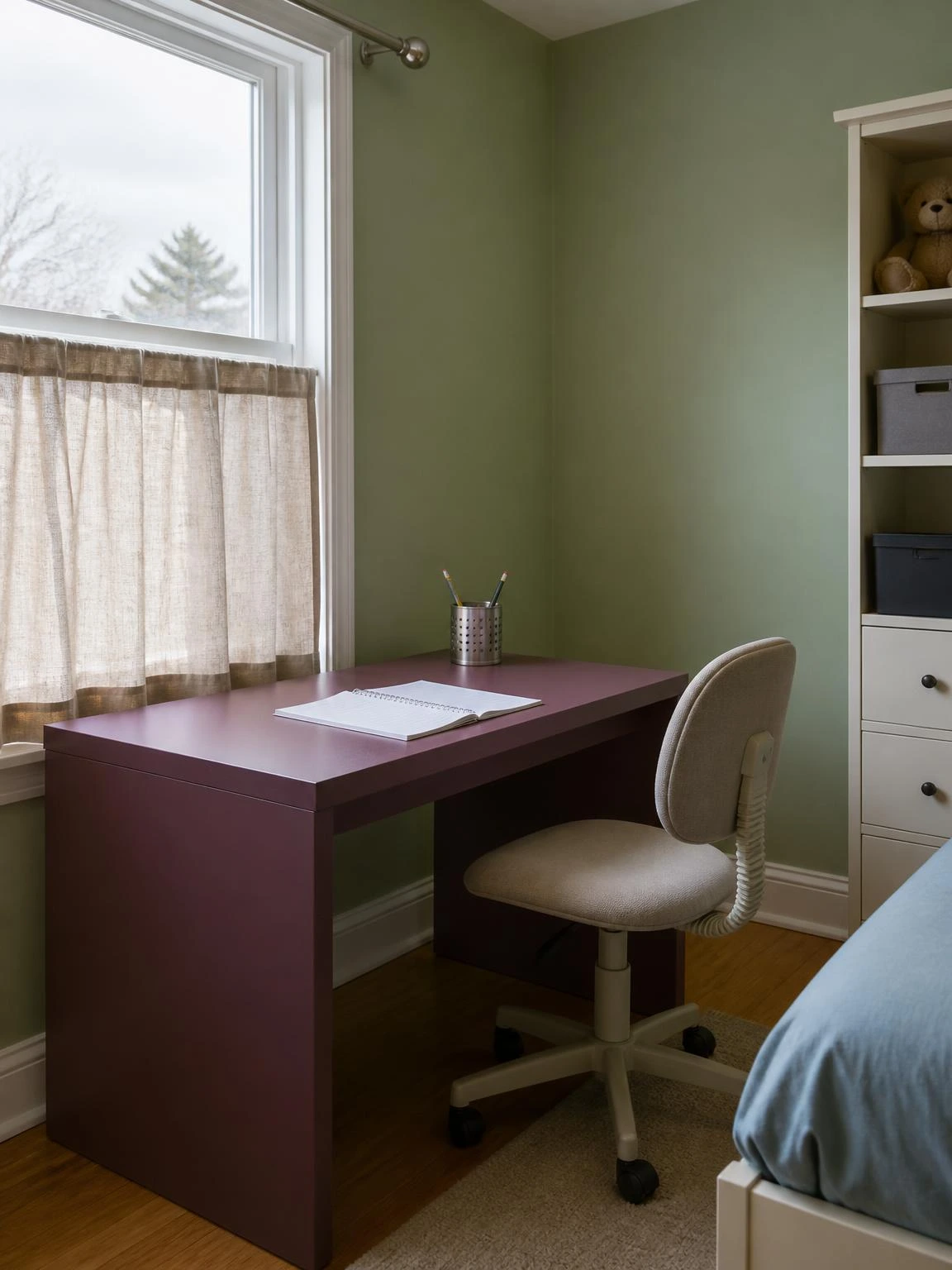
Where a desk is placed relative to a window is one of the most practical decisions in a kids’ study setup, and it costs nothing to get right.
A muted plum laminate desk placed perpendicular to the window, with the window on the left for a right-handed child, means daylight falls across the writing surface without the child’s arm casting a shadow over the work.
A stone-tone curtain panel on a metal rod at the window manages low winter sun without blocking the daylight that makes the whole arrangement worthwhile.
Soft green painted walls give the room warmth on overcast days when the desk relies on daylight supplemented by a task lamp rather than strong direct sun.
Left-handed children need the window on the right side for the same reason; it is a small adjustment in room layout that prevents years of slightly awkward seated posture.
A light-filtering sheer rather than a blackout panel during daytime hours preserves enough light for comfortable reading while removing the harsh glare that a bare south-facing window produces in early afternoon.
18- Study Table with Color-Coded Supply Zones
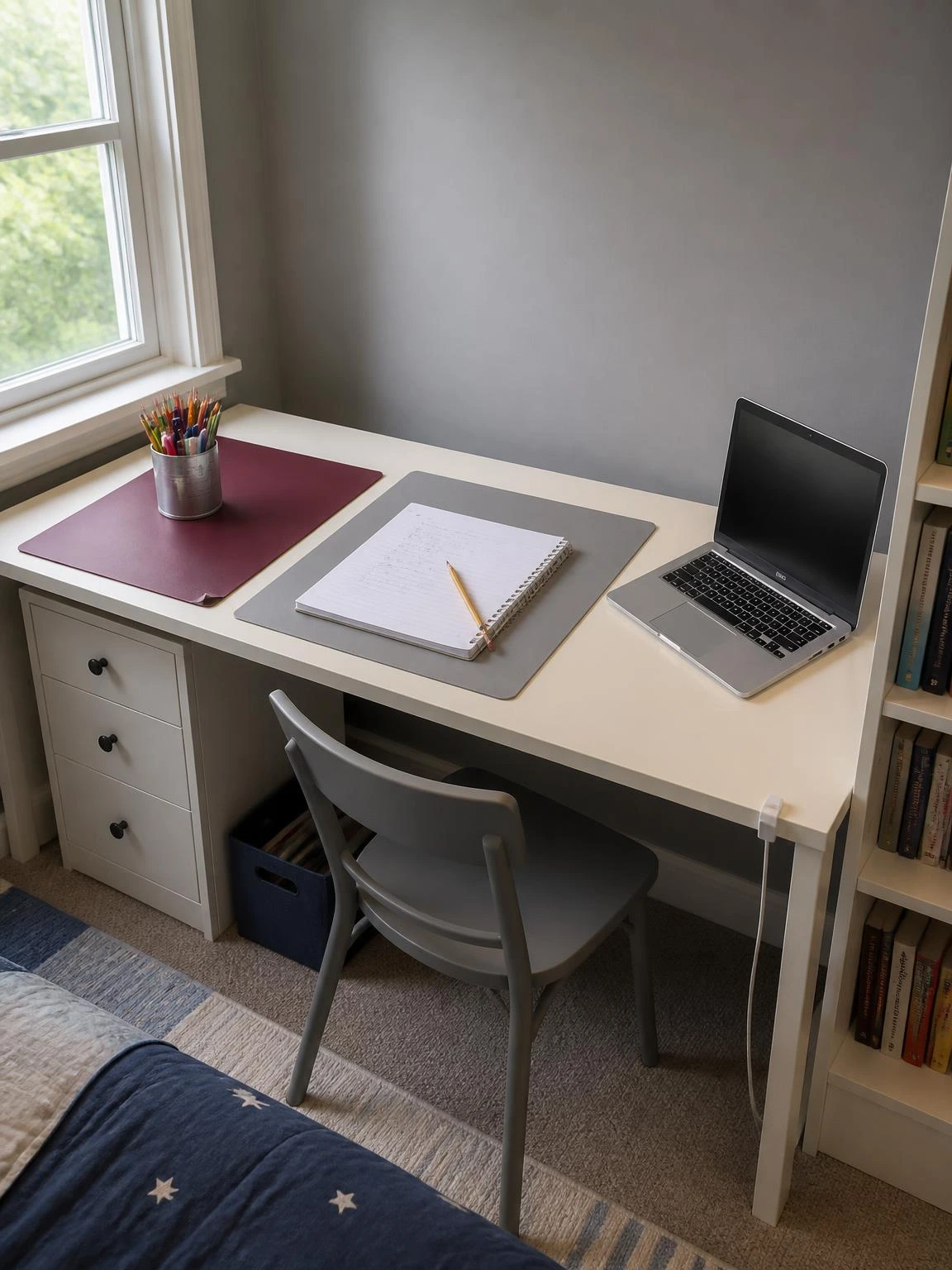
A wide ivory laminate desk divided into three zones by two rectangular desk mats gives a child a visual organization system that does not require any labeling or explanation to understand.
A burgundy mat on the left holds art supplies in a metal cup, a warm gray mat in the center serves as the main writing surface, and the right zone keeps the laptop separate from both, which reduces the number of times a drink or a paintbrush ends up near the keyboard.
Using a neutral tone for the center writing mat keeps the main work area visually calm while the accent-colored mats signal clearly that the other zones have a different purpose.
Warm gray walls and morning window light keep the three-zone layout readable without the room feeling like a classroom.
Desk mats slide on smooth laminate more than most product descriptions admit; a non-slip backing or a small piece of double-sided tape at the corners keeps each mat in position through a vigorous homework session.
This is one of those ideas that works as well for a child who loses things constantly as it does for an organized one, because the zones create a default home for each category of supply without requiring any ongoing decision-making.
19- Study Table with Acrylic Desktop Organizer
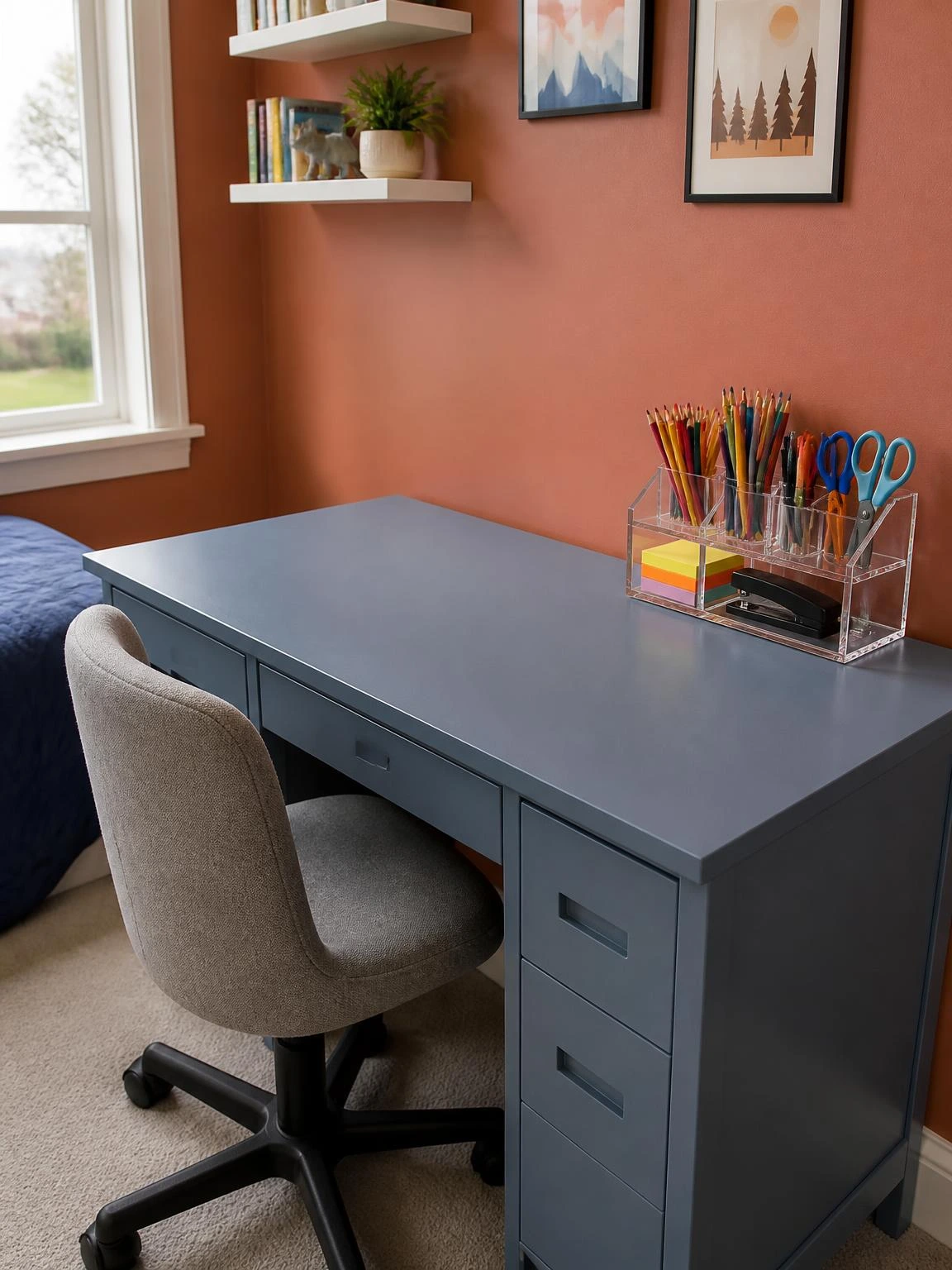
A multi-compartment clear acrylic organizer at the rear corner of a dusty blue laminate desk is one of the most straightforward ways to contain the pencils, scissors, sticky notes and stapler that accumulate on a child’s work surface.
Clear acrylic has the specific advantage of visibility: a child can see exactly where the scissors are without opening anything or moving anything, which removes a predictable homework delay.
Place the organizer on the non-dominant hand side so the full dominant-hand side of the desk remains open for writing, drawing and spreading out project work.
A terracotta wall behind a dusty blue desk is a warm, slightly unexpected combination that keeps the room feeling like a child’s bedroom rather than a miniature office, and the warm white trim holds the palette together.
Clear acrylic collects fingerprints and a light coating of chalk or eraser dust fairly quickly; a weekly wipe with a damp microfiber cloth is all it needs, but skipping it for a month makes the organizer look considerably worse than it actually is.
The overcast soft daylight in this setup is worth noting: diffuse natural light from the left shows the compartment contents through the acrylic clearly without the glare that direct sun would produce on a transparent surface.
20- Study Table with Under-Shelf Clip Lighting
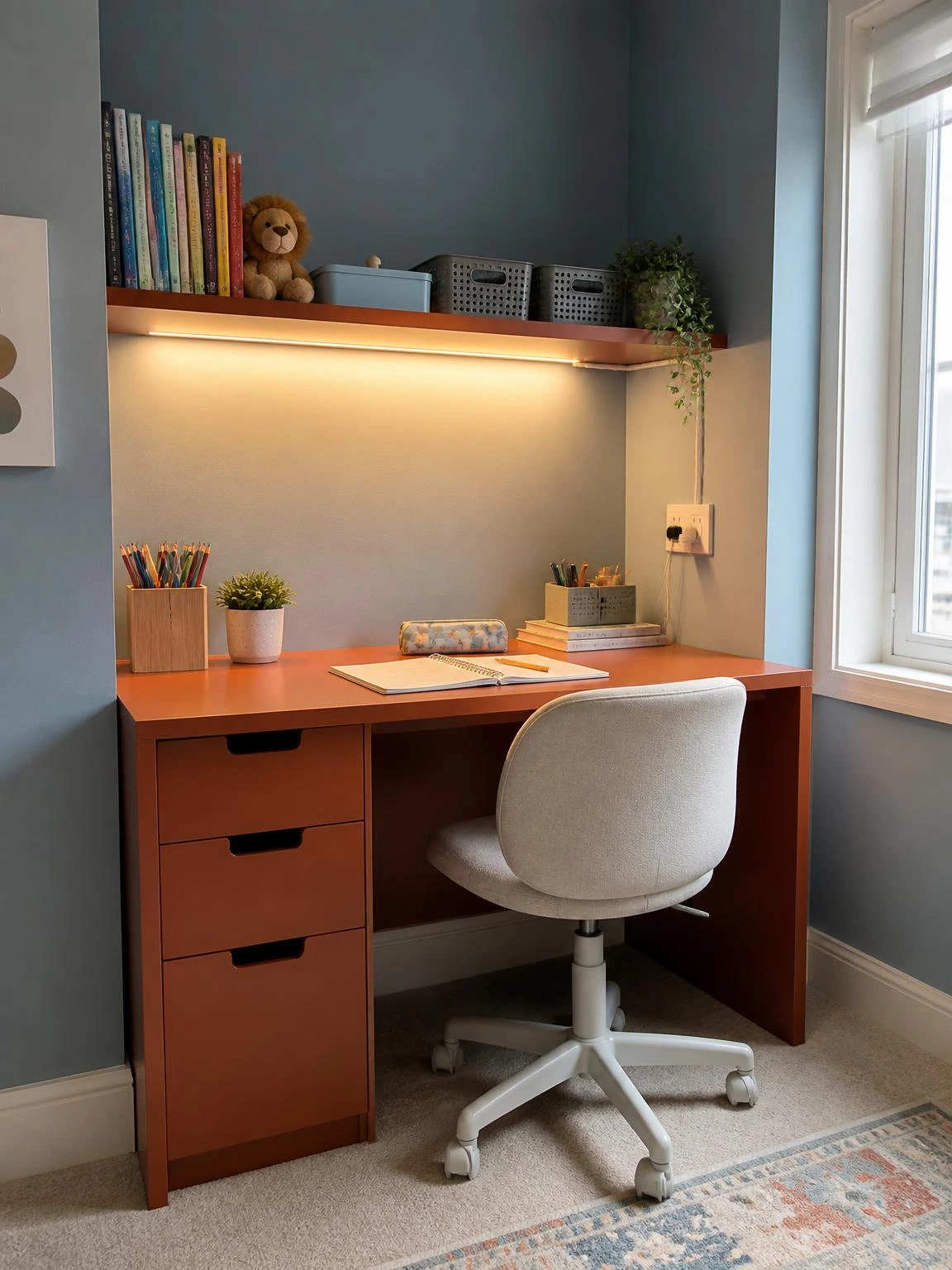
A rust-colored laminate desk sitting below a wall-mounted shelf in a study alcove is a natural setup for under-shelf LED lighting, because the shelf already creates a shadowed zone over the desk that a ceiling light does not reach well.
A warm-white LED strip adhesive-mounted to the underside of the shelf casts even downward light across the desk surface without glare, and the LED driver tucked to one side of the shelf keeps the wiring contained.
Choose a strip rated between 2700K and 3000K for evening homework; cooler blue-white strips above 4000K produce a clinical light quality that sits oddly in a child’s bedroom and can interfere with winding down before sleep.
A soft blue wall on either side of the alcove catches the warm LED glow gently, and the neutral adjustable chair below completes a setup that looks as considered by night as it does in daylight.
Run the power cord along the shelf edge using cable clips to a properly positioned outlet at desk height; a cord crossing the floor between a shelf and a distant outlet is a trip hazard in an active child’s room.
If the only available outlet is at floor level or across the room, have an electrician add an outlet at desk height before installing the lighting, rather than working around a cable route that does not suit the space.
Choosing the Right Study Table Setup for Your Child’s Room
No single study table design for kids works for every room, every age or every child’s working style, and that is the starting point for any decision here.
The most durable setups are the ones that match the child’s actual habits rather than the organizational system a parent hopes will develop.
A child who spreads large art projects needs surface area; a child who works exclusively on a laptop needs good ergonomics and cable management more than extra desk space.
The desk is furniture, but the lighting, the storage placement and the orientation to natural light are what determine whether a child actually uses it willingly each evening.